Showing posts with label highly composite. Show all posts

Friday, 30 April 2021

Odd Deficient Numbers

I've written about deficient numbers in an eponymous post on January 28th 2018 and in which I mentioned, for the first time in my postings, the ratio between the sum of the divisors of a number and the number itself viz. \( \displaystyle \frac{\sigma_1(n)}{n} \).

In that post, I didn't refer to the ratio by its name of abundancy but in later posts I explored the concept of abundancy in more detail. Here are links to posts in which it was discussed:

The last two posts, as can be noted, are relatively recent. Today, in turning 26325 days old, I encountered a reference to abundancy once again. Specifically in the context of OEIS A188597:


 A188597

Odd deficient numbers whose abundancy is closer to 2 than any smaller odd deficient number.


My diurnal age is a member of this sequence which runs:
1, 3, 9, 15, 45, 105, 315, 1155, 26325, 33705, 449295, 1805475, 10240425, 13800465, 16029405, 16286445, 21003885, 32062485, 132701205, 594397485, 815634435, 29169504045, 40833636525, 295612416135, 636988686495, 660733931655, 724387847085, 740099543085, 1707894294975, 4439852974095, 7454198513685

 Figure 1 shows the progression:


Figure 1

Not surprisingly, all these numbers are highly composite, despite all being deficient. This can be seen in Figure 2 where a table of factorisation and number of divisors is presented.


Figure 2

There are a number of related sequences, one of them is OEIS A171929


 A171929

Odd numbers whose abundancy is closer to 2 than any smaller odd number.


Here the numbers need only to odd and can be abundant or deficient. Figure 3 shows the abundancy and its absolute difference from 2.


Figure 3

Another related sequence is OEIS A188263:


 A188263


Odd abundant numbers whose abundancy is closer to 2 than any smaller odd abundant number.

 
In this sequence, all the numbers are abundant and thus their abundancy is greater than 2. Figure 4 shows a table of the initial numbers and their abundancies.


Figure 4

It's interesting to consider the idea that the limit of the abundancy of these sorts of odd abundant and odd deficient numbers is actually 2 as their abundancy can be as close to 2 as desired. 

Saturday, 21 March 2020

Highly Factorable Numbers

The number of OEIS (Online Encyclopaedia of Integer Sequences) entries for number close to 26000 are not numerous (typically no more than ten). So I was surprised today, having turned 25920 days old, to discover that there were 184 entries in the OEIS for the number 25920. Amongst its many properties was the following(OEIS A0338833):


    A033833

Highly factorable numbers: numbers with a record number of proper factorisations.


The sequence, up to and including 25920, runs as follows:
1, 4, 8, 12, 16, 24, 36, 48, 72, 96, 120, 144, 192, 216, 240, 288, 360, 432, 480, 576, 720, 960, 1080, 1152, 1440, 2160, 2880, 4320, 5040, 5760, 7200, 8640, 10080, 11520, 12960, 14400, 15120, 17280, 20160, 25920
It's easy at first sight to confuse highly factorable with highly composite. However, the terms are not the same. WolframMathWorld defines the latter as:
Highly composite numbers are numbers such that the divisor function$$d(n)=\sigma_0(n)$$In other words, the number of divisors of \(n\) is greater than for any smaller \(n\). 
Figure 1 shows a list of the first 38 highly factorisable numbers and their factorisation. Double click the image to enlarge it.

Figure 1

As can be seen, 25920 does not appear on the list. This is because highly factorable numbers are characterised by the size of their multiplicative partitions (the number of ways in which a positive integer n can be expressed as a product of integers (each greater than 1). The OEIS comments for the sequence A033833 give examples for the initial terms. See Figure 2.

Figure 2

Clearly there is an overlap between between the highly composite and highly factorable numbers but notice that 2 and 6 are missing in the latter. Figure 3 shows a more comprehensive list of the initial highly factorable numbers and their factorisations, obtained from a 1981 paper with Paul Erdos as one of the three contributing authors.

Figure 3

Looking at Figure 3, it can be seen that 25920 sets a record as being able to be represented in 1386 different ways. In other words the size of its multiplicative partition is 1386. This article titled "Additive and Multiplicative Partitions" looks, as its title suggests, at the both types of partitions but no formula for calculating the size of multiplicative partitions emerged. This article title "Multiplicative Partitions" attempts an explanation of the topic and begins:
A phenomenal amount of research has been conducted on the additive partition function  over  the  last  100  years,  with  striking  classical  results  due  to  Hardy, Ramanujan, and others.  In contrast,  the topic of multiplicative partitions — sometimes referred to as  “factorisatio  numerorum”  —  has  received  little  attention.   Counting  the  number  of multiplicative partitions is a natural question since it lies between the two most common questions concerning primes:  “Is \(n\) prime?” and “What is the prime factorization of \(n\)?” 
However, the algorithms that the paper came up with were a little beyond my comprehension. I was hoping to find a SageMath or a Python program that would generate the size of the multiplicative partition of any given integer. In my post of Monday, 11th November 2019, I made mention of these sorts of partitions in the context of Bell numbers:
Factorisations 
If a number \(N\) is a square-free positive integer (meaning that it is the product of some number \(n\) of distinct prime numbers), then Bn gives the number of different multiplicative partitions of \(N\). These are factorisations of N into numbers greater than one, treating two factorisations as the same if they have the same factors in a different order. For instance, 30 is the product of the three primes 2, 3, and 5, and has \(B_3\) = 5 factorisations: 30 = 2×15 = 3×10 = 5×6 = 2×3×5
That works for numbers like 30 but it's no good when the factors are not square free as in 25920. There is a Dirichlet series generating function \(f(s)\) that can be used for this purpose but I don't understand it: $$f(s)=\sum_{n=1}^{\infty}\frac{a_n}{n^s}=\prod_{k=2}^{\infty}\frac{1}{1-k^{-s}}$$I guess I'll keep investigating this matter and more to this post, if and when I discover something.

Sunday, 1 April 2018

Highly Composite Numbers

Today I turned 25200 days old and I was surprised to find that this number has a staggering 347 entries in the Online Encyclopaedia of Integer Sequences (OEIS). Most numbers of this size are lucky to have more than a dozen entries. So what's so special about 25200? Well, it turns out to be a highly composite number, a term first coined by Ramanujan in 1915 and defined as a number that sets a record for the highest number of factors (in this case 90). Here is a table from Wikipedia showing details for the first 38 highly composite numbers (sequence A002182 in the OEIS).
OrderHCN
n
prime
factorization
prime
exponents
prime
factors
d(n)primorial
factorization
1101
22112
34223
461,124
5122,136
6243,148
7362,249
8484,1510
9602,1,1412
101203,1,1516
111802,2,1518
122404,1,1620
133603,2,1624
147204,2,1730
158403,1,1,1632
1612602,2,1,1636
1716804,1,1,1740
1825203,2,1,1748
1950404,2,1,1860
2075603,3,1,1864
21100805,2,1,1972
22151204,3,1,1980
23201606,2,1,11084
24252004,2,2,1990
25277203,2,1,1,1896
26453604,4,1,110100
27504005,2,2,110108
28554404,2,1,1,19120
29831603,3,1,1,19128
301108805,2,1,1,110144
311663204,3,1,1,110160
322217606,2,1,1,111168
332772004,2,2,1,110180
343326405,3,1,1,111192
354989604,4,1,1,111200
365544005,2,2,1,111216
376652806,3,1,1,112224
387207204,2,1,1,1,110240
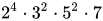
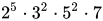
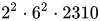
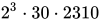
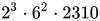
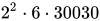
All highly composite numbers are products of primorials as can be see from rightmost column of the table. In the case of 25200, the primorial factorisation is \( 2^2 \times 30 \times 210 \). There is a formula for calculating the number of factors for a number n:$$ \text{If }n=\prod_{i=1}^k p_i \, c^i \text{ then } d(n)=\prod_{i=1}^k (c^i+1)$$For example: $$ 25200=2^4\cdot 3^2\cdot 5^2\cdot 7 $$ $$ d(25200)=(4+1) \cdot (2+1) \cdot (2+1) \cdot (1+1) = 5 \cdot 3 \cdot 3 \cdot 2 = 90 $$The sequence of indices is non-increasing when the prime factor bases are placed in ascending order (4, 2, 2, 1 in the case of 25200). The final index is always 1 except in the cases of 4 and 36 where it is 2, thus making 1, 2 and 4 the only square, highly composite numbers.