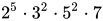
Today I turned 25320 days old but I accidentally entered 25230 into the OEIS and discovered that it was a practical number, specifically one that formed the central member of a triple of practical numbers. It is a number \(n\) such that \(n-2\), \(n\), \(n+2\) are all practical numbers (OEIS A287682). So in this case, the other members of the triple are 25228 and 25232. This is not a common occurrence as can be seen by the initial members of the sequence:
4, 6, 18, 30, 198, 306, 462, 702, 1482, 2550, 3330, 4422, 5778, 6102, 6498, 9042, 11178, 11778, 14418, 15498, 17298, 17442, 19458, 20862, 21582, 22878, 23322, 23550, 25230, ...
This led me to investigate what characterised a practical number and during that process I realised that I'd wrongly entered my number of the day. However, as it turns out 24320 is also a practical number but not a member of a triplet (the next entry in OEIS A287682 is 26622). I was encouraged to continue my investigations. According to Wikipedia:
In number theory, a practical number or panarithmic number is a positive integer \(n\) such that all smaller positive integers can be represented as sums of distinct divisors of \(n\). For example, 12 is a practical number because all the numbers from 1 to 11 can be expressed as sums of its divisors 1, 2, 3, 4, and 6: as well as these divisors themselves, we have 5 = 3 + 2, 7 = 6 + 1, 8 = 6 + 2, 9 = 6 + 3, 10 = 6 + 3 + 1, and 11 = 6 + 3 + 2.The practical numbers themselves are rather frequent. OEIS A005153 lists these initial practical numbers:
1, 2, 4, 6, 8, 12, 16, 18, 20, 24, 28, 30, 32, 36, 40, 42, 48, 54, 56, 60, 64, 66, 72, 78, 80, 84, 88, 90, 96, 100, 104, 108, 112, 120, 126, 128, 132, 140, 144, 150, 156, 160, 162, 168, 176, 180, 192, 196, 198, 200, 204, 208, 210, 216, 220, 224, 228, 234, 240, 252, ...As can be seen, all except 1 are multiples of 2 and this is one condition for a number being practical. The fully rigorous statement of what determines a practical number would be:
A positive integer greater than one with prime factorisation
\(n=p_1^{\alpha_1} \dots p_k^{\alpha_k}\) (with the primes in sorted order) is practical if and only if each of its prime factors \(p_i \) is small enough for \(p_i-1 \) to have a representation as a sum of smaller divisors. For this to be true, the first prime \(p_1 \) must equal 2 and, for every \(i \) from 2 to \( k \), each successive prime \(p_i \) must obey the inequality:$$ p_i\leq1+\sigma(p_1^{\alpha_1}p_2^{\alpha_2}\dots p_{i-1}^{\alpha_{i-1}})=1+\prod_{j=1}^{i-1}\frac{p_j^{\alpha_j+1}-1}{p_j-1}$$where \( \sigma(x) \) denotes the sum of the divisors of \(x\). For example, 2 × 3^2 × 29 × 823 = 429606 is practical, because the inequality above holds for each of its prime factors: 3 ≤ \(\ \sigma \)(2) + 1 = 4, 29 ≤ \( \sigma \)(2 × 3^2) + 1 = 40, and 823 ≤ \(\sigma \)(2 × 3^2 × 29) + 1 = 1171.

on August 1st 2021
With some difficulty I developed some SAGE code to calculate the practical numbers contained in a given range. The example at the end of this post is for the range from 26400 to 26500. It includes multiples of 2 because all powers of 2 are practical numbers along with all perfect numbers and primorials. Such numbers are not merely of interest to recreational mathematicians. They are of interest to professional mathematicians because many of their properties are similar to the properties of the prime numbers.