Thursday, 27 February 2025

Primeval Numbers

Today I learned what a \( \textbf{primeval number}\) is and it's not surprising that I haven't heard of this type of number before. They are after all rather light on the ground. Here's a definition:

Primeval number: a prime which "contains" more primes in it than any preceding number. Here "contains" means may be constructed from a subset of its digits.

Table 1 shows all the primeval numbers less than 100,000.


Table 1

These numbers form OEIS A072857. After 13679 there is huge jump to 100279.

1, 2, 13, 37, 107, 113, 137, 1013, 1037, 1079, 1237, 1367, 1379, 10079, 10123, 10136, 10139, 10237, 10279, 10367, 10379, 12379, 13679, 100279, 100379, 101237, 102347, 102379, 103679, 123479, 1001237, 1002347, 1002379, 1003679, 1012349, 1012379, 1023457, 1023467, 1023479, 1234579, 1234679, 10012349

It can be noted that all these numbers are plaindromes or numbers whose digits are in increasing order as required by the definition. For example, 31 contains three primes (3, 13 and 31) as does 13 but the former is not listed because 13 is the first prime to contain three primes.

I was made aware of these primeval numbers via a property of the number associated with my diurnal age today, 27724, that earns it admission into OEIS A173052:


A173052  partial sums of A072857 (primeval numbers: numbers that set a record for the number of distinct primes that can be obtained by permuting some subset of their digits).


These partial sums are:

1, 3, 16, 53, 160, 273, 410, 1423, 2460, 3539, 4776, 6143, 7522, 17601, 27724, 37860, 47999, 58236, 68515, 78882, 89261, 101640, 115319, 215598, 315977, 417214, 519561, 621940, 725619, 849098, 1850335, 2852682, 3855061, 4858740, 5871089

Sunday, 23 February 2025

Celebrating 27720

It's not often that numbers as large as 27720 attract 632 entries in the Online Encycopedia of Integer Sequences (OEIS). By contrast, 27719 attracts 31 entries and 27721 attracts 27 entries. So what's so special about 27720?


Well, it has lots of interesting properties. Let's look at some of them. 

\( \textbf{PROPERTY 1} \)

The very first entry in the database is OEIS A002182:


A002182  Highly composite numbers: numbers \(n\) where d(\(n\)), the number of divisors of \(n\)  increases to a record.

The initial record holders, up to 40000, are as follows where we see 27720 is a member:

1, 2, 4, 6, 12, 24, 36, 48, 60, 120, 180, 240, 360, 720, 840, 1260, 1680, 2520, 5040, 7560, 10080, 15120, 20160, 25200, 27720

Table 1 shows the details:

Table 1: permalink

\( \textbf{PROPERTY 2} \)

In a similar vein is OEIS A004394 where 27720 also features:


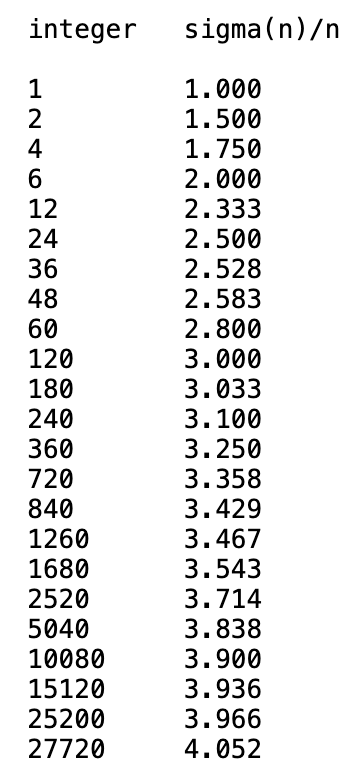
A004394    superabundant numbers: \(n\) such that \( \sigma(n)/n > \sigma(m)/m \) for all \( m < n\), \( \sigma(n)\) being A000203(n), the sum of the divisors of \(n\).

The initial members are as follows with most being the same as for OEIS A002182:

1, 2, 4, 6, 12, 24, 36, 48, 60, 120, 180, 240, 360, 720, 840, 1260, 1680, 2520, 5040, 10080, 15120, 25200, 27720

Table 2 shows the details:

Table 2: permalink

\( \textbf{PROPERTY 3} \)

Another interesting property of the number arises from its appearance in the denominator of the progressive sum of the harmonic numbers. These denominators constitute OEIS A002805.


A002805
    denominators of harmonic numbers \( \text{H}(n) =\displaystyle \sum_{i=1} ^n \dfrac{1}{i} \)

The first terms in the sequence are 1, 2, 6, 12, 60, 20, 140, 280, 2520, 2520, 27720, 27720. Table 3 shows the details.

Table 3: permalink

\( \textbf{PROPERTY 4} \)

The number also arises from a quite simple recurrence relation:


A052542     \( \text{a}(n) = 2 \times \text{a}(n-1) + \text{a}(n-2), \text{ with } \text{a}(0) = 1, \text{a}(1) = 2, \text{a}(2) = 4 \)

The initial members of the sequence are 1, 2, 4, 10, 24, 58, 140, 338, 816, 1970, 4756, 11482, 27720 (permalink).

\( \textbf{PROPERTY 5} \)

Since \(27720 = 2^3 \times 3^2 \times 5 \times 7 \times 11 \), it is 12 times the product of the primorial number \(2310 = 2 \times 3 \times 5 \times 7 \times 11 \) and this qualifies it for membership in OEIS A129912 because 12 is itself a product of primorials viz. 2 x 6.


A129912 numbers that are products of distinct primorial numbers (see A002110).

The initial members of the sequence (with the primorials themselves included) can be generated using this permalink:

1, 2, 6, 12, 30, 60, 180, 210, 360, 420, 1260, 2310, 2520, 4620, 6300, 12600, 13860, 27720, 30030, 37800

Initially I misinterpreted this sequence as meaning numbers that are multiples of primorials but this is not the case. Instead the multiples themselves must be products of primorials and this is far more restrictive.

Friday, 21 February 2025

Primorial Number Base Revisited

On the 14th February 2021, now over four years ago, I created a post on this blog about the Primorial Number System. Since then, I've thought very little about it but today's number (associated with my diurnal age) reminded me once again of this number system. The number is \( \textbf{27718} \) and it is a member of OEIS A333703:


A333703   Numbers \(k \)such that \(k\) divides the sum of digits in primorial base of all numbers from \(1\) to \(k\).


The numbers that satisfy up to 40000 are:

1, 2, 10, 22, 58, 62, 63, 64, 66, 67, 68, 118, 178, 418, 838, 1258, 1264, 1265, 1277, 1278, 1678, 2098, 4618, 9238, 10508, 10509, 10510, 10512, 10513, 10514, 13858, 14704, 14754, 18478, 23098, 23102, 23276, 27718


Table 1 shows the numbers from OEIS A333703 together with their primorial base equivalents and the progressive totals of the digits of the all the primorial numbers up and including each number. The primorial base representation I've employed here uses the base 10 digits (0 to 9) together with a space as a separator (although colons are more commonly used). However, for numbers in the range up to 40000 that I use the base 12 system using the additional digits A for 10 and B for 11 are sufficient so that concatenation of the "placeholders" does not produce any ambiguity. The primorial number then looks like a normal base 12 number which produces an ambiguity in itself.


Table 1: permalink

Table 2 shows the numbers together with their corresponding progressive totals and the results when these totals are divided by the corresponing number.


Table 2: permalink

The next number after 22718 is 60058 so I won't be around to see that. For more information see this source. I started this blog by referring to my diurnal age on the 21st February 2025 (27718) but my diurnal age on the very next day (\( \textbf{27719} \)) also has a property that connects it to the primorial number base.


A343048   a(\(n\)) is the least number whose sum of digits in primorial base equals \(n\).


The members of this sequence up to 40000 are (permalink):

0, 1, 3, 5, 11, 17, 23, 29, 59, 89, 119, 149, 179, 209, 419, 629, 839, 1049, 1259, 1469, 1679, 1889, 2099, 2309, 4619, 6929, 9239, 11549, 13859, 16169, 18479, 20789, 23099, 25409, 27719, 30029

Table 3 shows the increasing values of \(n\):


Table 3: permalink

Thursday, 20 February 2025

Not the Sum of Distinct Squares or Cubes

I guess I'd never really thought about the issue before. I've written about what numbers can and cannot be expressed as a sum of two squares and what numbers cannot be expressed as a sum of three squares but what numbers \( \textbf{cannot} \) be expressed a sum of two or more distinct squares? Well, the answer is not many and 128 is the largest of them. These number form OEIS A001422 :


A001422    Numbers which are \( \textbf{not} \) the sum of \( \textbf{distinct} \) squares.


The numbers are: 2, 3, 6, 7, 8, 11, 12, 15, 18, 19, 22, 23, 24, 27, 28, 31, 32, 33, 43, 44, 47, 48, 60, 67, 72, 76, 92, 96, 108, 112, 128


This led me on to OEIS A001476 that deals with the same issue but involving cubes. 


A001476    Numbers that are \( \textbf{not} \) the sum of \( \textbf{distinct} \) positive cubes.


2, 3, 4, 5, 6, 7, 10, 11, 12, 13, 14, 15, 16, 17, 18, 19, 20, 21, 22, 23, 24, 25, 26, 29, 30, 31, 32, 33, 34, 37, 38, 39, 40, 41, 42, 43, 44, 45, 46, 47, 48, 49, 50, 51, 52, 53, 54, 55, 56, 57, 58, 59, 60, 61, 62, 63, 66, 67, 68, 69, 70, 71, 74, 75, 76, 77, 78, 79, 80, 81, 82, 83, 84, 85, 86, 87, 88, 89, 90, 93,94, 95, 96, 97, 98

These are the initial terms below 100 and the OEIS comments go on to say the following:
There are 85 terms below 100, 793 terms below 1000, but only 2765 terms below 10000, and only 23 more up to the largest term a(2788)=12758.

An Interesting Triple 7 Number

Today I turned \( \textbf{27717} \) days old and this number has a plethora of interesting properties that deserve a special mention and thus a dedicated post. Here are some of those properties.

  • \( \textbf{27717} \) is a so-called Lucky Cube, meaning it is a number whose cubes contain the digit sequence “888”, here:$$27717^3 = 21293088810813$$The numbers that satisfy from 27717 to 40000 are: 27717, 27942, 27973, 28192, 28442, 28484, 28692, 28740, 28942, 29079, 29192, 29354, 29387, 29391, 29418, 29420, 29442, 29491, 29642, 29692, 29942, 29989.

  • \( \textbf{27717} \) is the lesser of a pair of adjacent composite numbers such that both are only one step away from their home primes. Here: 
    • \(27717 = 3 \times 9239 \rightarrow 39239\)
    • \(27718 = 2 \times 13859 \rightarrow 213859\)

  • \( \textbf{27717} \) is a number such that n + POD(n) and n - POD(n) are both prime (where POD stands for Product Of Digits). Here we have POD = 686:
    • \(27717 + 686 = 28403\) which is a prime number
    • \(27717 - 686 = 27031\) which is a prime number

  • \( \textbf{27717} \) is an interprime number because it is at equal distance from the previous prime (27701) and the next prime (27733).

  • \( \textbf{27717} \) is a number whose sum of divisors has prime factors (ignoring multiplicity) that multiply to the factorial 2310 where

    \(2310= 2 \times 3 \times 5 \times 7 \times 11\)

    Here 27717 has a sum of divisors 36960 and

    \(36960= 2^5 \times 3 \times 5 \times 7 \times 11\)

    but also forms a consecutive pair with 27718 because its sum of the divisors is 41580 and

    \(41580= 2^2 \times 3^3 \times 5  \times 7 \times11\)

    See blog post Primorials and the Sigma Function.

  • \( \textbf{27717} \) is the TENTH member of an interesting number chain (which is base independent):
    • \(27708 = 12 \times 2309\)
    • \(27709 = 11 \times 2519\)
    • \(27710 = 10 \times 2771\)
    • \(27711 = 9 \times 3079\)
    • \(27712 = 8 \times 3464\)
    • \(27713 = 7 \times 3959\)
    • \(27714 = 6 \times 4619\)
    • \(27715 = 5 \times 5543\)
    • \(27716 = 4 \times 6929\)
    • \(27717 = 3 \times 9239\)
    • \(27718 = 2 \times 13859\)
See blog post Count Down Number Chains  
 
  • \( \textbf{27717} \) is a cyclic number.

  • \( \textbf{27717} \) is a xenodrome in base 9 : 42016. See blog post Xenodromes.

  • \( \textbf{27717} \) is a number that does not reach a palindrome after 2001 cycles of the reverse and add algorithm.

  • \( \textbf{27717} \) is a D-number meaning it is a number \(n > 3\) such that n divides \( k^{n-2}- k\) for all \(1 < k < n\) relatively prime to \(n\).

  • \( \textbf{27717} \) can be rendered as a digit equation as follows: \(2 - \dfrac{7}{7} = 1 ^ 7\)

Tuesday, 18 February 2025

Special Primes

I'm surprised that I haven't written about these sorts of primes before. The primes form OEIS A092529:


A092529
  primes \(p\) such that both the digit sum of \(p\) plus \(p\) and the digit product of \(p\) plus \(p\) are also primes (zeroes are not permitted).

Up to 40000, there are 136 such primes and they are (permalink):

163, 233, 293, 431, 499, 563, 617, 743, 1423, 1483, 1489, 1867, 2273, 2543, 2633, 3449, 4211, 4217, 4273, 4547, 4729, 5861, 6121, 6529, 6637, 6653, 6761, 6857, 6949, 7681, 8273, 8431, 8837, 8839, 9649, 9689, 11251, 11657, 11677, 11897, 12379, 12553, 13163, 13457, 13523, 13697, 13729, 13877, 13879, 14423, 14533, 14537, 14957, 15121, 15217, 15277, 15361, 15413, 15451, 15619, 15727, 15859, 16319, 16427, 16993, 17183, 17299, 17837, 18229, 18287, 18517, 19381, 19457, 19583, 21379, 21467, 21577, 21737, 21751, 21977, 21991, 22123, 22259, 22369, 22549, 22921, 23117, 23269, 23599, 23719, 24499, 24527, 25111, 25153, 25577, 25771, 25847, 25913, 25997, 26251, 26699, 26927, 27427, 28181, 29153, 29179, 32173, 32687, 32957, 32971, 33413, 33547, 33581, 33587, 33769, 33851, 34313, 34667, 35251, 35257, 35323, 35521, 35569, 35831, 36229, 36469, 36559, 36919, 37321, 37369, 37547, 37871, 38351, 38959, 39161, 39521

Let's just check the first number in this sequence, 163. The digit sum is 10 and the digit product is 18. Now 163 + 10 = 173 which is prime and 163 + 18 = 181 is also prime.

Interestingly if we consider subtraction instead of addition then no such primes exist. That is to say that, even up to one million, there are no primes such that \(p\) minus the digit sum of \(p\) and \(p\) minus the digit product of \(p\) are also primes (with zeroes not permitted). I'm not sure why this is so.

We can thin the ranks of the above primes if we require that the sum and product of the squares of the digits also form primes when added to the original prime. Only four numbers such satisfy all these criteria in the range up to 40000. These are 1423, 13697, 14533 and 33413 (permalink). Let's examine the first of these numbers 1423. The sum of digits is 10 and the product is 24. The digits squared are 1, 16, 4 and 9 with a sum of 30 and a product of 576. Thus we have:

  • 1423 + 10 = 1433 (prime)
  • 1423 + 24 = 1447 (prime)
  • 1423 + 30 = 1453 (prime)
  • 1423 + 576 = 1999 (prime)

If we extend the range up to one million, there are 48 numbers that satisfy:

1423, 13697, 14533, 33413, 53419, 57529, 61991, 71569, 91129, 125789, 128153, 132527, 132679, 143477, 149161, 159463, 223423, 238649, 275929, 284831, 288493, 297613, 316343, 337261, 343639, 367819, 375227, 441797, 447791, 498733, 512521, 573829, 574969, 582937, 613673, 626723, 722333, 723923, 728681, 735283, 746533, 748883, 752273, 762539, 766531, 836917, 869951, 872959

To thin this sequence further, let's impose additional criteria, specifically that the number plus the sum of the cubes of the digits and the number plus the product of the cubes of the digits must be prime as well. Here are the numbers up to one million: 125789, 132527, 573829 and 752273. Let's look at the first of these numbers, 125789:

  • 125789 + 32 = 125821 (prime)
  • 125789 + 5040 = 130829 (prime)
  • 125789 + 224 = 126013 (prime)
  • 125789 + 25401600 = 25527389 (prime)
  • 125789 + 1718 = 127507 (prime)
  • 125789 + 128024064000 = 128024189789 (prime)
Notice how the product of the squares and cubes of the digits are larger than the number itself. If we remove the requirement that the initial number be prime then a few more numbers satisfy the criteria for digits, digits squared and digits cubed. These are 13969, 65821, 125789, 132527, 349789, 537881, 545123, 573829 and 752273 (primes are shown in red).

Sunday, 16 February 2025

A Seeming Coincidence

A friend of mine who turns 49 this year (2025) was born (of course) in 1976. I noticed that I will turn 76 this year and that I was born in 1949. If we ignore the '19' in our years of birth then our years of birth can be written as '76 and '49. The "coincidence" then is that we have this '76 and 49 versus '49 and 76 switching of the numbers. 

As I explained to my friend:


Taken to the extreme, I will turn 99 in 2048 in the unlikely event that I make it that far. Someone born in 1999 will turn 49 in this same year and so we have '99 and 49 versus '49 and 99. It doesn't hold in my case for people born in 2000 and beyond.