Showing posts with label year. Show all posts

Thursday, 11 September 2025

A Range Limit of 40000: Why?

In many of my posts when I'm considering sequences, I only look at sequence members whose values do not exceed 40000. Why? The answer to this question relates to the reason that I set this blog up in the first place. It was designed primarily to post about interesting sequences associated with the numbers marking my diurnal age.

If we divide 40000 by 365.2425 (the average number of days in a year) we get slightly more than 109.5 years and there are not many people who live to that ripe old age. Here are milestones, one might say, on the road to oblivion.

Quite a few people won't see 30000 days let alone 40000 but many will and hence the realistic upper limit to the numbers that I normally investigate. The focus of my blog posts is generally the number associated with my diurnal age and the sequences that it can be connected to. For example, today I am \( \textbf{27920} \) days old.


This number found its way into a sequence that I created that involves gapful numbers with the property that not only does the number formed by the concatenation of the first and last digit divide the number but this concatenated number is also the sum of the number's digits. Thus we have:$$ \begin{align} \frac{27920}{20} &=1396 \\ \\ 2 + 7 + 9 + 2 + 0 &= 20 \end{align}$$I described this sequence in a post titled Gapgul Numbers in December of 2024. Interestingly, 27920 also has the property that it has 20 divisors. Only 19 numbers satisfy this additional criterion in the range up to 40000. The conditions to be met are:
  • the number is gapful meaning the number formed by concantenating the first and last digits divides the number without remainder
  • the sum of the number's digits equals the number formed by the concatenated first and last digits
  • the number of divisors of the number equals its sum of digits (and the concatenated number)
Here are the numbers:

1548, 1812, 1908, 10188, 10548, 11268, 12252, 12612, 12708, 13428, 14052, 14412, 15138, 18108, 21984, 26480, 27920, 29360, 39996

Here are the details:

  number        factor          concat   dividend   S0D   divisors
  1548     2^2 * 3^2 * 43         18       86         18    18
  1812     2^2 * 3 * 151          12       151        12    12
  1908     2^2 * 3^2 * 53         18       106        18    18
  10188    2^2 * 3^2 * 283        18       566        18    18
  10548    2^2 * 3^2 * 293        18       586        18    18
  11268    2^2 * 3^2 * 313        18       626        18    18
  12252    2^2 * 3 * 1021         12       1021       12    12
  12612    2^2 * 3 * 1051         12       1051       12    12
  12708    2^2 * 3^2 * 353        18       706        18    18
  13428    2^2 * 3^2 * 373        18       746        18    18
  14052    2^2 * 3 * 1171         12       1171       12    12
  14412    2^2 * 3 * 1201         12       1201       12    12
  15138    2 * 3^2 * 29^2         18       841        18    18
  18108    2^2 * 3^2 * 503        18       1006       18    18
  21984    2^5 * 3 * 229          24       916        24    24
  26480    2^4 * 5 * 331          20       1324       20    20
  27920    2^4 * 5 * 349          20       1396       20    20
  29360    2^4 * 5 * 367          20       1468       20    20
  39996    2^2 * 3^2 * 11 * 101   36       1111       36    36

Sunday, 16 February 2025

A Seeming Coincidence

A friend of mine who turns 49 this year (2025) was born (of course) in 1976. I noticed that I will turn 76 this year and that I was born in 1949. If we ignore the '19' in our years of birth then our years of birth can be written as '76 and '49. The "coincidence" then is that we have this '76 and 49 versus '49 and 76 switching of the numbers. 

As I explained to my friend:


Taken to the extreme, I will turn 99 in 2048 in the unlikely event that I make it that far. Someone born in 1999 will turn 49 in this same year and so we have '99 and 49 versus '49 and 99. It doesn't hold in my case for people born in 2000 and beyond.

Saturday, 7 August 2021

Key Points in the Year

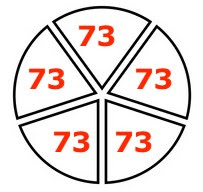
Thanks to my newly initiated tracking of the number of days that have elapsed in the current year and the number of days remaining, I noticed that today is quite significant. The date today is August 7th 2021, a non-leap year, and Figure 1 displays the numbers.


Figure 1: source

These numbers, along with 365, factor as follows:
  • 365 = 5 x 73
  • 146 = 2 x 73
  • 219 = 3 x 73


This means that today 60% of the year has passed and 40% remains. It can be seen that earlier in the year, on Wednesday May 26th 2021 to be exact, 146 days had elapsed and 219 days remained. Extending this it can be seen that:
  • 073 = 1 x 73 --> March 14th (20% elapsed and 80% remaining)
  • 146 = 2 x 73 --> May 26th (40% elapsed and 60% remaining)
  • 219 = 3 x 73 --> August 7th (60% elapsed and 40% remaining)
  • 292 = 4 x 73 --> October 19th (80% elapsed and 20% remaining)
Things of course are different during a leap year (the next is 2024) because:
  • 366 = 2 x 3 x 61
  • 366 = 2 x 183
  • 366 = 3 x 122
  • 366 = 6 x 61


It is only day 183 that yields a whole percentage (50%) and this occurs on July 1st of every leap year. However, the leap year divides into multiples of 61 and so we have:
  • 061 = 1 x 61 --> March 1st
  • 122 = 2 x 61 --> May 1st
  • 183 = 3 x 61 --> July 1st (50% elapsed and 50% remaining)
  • 244 = 4 x 61 --> August 31st 
  • 305 = 5 x 61 --> October 31st

Friday, 11 June 2021

Concatenations

Today I turned 26366 days old and yesterday, of course, I was 26365 days old. Each of these numbers have the property that the leading two digits (26) represent the number of fortnights in a year while the final three digits (365 and 366) represents the number of days in non-leap years and a leap years respectively. Incidentally, 26 fortnights represent 26 x 14 = 364 days and so 26364 encodes that fact. Similar pairs of numbers include:

  • 12365 and 12366 where 12 represents the number of months in a calendar year
  • 13365 and 13366 where 13 represents the number of lunar months in a calendar year
  • 52365 and 52366 where 52 represents the number of full weeks in a calendar year
The concatenation of numbers, according to WolframMathWorld, is represented by the symbol \( \parallel \) and thus 26\( \parallel \)366 = 26366. The formula for the concatenation in base \(b\) of two numbers, \(p\) and \(q\), is given by:$$p \parallel q=p \, b^{f(q)} + q \text{ where } f(q)=\left \lfloor \log_b{q} \right \rfloor + 1$$$$ \text{where }f(q) \text{ represents the length of } q$$Let's test this formula out in the case of 26366. We have \(p=26\) and \(q=366\). Clearly the length of \(q\) is 3 but let's check using \( \left \lfloor \log_{10}366 \right \rfloor + 1\). The value of this is indeed 3 so all is good.

When constructing an algorithm, the formula is useful as a way of accomplishing the concatenation without resorting to strings. Figure 1 shows the relevant SageMath code.


Figure 1: permalink

26365 and 26366 have some interesting shared properties. They are both semiprimes and emirpimes :
  • 26365 = 5 * 5273 and 56362 = 2 * 28181
  • 26366 = 2 * 13183 and 66362 = 2 * 33181
In recreational mathematics, there are some interesting applications of concatenation. One of these involves so-called home primes. These are primes obtained by repeatedly factoring the increasing concatenation of prime factors of a given number. I've written about these in an eponymous post on May 2nd 2021. Let's work out the home primes for 26364, 26365 and 26366.

For 26364, we find ten steps are required to reach the home prime: 
 
26364
223131313
792824447
10113956473
21147933443
713589739409
4059117579999
31353039193333
1113305413717887
313175353597790561

For 26365, only six steps are required:

26365
55273
311783
734271
3311787
31764937

For 26366, seven steps are required:

26366
213183
3323687
17195511
35731837
196728069
365576023

The Smarandache–Wellin numbers involve the concatenations of the first prime numbers. These numbers form OEIS A019518:


 A019518

Smarandache-Wellin numbers: a(n) is the concatenation of first n primes (written in base 10).


The sequence begins:

2
23
235
2357
235711
23571113
2357111317
235711131719
23571113171923
2357111317192329
235711131719232931
23571113171923293137
2357111317192329313741
235711131719232931374143
23571113171923293137414347

Of the numbers listed here only 2, 23 and 2357 are prime. The next such number that is prime has 355 digits!

If we concatenate the integers, we create the Champernowne constant, a transcendental real constant whose decimal expansion has important properties. It is named after economist and mathematician D. G. Champernowne, who published it as an undergraduate in 1933. I've written about this constant in an eponymous post on March 22nd 2019. The constant begins 12345678910111213141516 ... 

The Copeland–ErdÅ‘s constant is formed by the concatenation of "0." with the base 10 representations of the prime numbers in order. Its value, using the modern definition of prime, is approximately 0.235711131719232931374143…

There is a reverse integer sequence that comprises OEIS A000422:


 A000422

Concatenation of numbers from n down to 1.             


The sequence begins:

1
21
321
4321
54321
654321
7654321
87654321
987654321
10987654321
1110987654321
121110987654321
13121110987654321
1413121110987654321
151413121110987654321
16151413121110987654321
1716151413121110987654321
181716151413121110987654321

Interestingly, this sequence produces very few primes with the first being when \(n=82\) and the next being \(n=37765\).

We can concatenate the odd, even, triangular, square, cubic and Fibonacci numbers and all of these have associated OEIS sequences. Follow this link for more information.