Sunday, 13 December 2020

Iterations that lead to a Constant or a Loop

One of my first encounters with an iterative process that leads to either a constant or a loop was with so-called happy numbers. See my post of 28th June 2018 titled Happy Numbers. The iterative process involved with these numbers is to repeatedly add the sums of squares of digits to either reach a constant (1) or enter a loop (4, 16, 37, 58, 89, 145, 42, 20, 4, ... ). Approximately, 15% of numbers are happy.

25286 is a happy number because the process leads to 1: 

25286 --> 133 --> 19 --> 82 --> 68 --> 100 --> 1

89 is a nominally unhappy number because the process leads to a loop:

89 --> 145 -->  42 --> 20 --> 4

Today I turned 26187 days old and this number forms part of OEIS A219960:


 A219960

Numbers which do not reach zero under the repeated iteration
x -> ceiling(sqrt(x)) * (ceiling(sqrt(x))^2 - x).


In the case of 26187 the iteration proceeds as follows:

[26187, 9234, 16975, 24366, 44431, 18990, 7452, 10179, 2222, 3936]

whereupon it enters the loop:

[2079, 1702, 2604, 5200, 9417, 18326, 23120, 44217, 64144, 94488, 115808, 161293, 125022, 104076, 81719, 22022, 26671, 36900, 67357, 63180, 81648, 42328, 22248, 37800, 43875, 47250, 59732, 71785, 10452, 16171, 27264, 48472, 81549, 70642, 30324, 52675, 51750, 53352, 2079]

Graphically the situation is as in Figure 1 with 161293 being the highest value reached:


Figure 1

Of the numbers up to 26187, 504 do not reach zero which represents a little under 2% of the total.

There is a similar iterative process involving the floor function (OEIS A219303):


 A219303


Numbers which do not reach zero under the repeated iteration
x -> floor(sqrt(x)) * (x - floor(sqrt(x))^2).


In the comments for OEIS A219960 (with the ceiling function), the following is stated:
Conjecture 1: All numbers under the iteration reach 0 or, like the elements of this sequence, reach a finite loop, and none expand indefinitely to infinity.

Conjecture 2: There are an infinite number of such finite loops, though there is often significant distance between them.

Conjecture 3: There are an infinite number of pairs of consecutive integers in this sequence despite being less abundant than in A219303.

In regard to Conjecture 3, we find that in the range from 1 to 26187, the following pairs occur:

(2222, 2223), (8399, 8400), (11457, 11458), (12950, 12951), (19005, 19006), (19847, 19848), (22444, 22445), (23597, 23598), (25089, 25090), (25175, 25176), (25742, 25743)

In the comments for OEIS A219303 (with the floor function), the following is stated:

Collatz-like hailstone behavior is evident, but the iteration more closely resembles the iteration used to determine happy numbers (A007770), albeit in a non-base-specific manner. Unlike happy numbers, and despite being approximately as dense in the integers, these numbers do not reach their iterative goal.

Conjecture 1: All numbers under the iteration reach 0 or, like the elements of this sequence, reach a finite loop, and none expand indefinitely to infinity.

Conjecture 2: There are an infinite number of such finite loops, though there is often significant distance between them.

Conjecture 3: There are an infinite number of pairs of consecutive integers in this sequence, e.g. 14 and 15, 197 and 198. This argument is strengthened by the fact there are other groupings such as triples - The first of these is 11527, 11528 and 11529 - and also that for randomly chosen numbers of hundreds of digits, N, the nearest pair or grouping appears to be within N +/- 1000.

We find that the 10,000th member of OEIS A219303 is 211,264 so the numbers have a density of around 4.73% which is well over twice the density of numbers in OEIS A219960. Figure 2 shows a plot of the trajectory of 211,264 using a log scale for the y axis. Notice that once it reaches 8 it flatlines and stay on 8 forever because floor(sqrt(8)) * (8 - floor(sqrt(8))^2) = 8:


Figure 2: permalink

Thursday, 10 December 2020

Lynch-Bell Numbers

Today I turned 26184 days old and this happens to be a Lynch-Bell number, defined as a number that has all its digits distinct and that is divisible by each digit. 26184 clearly qualifies. There are only 548 such numbers and none of them contain more than seven digits. Let's examine why this is the case.

Tweet of 10th December 2020: link

By definition, any candidate number cannot contain 0 and thus possible numbers can only contain the nine non-zero digits: 1, 2, 3, 4, 5, 6, 7, 8 and 9 because we cannot repeat digits. If a number is to be divisible by 5, it must end in a 5 or a 0. We have eliminated 0 and so the number must end in a 5. This makes it an odd number that is then not divisible by 2, 4, 6 or 8. Thus 5 must be excluded and we are left with the digits 1, 2, 3, 4, 6, 7, 8 and 9. No 9-digit Lynch-Bell numbers are possible.

If a number is to be divisible by 9, it's sum of digits must be divisible by 9. However, the eight digits (1, 2, 3, 4, 6, 7, 8 and 9) add to 40 which is not divisible by 9. If we exclude 9, the sum of the remaining digits in 31 which is not divisible by 3 because if a number is divisible by 3, it's digits must add to a multiple of 3. Thus 9 cannot be excluded. Only by eliminating 4 do we get a digit sum that is divisible by 9, namely 36. Thus no 8-digit Lynch-Bell numbers are possible.

The remaining digits are 1, 2, 3, 6, 7, 8 and 9. What arrangements of these seven digits produce Lynch-Bell numbers? We know that any arrangement of these digits is divisible by 9 because the digits sum to 36. Similarly, all arrangements are divisible by 3. Any candidate numbers must be even and so end in 2, 6 or 8. We thus need to know what the divisibility rules are for 7 and 8.

The rule for divisibility by 8 is that the last three digits of the number must be divisible by 8. Thus 9876312 is a possibility. The test for divisibility by 7 is to take the last digit of the number, double it and then subtract the result from the rest of the number. If the resulting number is evenly divisible by 7, so is the original number. Let's do that for 9876312. Here we get 9876312 - 4 = 9876308 which is not divisible by 7. Thus 9876312 is not a Lynch-Bell number.

It turns out that of the 5040 possible permutations of 1, 2, 3, 6, 7, 8 and 9, only 105 are Lynch-Bell numbers because of the divisibility by 8 and 7 restrictions. It's easy enough to write an algorithm in SageMath that will calculate all of the Lynch-Bell numbers but unfortunately, using SageMathCell, it timed out when going from 1 to 9876312. There are only 60 Lynch-Bell numbers between 5,000,000 and 9,876,312 but these large numbers really slow the algorithm down. I solved the problem by breaking the calculation into 2 parts: one between 1 and 5,000,000 and the second from 5,000,000 to 9,876,312. Figure 1 shows the first calculation (permalink):

Output from code is: 
There are 488 Lynch-Bell numbers

Running the second calculation as I said yields 60 and 488 + 60 = 548 which is he correct number. I've tried some more efficient algorithms, building on the fact that 533 of the Lynch-Bell numbers are even but ran into other problems. I'm sure that there are more efficient algorithms but that will do it for now. It will be a while until my next such number: 27384. This is about 3.29 years away. The full list of numbers can be found here.

The Lynch-Bell numbers are named after Stephen Lynch and Andrew Bell, who are Brisbane (my home town) surgeons who contributed to the identification of this sequence viz. OEIS A115569:


A115569

Lynch-Bell numbers: numbers n such that the digits are all different (and do not include 0) and n is divisible by each of its individual digits.


By the way, the largest Lynch-Bell number is 9867312.

Saturday, 5 December 2020

The Juggler Sequence

Today I stumbled upon the so-called Juggler sequence explained by Wikipedia as
an integer sequence that starts with a positive integer \(a_0 \), with each subsequent term in the sequence defined by the recurrence relation:
$$a_{k+1}= \begin{cases}

\left \lfloor a_k^{\frac{1}{2}} \right \rfloor, & \mbox{if } a_k \mbox{ is even} \\

\\

\left \lfloor a_k^{\frac{3}{2}} \right \rfloor, & \mbox{if } a_k \mbox{ is odd}.

\end{cases}$$
Juggler sequences were publicised by American mathematician and author Clifford A. Pickover. The name is derived from the rising and falling nature of the sequences, like balls in the hands of a juggler. If a juggler sequence reaches 1, then all subsequent terms are equal to 1. It is conjectured that all juggler sequences eventually reach 1. This conjecture has been verified for initial terms up to one million, but has not been proved. Juggler sequences therefore present a problem that is similar to the Collatz conjecture, about which Paul Erdős stated that "mathematics is not yet ready for such problems". 

Figure 1 shows the SageMath code (permalink) to determine the trajectory for any given number, along with the numbers of steps required and the maximum value reached.

Figure 1

Most numbers reach the value 1 quickly but others are more stubborn. Records are set as we move through the natural numbers and these numbers form OEIS sequence A094679. The sequence begins:

1, 2, 3, 9, 19, 25, 37, 77, 163, 193, 1119, 1155, 4065, 4229, 4649, 7847, 13325, 34175, 59739, 78901, 636731, 1122603, 1301535, 2263913, 5947165, 72511173, 78641579, 125121851, 198424189, ...

OEIS A094698 shows what these records are: 

0, 1, 6, 7, 9, 11, 17, 19, 43, 73, 75, 80, 88, 96, 107, 131, 166, 193, 201, 258, 263, 268, 271, 298, 335, 340, 443, 479, 484 

Comparing the two sequences we can see that there are 73 steps required for 193 to reach 1. The maximum value reached is a rather large during the trajectory is:

6743569603489758391265376070807357156339920158784377929096419715849060516985205368792190354996630779167466266586213526771780967700267133711091446786931423291036091166608223302792047793105565012490585915410391500762927066039966992101729450252321626382793545523711387059090

With such large numbers being involved, it's better to use a logarithmic scale for viewing the trajectory of a given number. For example, the trajectory of 1003 has 15 steps with maximum value 39526058. Here is its trajectory and Figure 2 gives a graphical representation: 1003, 31765, 5661392, 2379, 116035, 39526058, 6286, 79, 702, 26, 5, 11, 36, 6, 2, 1.

Figure 2: juggler trajectory of 1003

GeeksforGeeks gives the C++, C, Java, Python, C# and PHP code to generate the juggler trajectory for any natural number input.

Friday, 4 December 2020

The Fine-Structure Constant

 Yesterday I came across Quanta Magazine article titled:

Physicists Nail Down the ‘Magic Number’ That Shapes the Universe

The article continued:

... the fine-structure constant, denoted by the Greek letter α (alpha), comes very close to the ratio 1/137 ... The constant is everywhere because it characterises the strength of the electromagnetic force affecting charged particles such as electrons and protons. “In our everyday world, everything is either gravity or electromagnetism. And that’s why alpha is so important,” said Holger Müller, a physicist at the University of California, Berkeley. Because 1/137 is small, electromagnetism is weak; as a consequence, charged particles form airy atoms whose electrons orbit at a distance and easily hop away, enabling chemical bonds. On the other hand, the constant is also just big enough: Physicists have argued that if it were something like 1/138, stars would not be able to create carbon, and life as we know it wouldn’t exist.

Today, in a new paper in the journal Nature, a team of four physicists led by Saïda Guellati-Khélifa at the Kastler Brossel Laboratory in Paris reported the most precise measurement yet of the fine-structure constant. The team measured the constant’s value to the 11th decimal place, reporting that \( \alpha \) = 1/137.03599920611. (The last two digits are uncertain.) With a margin of error of just 81 parts per trillion, the new measurement is nearly three times more precise than the previous best measurement in 2018 by Müller’s group at Berkeley, the main competition. (Guellati-Khélifa made the most precise measurement before Müller’s in 2011.) Müller said of his rival’s new measurement of alpha, “A factor of three is a big deal. Let’s not be shy about calling this a big accomplishment.”

As can be seen, even with the latest refinements to the value of \( \alpha \), the value is still very close to 1/137 and so the attention tends to focus on the number 137 itself rather than its reciprocal. The question is asked: what makes 137 so special? The physicists Richard Feynmann and Wolfgang Pauli were intrigued by this the fine-structure constant. Here is a short but informative video about the constant:


We learn from the video that the constant is dimensionless and that it can be expressed in terms of three other fundamental constants. We can write:$$ \alpha=\frac{e^2}{\hbar \,c} \approx \frac{1}{137.03599920611}$$where \(e\) is the charge on the electron, \( \hbar\) is Plank's constant divided by 2\(\pi\) and \(c\) is the speed of light. It's important to note the \(e\) in this formula is not the famous mathematical constant that is sometimes called Euler's number. Another way to write the previous result is as:$$\alpha^{-1} =\frac{\hbar \,c}{e^2}\approx 137.03599920611$$There is an interesting concluding quote from this source:
In his essay, “Pauli (Wolfgang) 1900-1958,” Charles Enz (Pauli’s last assistant) writes; “This number 137 symbolised for Pauli the link with the magic world of the alchemists which has so much fascinated him.”. Recalling his preoccupation with the fine-structure constant and research on synchronicity with Carl Jung, Pauli was moved upon finding his room number was 137 at the Red Cross hospital during his last days when pineal activation can happen in transition.

 The abstract for this source states that:

Wolfgang Pauli was influenced by Carl Jung and the Platonism of Arnold Sommerfeld, who introduced the fine-structure constant. Pauli’s vision of a World Clock is related to the symbolic form of the Emerald Tablet of Hermes and Plato’s geometric allegory otherwise known as the Cosmological Circle attributed to ancient tradition. With this vision Pauli revealed geometric clues to the mystery of the fine-structure constant that determines the strength of the electromagnetic interaction. A Platonic interpretation of the World Clock and the Cosmological Circle provides an explanation that includes the geometric structure of the pineal gland described by the golden ratio. In his experience of archetypal images Pauli encounters the synchronicity of events that contribute to his quest for physical symmetry relevant to the development of quantum electrodynamics.
The article is largely incomprehensible to me but it at least shows that this constant touches on many other areas outside of particle physics. Arthur I Miller has written a book titled 137 in the paperback. On the author's website, he writes:
In Deciphering the Cosmic Number I explore how Carl Jung analysed the dream imagery of one of his most famous patients, the ground-breaking physicist Wolfgang Pauli. Pauli’s unconventional and wild life brought him to the brink of a mental breakdown. He obsessed over how he had made his greatest discovery, feeling that he had tapped into something beyond physics.

It’s the story of two mavericks – Pauli, a scientist who – unlike his peers – was fascinated by the inner reaches of his own psyche and not afraid to dabble in the occult; and Jung, the famous psychologist who nevertheless was sure that science held answers to some of the questions that tormented him. Both made enormous and lasting contributions to their fields. But in their many conversations over dinner and wine at Jung’s Gothic mansion on the shores of Lake Zurich, they went much further, striking sparks off each other as they explored the middle ground between their two subjects.

They deliberated at great length over whether there was a number that everything in the universe hinged on, that explained everything – a primal number that provided insight into the equations of the soul. Might it be three as in the Trinity? Or four as argued in alchemical texts? Could it be the weird number 137, which on the one hand described the DNA of light and on the other is the sum of the Hebrew letters of the word “Kabbalah”?

Deciphering the Cosmic Number is a tale of an extraordinary friendship between two equally brilliant yet very different men. Jung’s and Pauli’s was a truly unique meeting of the minds. It was, as Jung wrote, to lead both of them into “the no-man’s land between Physics and the Psychology of the Unconscious…the most fascinating yet the darkest hunting ground of our times.”

There is a radio interview, first broadcast on 2nd May, 2009, in which Arthur I Miller is talking to Gene Heinemeyer about Deciphering the Cosmic Number: link.

I found a link to an article that provides a more mathematical treatment of the constant. The author cites various quartic equations that have a close approximation of the constant as a root. Two of these are:$$x^4-136x^3-136x^2-818x+1=0 \text{ with }x=137.03599916816339$$ $$x^4-137x^3-10x^2+697x-365=0 \text{ with }x=137.03599916836927$$Here is the abstract for this article:

The fine-structure constant, which determines the strength of the electromagnetic interaction, is briefly reviewed beginning with its introduction by Arnold Sommerfeld and also includes the interest of Wolfgang Pauli, Paul Dirac, Richard Feynman and others. Sommerfeld was very much a Pythagorean and sometimes compared to Johannes Kepler. The archetypal Pythagorean triangle has long been known as a hiding place for the golden ratio. More recently, the quartic polynomial has also been found as a hiding place for the golden ratio. The Kepler triangle, with its golden ratio proportions, is also a Pythagorean triangle. Combining classical harmonic proportions derived from Kepler’s triangle with quartic equations determine an approximate value for the fine-structure constant that is the same as that found in our previous work with the golden ratio geometry of the hydrogen atom. These results make further progress toward an understanding of the golden ratio as the basis for the fine-structure constant.

I have little idea what all that means but it shows the interconnectedness of this constant. 

UPDATE: February 4th 2022

Here is another informative YouTube video about topic:

Wednesday, 2 December 2020

Pentatope Numbers

Today I turned 26176 days old and one of the properties of this number, as listed in the Online Encyclopaedia of Integer Sequences (OEIS), is that it's a member of OEIS A118411:


A118411

Numerator of sum of reciprocals of first n pentatope numbers A000332.

 The sequence runs:

1, 6, 19, 136, 83, 119, 656, 73, 190, 121, 1816, 559, 679, 815, 3872, 1139, 886, 513, 2360, 2023, 2299, 2599, 11696, 3275, 7306, 1353, 5992, 1653, 5455, 5983, 26176, ...

I didn't know what pentatope numbers were so I needed to find out. Firstly, this type of number is a particular example of a more general type of number, the polytope number. It can exist in any number of dimensions and so we can speak of an \(n\)-polytope where \(n\) represents the number of dimensions. However, we get into deep water quickly if we wax too general so I'll bring it back to specifics for the moment by looking at Pascal's triangle (Figure 1).


Figure 1
: Derivation of pentatope numbers from
    a left-justified Pascal's triangle. Source.

So a pentatope number could be defined as any number in the fifth cell of any row of Pascal's triangle starting with the 5-term row 1 4 6 4 1. The terms are given by OEIS A000332:

1, 5, 15, 35, 70, 126, 210, 330, 495, 715, 1001, 1365, 1820, 2380, 3060, 3876, 4845, 5985, 7315, 8855, 10626, 12650, 14950, 17550, 20475, 23751, 27405, 31465, 35960, ...

Pascal's triangle lists the binomial coefficients and the pentatope numbers (let's refer to them as \(P_n\)), can be expressed in terms of these coefficients, specifically:$$P_n=\binom{n+3}{4} \text{ where }n \geq 1$$This reads as the number of ways to choose \(n+3\) things four at a time. An alternative representation involves the use of the rising factorial, so that we can write:$$P_n=\frac {n^{ \overline 4}}{4!}=\frac{n(n+1)(n+2)(n-3)}{24} \text { where }n \geq 1$$The infinite sum of the reciprocals of all pentatope numbers is \(\frac{4}{3} \) and this takes us back to OEIS A118411, the sequence that started this post. In other words:$$ \sum^ {\infty}_{n=1} \frac{4!}{n(n+1)(n+2)(n+3)}=\frac{4}{3}$$This sequence only shows the numerators, so let's write some SageMath code to generate the actual fractions (permalink). See Figure 2.

Figure 2

The result is:

(1, 1), (6, 5), (19, 15), (136, 105), (55, 42), (83, 63), (119, 90), (656, 495), (73, 55), (190, 143), (121, 91), (1816, 1365), (559, 420), (679, 510), (815, 612), (3872, 2907), (1139, 855), (886, 665), (513, 385), (2360, 1771), (2023, 1518), (2299, 1725), (2599, 1950), (11696, 8775), (3275, 2457), (7306, 5481), (1353, 1015), (5992, 4495), (1653, 1240), (5455, 4092), (5983, 4488), (26176, 19635)

Now \(\frac{4}{3}=1. \dot{3} \) and even \( \frac{6}{5}=1.2 \) is getting close to this. If we look at the final fraction in the above list, we see that: $$\frac{26176}{19635}=1.33312961548256$$ Clearly the fractions are getting closer to \(1. \dot{3}\). The generating function for the pentatope numbers is:$$ \frac{x}{(1-x)^5}=x+5x^2+15x^3+35x^4+...$$Referring back to Figure 1, it can be seen that the pentatope numbers are the cumulative sums of the tetrahedral number, just as the tetrahedral numbers are the cumulative sums of the triangular numbers and the triangular numbers are the cumulative sums of the natural numbers. 

To quote from this source:

"Pentatope" is a recent term. Regarding the fifth row, Pascal wrote that ... since there are no fixed names for them, they might be called triangulo-triangular numbers. Pentatope numbers exists in the 4D space and describe the number of vertices in a configuration of 3D tetrahedrons joined at the faces.

This is a big topic and a lot more could be said of about pentatopes and polytopes but that will do for now as we are focusing on the pentatope numbers. 

Wednesday, 25 November 2020

Polyiamonds

Figure 1

Link to post on Polyominoes from March 1st 2020.

Just recently I turned 26166 days old and one of the properties of this number is that it is a member of OEIS A000577: number of polyiamonds with \(n\) cells (turning over allowed, holes allowed, must be connected along edges). In the case of 26166, the value of \(n\) is 14. Figure 1 shows a polyiamond with 13 cells that conforms with the sequence's restrictions. It has a hole but if that hole were filled by a triangle then there would be 14 triangles and its shape would account for one of the 26166 possible polyiamonds.  

Wolfram Mathworld gives the following definition of a polyiamond:
A generalisation of the polyominoes using a collection of equal-sized equilateral triangles (instead of squares) arranged with coincident sides. Polyiamonds are sometimes simply known as iamonds.
Figure 2 shows the possible polyiamond shapes formed by one up to six polyiamonds. The categories can be identified by a prefix \(n\) indicating the number of polyiamonds that comprise them viz. \(n\)-polyiamonds. So Figure 2 shows the different types of 1-polyiamonds up to 6-polyiamonds. Alternatively, a 6-polyiamond can be referred to as a hexiamond and so forth as shown in the diagram.


Figure 2

Figure 3
Generally, mirror images are not considered distinct. In other words, any polyiamond can be picked up, flipped over and the two mirror images are considered the same. See Figure 3. Once there are nine or more polyiamonds, holes are possible. Some of these are shown in Figure 4. So returning to OEIS A000577 and Figure 2, it can be seen why the initial terms are 1, 1, 1, 3, 4 and 12. The full sequence, up to \(n=14\) is 1, 1, 1, 3, 4, 12, 24, 66, 160, 448, 1186, 3334, 9235, 26166 and 73983. The terms getting rapidly larger as \(n\) increases. 

The hexiamonds are given special names. Again, quoting from Wolfram Mathworld and referring to Figure 2, these are:

Top row: bar, crook, crown, sphinx, snake, and yacht.
Bottom row: chevron, signpost, lobster, hook, hexagon, butterfly.

Polyiamonds with holes are shown in Figure 4. The number of holes associated with the different categories of polyiamonds are given by OEIS A070764: number of polyiamonds with \(n\) cells, with holes. The sequence, up to \(n\)=17, runs: 0, 0, 0, 0, 0, 0, 0, 0, 1, 4, 25, 108, 450, 1713, 6267, 21988, 75185.


Figure 4

These shapes can be put together in interesting ways. For example, Figure 5 shows how 9 hexiamonds can be assembled to form a hexagon while Figure 6 shows how 19 hexiamonds can be assembled to form a more complex hexagonal shape:

Figure 5: source

Figure 6: source

Lots of interesting information, puzzles, tables etc. to be found at:
Of course, another approach is to look at the 3-D connections of polyiamonds. Figure 7 shows how a 20-polyiamond folds to form an icosahedron.

Figure 7: source

This leads into the "deltahedron (plural deltahedra), a polyhedron whose faces are all equilateral triangles. The name is taken from the Greek upper case delta (Δ), which has the shape of an equilateral triangle. There are infinitely many deltahedra, but of these only eight are convex, having 4, 6, 8, 10, 12, 14, 16 and 20 faces". Source.

Clearly, there's a lot of room for exploration in this topic but that's enough for this post.

Saturday, 21 November 2020

Twenty Three

With the 23rd November only two days away, I thought that I'd make a post focused simply on this number 23. I know four people who were born on that day. Firstly, I thought I'd look back over my previous posts and see what references to 23 that I could find:

SUM OF CUBES

Most recently I made a post on Sum of Cubes (October 20th 2020) in which I noted that 23 and 239 are the only integers requiring nine positive cubes for their representation. Only 15 integers require eight cubes: 15, 22, 50, 114, 167, 175, 186, 212, 231, 238, 303, 364, 420, 428, and 454. All other numbers require seven cubes or less. In the case of 23 we have:$$23=1^3+1^3+1^3+1^3+1^3+1^3+1^3+2^3+2^3$$CYCLIC NUMBERS

In a post on Cyclic Numbers (November 23rd 2019), I observed that if the digital period of \(1/p\) where \(p\) is prime is \(p\)−1, then the digits represent a cyclic number. 23 is such a prime because it has a period of 22:$$\frac{1}{23}=\text{ 0.0434782608695652173913 }$$Multiplying 0434782608695652173913 progressively by 1 to 22 yields all possible cyclic permutations of this number:

0434782608695652173913    multiplication by 1
0869565217391304347826    multiplication by 2
1304347826086956521739    multiplication by 3
1739130434782608695652    multiplication by 4
2173913043478260869565    multiplication by 5
2608695652173913043478    multiplication by 6
3043478260869565217391    multiplication by 7
3478260869565217391304    multiplication by 8
3913043478260869565217    multiplication by 9
4347826086956521739130    multiplication by 10
4782608695652173913043    multiplication by 11
5217391304347826086956    multiplication by 12
5652173913043478260869    multiplication by 13
6086956521739130434782    multiplication by 14
6521739130434782608695    multiplication by 15
6956521739130434782608    multiplication by 16
7391304347826086956521    multiplication by 17
7826086956521739130434    multiplication by 18
8260869565217391304347    multiplication by 19
8695652173913043478260    multiplication by 20
9130434782608695652173    multiplication by 21
9565217391304347826086    multiplication by 22

Those two posts were the only two that I could find that were of interest regarding 23. Now let's look elsewhere. 

BIRTHDAY PARADOX

23 pops up in the birthday paradox where, in a group of 23 (or more) randomly chosen people, the probability is more than 50% that some pair of them will have the same birthday. Here is the explanation (source):

With 23 people we have 253 pairs: \(\frac{23 \: 22}{2} = 253\). The chance of two people having different birthdays is:$$1 - \frac{1}{365} = \frac{364}{365} = .997260$$Makes sense, right? When comparing one person's birthday to another, in 364 out of 365 scenarios they won't match. Fine. But making 253 comparisons and having them all be different is like getting heads 253 times in a row -- you had to dodge "tails" each time. Let's get an approximate solution by pretending birthday comparisons are like coin flips.We use exponents to find the probability:$$\big( \frac{364}{365} \big )^{253} = 0.4995$$Our chance of getting a single miss is pretty high (99.7260%), but when you take that chance hundreds of times, the odds of keeping up that streak drop. Fast.

SPECIAL PRIMES
  • Sophie-Germain prime: a prime \(p\) is a Sophie-Germain prime if \(2 \times p+1\) is prime. In the case of 23, we have 23 x 2 + 1 = 47, a prime. 

  • Safe prime: a prime \(p\) is a  safe prime if \( \frac{p-1}{2} \) is prime. In the case of 23, we have \( \frac{23-1}{2} =11\) and 11 is prime. 

  • Cunningham chain: 23 is the next to last member of the first Cunningham chain (a sequence of prime numbers) of the first kind to have five terms (2, 5, 11, 23, 47). 

  • Twin prime: 23 is the smallest odd prime that is not a twin prime.

  • Woodell prime: a Woodell number \(W_n\) is any natural number of the form \( W_{n}=n\cdot 2^{n}-1\) for some natural number \(n\). A Woodell prime is simply a Woodell number that is prime. 23 is the second such prime after 7. The progression is 7, 23, 383, 32212254719, ... so they are not that common.

  • Factorial prime: a factorial prime is a prime number that is one less or one more than a factorial (all factorials > 1 are even). 23 = 4!-1 and so it qualifies.

  • Eisenstein prime: this is a little complicated but here is a Wikipedia link for learning more about them. The initial Eisenstein primes are 2, 5, 11, 17, 23, 29, 41, 47, 53, 59, 71, 83, 89, 101, ...

  • Smarandache–Wellin prime: an integer that in a given base is the concatenation of the first \(n\) prime numbers written in that base is called a Smarandache–Wellin number. If the number is prime, it's called a Smarandache–Wellin prime. The initial such primes are 2, 23 and 2357.

  • Sum of primes: the sum of the first 23 primes is 874, which is divisible by 23, a property shared by few other numbers.

  • Repunit prime: a number whose digits are all 1 is called a repunit and if that number is prime, then it is called a repunit prime. The 23 digit number 11111111111111111111111 is such a prime 

FACTORIALS

The number 23 is the only prime \(p\) such that \(p\)! is \(p\) digits long. 

23! = 25852016738884976640000

In fact 23 is one of only four numbers \(n\) such that \(n\)! is \(n\) digits long. The others are 1, 22, and 24. The number 23! is the smallest pandigital factorial—it contains each digit at least once.

HUMAN GENOME

Human cells (apart from the sex cells) contain 46 chromosomes: 23 from the mother and 23 from the father. The sex cells contain 23 chromosomes. There are$$2^{23}=8,324,608$$ possible combinations of 23 chromosome pairs and thus$$2^{46}=70,368,744,177,664$$ possible combinations when male and female sex cells combine to produce a human.

CHEMISTRY
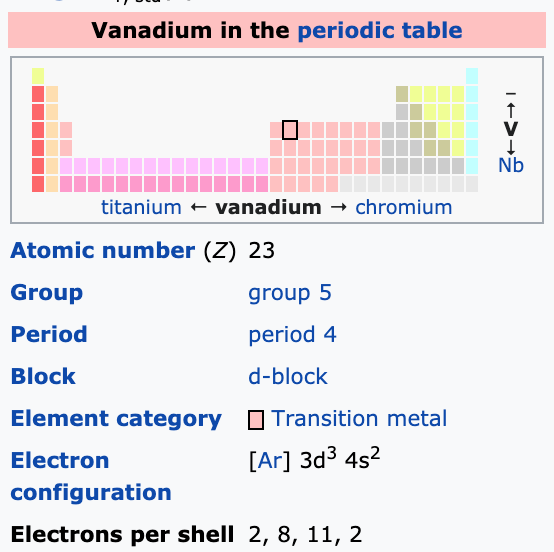
  • Atomic Number: the atomic number is the number of protons in the nucleus and this number uniquely identifies the element. The atomic number of Vanadium is 23 meaning that it has 23 protons in its nucleus. To quote from Wikipedia:
Vanadium is a chemical element with the symbol V and atomic number 23. It is a hard, silvery-grey, malleable transition metal. The elemental metal is rarely found in nature, but once isolated artificially, the formation of an oxide layer (passivation) somewhat stabilizes the free metal against further oxidation.

Figure 1: source

  • Atomic Mass Number: the atomic mass number is the total number of protons and neutrons (together known as nucleons) in an atomic nucleus. The stable isotope of Sodium (Na) has an atomic mass number of 23 (11 protons and 12 neutrons). To quote from Wikipedia again:
Sodium is a chemical element with the symbol Na (from Latin "natrium") and atomic number 11. It is a soft, silvery-white, highly reactive metal. Sodium is an alkali metal, being in group 1 of the periodic table. Its only stable isotope is \(^{23}\)Na. The free metal does not occur in nature, and must be prepared from compounds. Sodium is the sixth most abundant element in the Earth's crust and exists in numerous minerals such as feldspars, sodalite, and rock salt (NaCl). Many salts of sodium are highly water-soluble: sodium ions have been leached by the action of water from the Earth's minerals over eons, and thus sodium and chlorine are the most common dissolved elements by weight in the oceans.

ASTRONOMY

To quote from this source:

Today, the Earth's axis is tilted 23.5° from the plane of its orbit around the sun. But this tilt changes. During a cycle that averages about 40,000 years, the tilt of the axis varies between 22.1° and 24.5°.  The average of 22.1° and 24.5° is of course 23.3°.


COSMOLOGY

Not that I believe in dark matter but for those that do, it's postulated that 23% of the Universe consists of it. Here is a graph to convince you it's true!


*********************************************

 There's a lot more that could be said about the number 23 but that will do for now.