Showing posts with label hexagon. Show all posts

Wednesday, 21 October 2026

Truncated Tetrahedral Numbers

The number associated with my diurnal age today, 28325, has a property that allows it membership of OEIS A100156:


 A100156: structured truncated tetrahedral numbers.

So what is a truncated tetrahedron. It belongs to a class of three-dimensional figurate numbers. They are geometrically constructed by taking a regular tetrahedral number of a given size and removing smaller tetrahedral corners from each of its four vertices.

What does it look like? Figure 1 shows an example.


Figure 1: source

Figure 2 shows the associated net made up from four hexagons and four equilateral triangles.


Figure 2

The details are:

Faces: 8

Edges: 18

Vertices: 12 

A structured truncated tetrahedral number (OEIS A100156) is a three-dimensional figurate number that counts the total number of points (or spheres) in a truncated tetrahedron built outward in nested shells from a single corner vertex, where every polygonal face is populated as a classical vertex-grown figurate polygon rather than a centered polygon.

The initial members of the sequence are: 1, 12, 44, 108, 215, 376, 602, 904, 1293, 1780, 2376, 3092, 3939, 4928, 6070, 7376, 8857, 10524, 12388, 14460, 16751, 19272, 22034, 25048, 28325, 31876, 35712, 39844


Figure 3

To quote from Gemini:

The shape first emerged prominently in the 15th and 16th centuries as artists sought to calculate and render perfect three-dimensional forms on flat surfaces:

Leonardo da Vinci & Luca Pacioli (1509): The most celebrated early appearance of the truncated tetrahedron is in Fra Luca Pacioli's treatise, De Divina Proportione. Leonardo da Vinci provided the illustrations, drawing the solid in two revolutionary forms: solidus (a solid form showing surface planes) and vacuus (a skeletal wireframe showing its interior framework). See Figure 3.

Albrecht Dürer (1525): In his foundational work Underweysung der Messung (Instruction in Measurement), German master Albrecht Dürer revolutionized geometric study by publishing the first foldable paper nets. His flat layout of the truncated tetrahedron allowed readers to cut out and construct physical models, making complex perspective easier to perceive in physical space.

Thursday, 8 December 2022

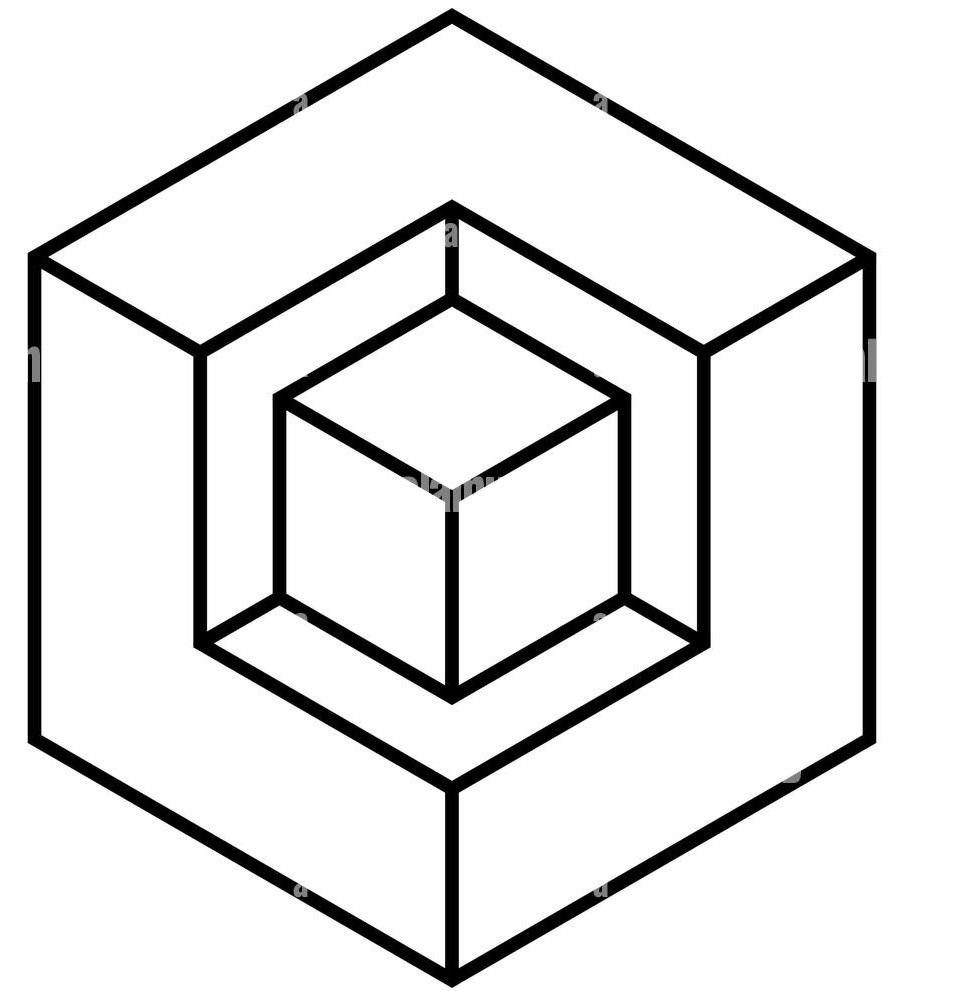
Hexagon and Cube

A regular hexagon is a two dimensional polygon with six equal sides while a cube is a three dimensional polyhedron with twelve edges formed by its six sides meeting at right angles.


Represention of 3-D cube


It's only when we see the three dimensional cube represented in two dimensions that the connection with the hexagon is obvious. Here are some more images highlighting the connection between the two.


A cube or hexagon?
The stripes support a 3-D view

Strong 3-D effect created by the central embedded cube


Strong 3-D effect created by multiple embedded cubes


Three hexagons/cubes from nine trapezia


Cube/hexagon embedded in triangular shape


Strong colours produce a striking hexagon/cube ambivalence

That's all there is to this post that simply shows by means of visual examples how the two dimensional regular hexagon and the three dimensional cube merge into each other when viewed from a certain perspective. It occurred to me, while completing this post, that I should consider more posts such as this linking mathematics to visual art (and to other topics as well).

Wednesday, 25 November 2020

Polyiamonds

Figure 1

Link to post on Polyominoes from March 1st 2020.

Just recently I turned 26166 days old and one of the properties of this number is that it is a member of OEIS A000577: number of polyiamonds with \(n\) cells (turning over allowed, holes allowed, must be connected along edges). In the case of 26166, the value of \(n\) is 14. Figure 1 shows a polyiamond with 13 cells that conforms with the sequence's restrictions. It has a hole but if that hole were filled by a triangle then there would be 14 triangles and its shape would account for one of the 26166 possible polyiamonds.  

Wolfram Mathworld gives the following definition of a polyiamond:
A generalisation of the polyominoes using a collection of equal-sized equilateral triangles (instead of squares) arranged with coincident sides. Polyiamonds are sometimes simply known as iamonds.
Figure 2 shows the possible polyiamond shapes formed by one up to six polyiamonds. The categories can be identified by a prefix \(n\) indicating the number of polyiamonds that comprise them viz. \(n\)-polyiamonds. So Figure 2 shows the different types of 1-polyiamonds up to 6-polyiamonds. Alternatively, a 6-polyiamond can be referred to as a hexiamond and so forth as shown in the diagram.


Figure 2

Figure 3
Generally, mirror images are not considered distinct. In other words, any polyiamond can be picked up, flipped over and the two mirror images are considered the same. See Figure 3. Once there are nine or more polyiamonds, holes are possible. Some of these are shown in Figure 4. So returning to OEIS A000577 and Figure 2, it can be seen why the initial terms are 1, 1, 1, 3, 4 and 12. The full sequence, up to \(n=14\) is 1, 1, 1, 3, 4, 12, 24, 66, 160, 448, 1186, 3334, 9235, 26166 and 73983. The terms getting rapidly larger as \(n\) increases. 

The hexiamonds are given special names. Again, quoting from Wolfram Mathworld and referring to Figure 2, these are:

Top row: bar, crook, crown, sphinx, snake, and yacht.
Bottom row: chevron, signpost, lobster, hook, hexagon, butterfly.

Polyiamonds with holes are shown in Figure 4. The number of holes associated with the different categories of polyiamonds are given by OEIS A070764: number of polyiamonds with \(n\) cells, with holes. The sequence, up to \(n\)=17, runs: 0, 0, 0, 0, 0, 0, 0, 0, 1, 4, 25, 108, 450, 1713, 6267, 21988, 75185.


Figure 4

These shapes can be put together in interesting ways. For example, Figure 5 shows how 9 hexiamonds can be assembled to form a hexagon while Figure 6 shows how 19 hexiamonds can be assembled to form a more complex hexagonal shape:

Figure 5: source

Figure 6: source

Lots of interesting information, puzzles, tables etc. to be found at:
Of course, another approach is to look at the 3-D connections of polyiamonds. Figure 7 shows how a 20-polyiamond folds to form an icosahedron.

Figure 7: source

This leads into the "deltahedron (plural deltahedra), a polyhedron whose faces are all equilateral triangles. The name is taken from the Greek upper case delta (Δ), which has the shape of an equilateral triangle. There are infinitely many deltahedra, but of these only eight are convex, having 4, 6, 8, 10, 12, 14, 16 and 20 faces". Source.

Clearly, there's a lot of room for exploration in this topic but that's enough for this post.

Tuesday, 3 April 2018

Permutahedron

On Quanta, I came across an interesting interview with a mathematician, Federico Ardila, who speaks about the connection between combinatorics and geometry:
When you look at the geometric side of things, suppose, for example, you want to study the permutations (the ways of rearranging a collection of objects). It’s pretty well known that if you have n objects, the number of ways of putting them in a row is n factorial (the product n(n-1)(n-2)…1). So it’s not a very interesting problem to count how many ways there are. But what is their inherent structure?  
The three-dimensional permutahedron, a geometric depiction of the ways to rearrange the numbers 1, 2, 3 and 4. Two permutations are connected by an edge if one can be transformed into the other by swapping two consecutive numbers.     
If you look at when two permutations are related to each other by just swapping two elements, then you start understanding not only how many there are but how are they related to each other. And then, when you say, “OK, let’s take all the permutations, and put an edge between two of them if they’re a swap away,” then you find that you get this beautiful shape that’s a polytope (a geometric object with flat sides). I think it’s completely surprising initially that the inherent relations between permutations are captured in this beautiful polytope called a permutahedron. So all of a sudden you have this geometric model, and you can use tools from polytope theory to try to say new things about permutations. And that polytope has existed for a long time and is very well understood.
The three-dimensional permutahedron, a geometric depiction of the ways to rearrange the numbers 1, 2, 3 and 4. Two permutations are connected by an edge if one can be transformed into the other by swapping two consecutive numbers
This particular structure is in fact a truncated octahedron with fourteen faces comprised of six squares and eight hexagons. There are 24 vertices and 36 edges. Whereas the octahedron is a Platonic solid, the truncated version is an Archimedean solid defined as follows:

In geometry, an Archimedean solid is one of the 13 solids first enumerated by Archimedes. They are the semi-regular convex polyhedra composed of regular polygons meeting in identical vertices, excluding the 5 Platonic solids (which are composed of only one type of polygon) and excluding the prisms and antiprisms. They differ from the Johnson solids, whose regular polygonal faces do not meet in identical vertices. Source.

An example of a Johnson solid would be a triangular bipyramid or dipyramid, a type of hexahedron formed by joining two identical tetrahedra together, the face on one being exactly against a face of the other. The truncated octahedron ends up looking like this:


Interestingly the above shape can, like the cube, tesselate or pack 3-dimensional space. It's by no means obvious but, quite amazingly, this is what happens:


In Mathematics, a permutahedron is an (n−1)-dimensional polytope embedded in an n-dimensional space, the vertices of which are formed by permuting the coordinates of the vector (1, 2, 3, ..., n). Thus the permutahedron of order 4 exists in 3 dimensions, order 3 in two dimensions and order 2 in 1 dimension. A polytope is defined as:
... a geometric object with "flat" sides. It is a generalisation in any number of dimensions of the three-dimensional polyhedron. Polytopes may exist in any general number of dimensions n as an n-dimensional polytope or n-polytope. Flat sides mean that the sides of a (k+1)-polytope consist of k-polytopes that may have (k-1)-polytopes in common. For example, a two-dimensional polygon is a 2-polytope and a three-dimensional polyhedron is a 3-polytope. Source.
All this takes us into complicated areas of mathematics but what's important here is simply to note the link has been forged between two apparently disparate mathematical topics: combinatorics and geometry.