Showing posts with label genome. Show all posts

Saturday, 25 May 2024

Human Genome Numbers

For want of a better term, I'll refer to the numbers that this post is about as Human Genome Numbers because the human genome is comprised of 46 chromosomes, 23 each of which are supplied by the father and mother. But first some background. I very much enjoy coming across numbers that mark my diurnal age and that have, seemingly, no interesting properties that are immediately discoverable. Such is the case today as I turn 27446 days old. My usual resources turned up nothing. 

Looking further however, I noted that the sum of this number's digits is 23, a very interesting number in its own right. I then noticed the number 46 formed by the last two digits of the number. Now 27446 factorises as follows:$$27446 = 2 \times 13723$$It can be seen that the 46 arises from the doubling of the last two digits in the factor 13723. This led me to seek out semiprimes with digit sums of 23 and with a smallest factor of 2 and a larger factor with 23 as its last two digits.

This turns out to be a rather exclusive club and there are only six such numbers in the range up to 40,000 (the top of the range that I normally work with). Here are the numbers and their factorisations:$$ \begin{align} 7646 &= 2 \times 3823 \\ 9446 &= 2 \times 4723 \\23846 &= 2 \times 11923 \\ 25646 &= 2 \times 12823 \\ 27446 &= 2 \times 13723 \\ 36446 &= 2 \times 18223 \end{align}$$So to focus on 27446 is particular, we see that:$$ \overbrace{27446}^{digits \, sum \, to \, 23} = 2  \times 13723 \text{ where 2 x 23 = 46} $$There are 82 such numbers in the range up to one million and they are:

7646, 9446, 23846, 25646, 27446, 36446, 47246, 50846, 56246, 58046, 63446, 70646, 74246, 106646, 113846, 124646, 128246, 135446, 140846, 144446, 162446, 166046, 175046, 207446, 209246, 214646, 216446, 221846, 227246, 234446, 241646, 252446, 254246, 265046, 292046, 302846, 313646, 320846, 322646, 328046, 333446, 335246, 337046, 346046, 351446, 362246, 403646, 410846, 421646, 423446, 427046, 443246, 450446, 452246, 490046, 500846, 502646, 504446, 513446, 522446, 526046, 535046, 540446, 551246, 562046, 580046, 601646, 630446, 652046, 702446, 704246, 711446, 720446, 751046, 801446, 812246, 814046, 821246, 832046, 900446, 913046, 931046

There are other ways to search for the presence of 23 and 46 in numbers but the method I've chosen identifies 27446 and that was the intent. Let's repeat the criteria for selection:

  • number must have a digit sum of 23
  • number must be a semiprime with 2 as the smaller factor
  • larger factor must end in the digits 23 (ensuring number itself ends in 46)
Two of the previous numbers have the digit sequence 23 occurring twice in the larger factor. These numbers are:
  • 47246 = 2 x 23623
  • 124646 = 2 x 62323 (notice that the number itself contains two instances of 46)
One number has the digit sequence 23 and 46 in the larger factor. This number is:
  • 292046 = 2 x 146023 (notice that 46 also appears in the larger factor)
Another method of selection is to choose numbers with digit sums of 23 and with 46 = 2 x 23 as a factor. This selection method yields 47 numbers in the range up to 40,000. These numbers are:

1886, 3956, 4784, 5198, 6854, 7268, 7682, 8096, 8924, 9338, 9752, 10994, 13478, 13892, 15548, 15962, 16376, 16790, 17618, 18446, 18860, 19274, 21758, 22586, 23828, 24656, 25484, 26726, 27554, 28382, 29624, 30866, 31694, 32936, 33764, 34178, 34592, 35834, 36248, 36662, 37076, 37490, 37904, 38318, 38732, 39146, 39560

Take the first member in the sequence as an example:
  • 1886 = 2 x 23 x 41 = 46 x 41
The common thread that justifies the selection of what might be termed human genome numbers is that the numbers 23 and 46 must be involved in some way. This opens the door for other selection criteria but I'll leave off at this point and maybe return to this theme at a later date.

Saturday, 21 November 2020

Twenty Three

With the 23rd November only two days away, I thought that I'd make a post focused simply on this number 23. I know four people who were born on that day. Firstly, I thought I'd look back over my previous posts and see what references to 23 that I could find:

SUM OF CUBES

Most recently I made a post on Sum of Cubes (October 20th 2020) in which I noted that 23 and 239 are the only integers requiring nine positive cubes for their representation. Only 15 integers require eight cubes: 15, 22, 50, 114, 167, 175, 186, 212, 231, 238, 303, 364, 420, 428, and 454. All other numbers require seven cubes or less. In the case of 23 we have:$$23=1^3+1^3+1^3+1^3+1^3+1^3+1^3+2^3+2^3$$CYCLIC NUMBERS

In a post on Cyclic Numbers (November 23rd 2019), I observed that if the digital period of \(1/p\) where \(p\) is prime is \(p\)−1, then the digits represent a cyclic number. 23 is such a prime because it has a period of 22:$$\frac{1}{23}=\text{ 0.0434782608695652173913 }$$Multiplying 0434782608695652173913 progressively by 1 to 22 yields all possible cyclic permutations of this number:

0434782608695652173913    multiplication by 1
0869565217391304347826    multiplication by 2
1304347826086956521739    multiplication by 3
1739130434782608695652    multiplication by 4
2173913043478260869565    multiplication by 5
2608695652173913043478    multiplication by 6
3043478260869565217391    multiplication by 7
3478260869565217391304    multiplication by 8
3913043478260869565217    multiplication by 9
4347826086956521739130    multiplication by 10
4782608695652173913043    multiplication by 11
5217391304347826086956    multiplication by 12
5652173913043478260869    multiplication by 13
6086956521739130434782    multiplication by 14
6521739130434782608695    multiplication by 15
6956521739130434782608    multiplication by 16
7391304347826086956521    multiplication by 17
7826086956521739130434    multiplication by 18
8260869565217391304347    multiplication by 19
8695652173913043478260    multiplication by 20
9130434782608695652173    multiplication by 21
9565217391304347826086    multiplication by 22

Those two posts were the only two that I could find that were of interest regarding 23. Now let's look elsewhere. 

BIRTHDAY PARADOX

23 pops up in the birthday paradox where, in a group of 23 (or more) randomly chosen people, the probability is more than 50% that some pair of them will have the same birthday. Here is the explanation (source):

With 23 people we have 253 pairs: \(\frac{23 \: 22}{2} = 253\). The chance of two people having different birthdays is:$$1 - \frac{1}{365} = \frac{364}{365} = .997260$$Makes sense, right? When comparing one person's birthday to another, in 364 out of 365 scenarios they won't match. Fine. But making 253 comparisons and having them all be different is like getting heads 253 times in a row -- you had to dodge "tails" each time. Let's get an approximate solution by pretending birthday comparisons are like coin flips.We use exponents to find the probability:$$\big( \frac{364}{365} \big )^{253} = 0.4995$$Our chance of getting a single miss is pretty high (99.7260%), but when you take that chance hundreds of times, the odds of keeping up that streak drop. Fast.

SPECIAL PRIMES
  • Sophie-Germain prime: a prime \(p\) is a Sophie-Germain prime if \(2 \times p+1\) is prime. In the case of 23, we have 23 x 2 + 1 = 47, a prime. 

  • Safe prime: a prime \(p\) is a  safe prime if \( \frac{p-1}{2} \) is prime. In the case of 23, we have \( \frac{23-1}{2} =11\) and 11 is prime. 

  • Cunningham chain: 23 is the next to last member of the first Cunningham chain (a sequence of prime numbers) of the first kind to have five terms (2, 5, 11, 23, 47). 

  • Twin prime: 23 is the smallest odd prime that is not a twin prime.

  • Woodell prime: a Woodell number \(W_n\) is any natural number of the form \( W_{n}=n\cdot 2^{n}-1\) for some natural number \(n\). A Woodell prime is simply a Woodell number that is prime. 23 is the second such prime after 7. The progression is 7, 23, 383, 32212254719, ... so they are not that common.

  • Factorial prime: a factorial prime is a prime number that is one less or one more than a factorial (all factorials > 1 are even). 23 = 4!-1 and so it qualifies.

  • Eisenstein prime: this is a little complicated but here is a Wikipedia link for learning more about them. The initial Eisenstein primes are 2, 5, 11, 17, 23, 29, 41, 47, 53, 59, 71, 83, 89, 101, ...

  • Smarandache–Wellin prime: an integer that in a given base is the concatenation of the first \(n\) prime numbers written in that base is called a Smarandache–Wellin number. If the number is prime, it's called a Smarandache–Wellin prime. The initial such primes are 2, 23 and 2357.

  • Sum of primes: the sum of the first 23 primes is 874, which is divisible by 23, a property shared by few other numbers.

  • Repunit prime: a number whose digits are all 1 is called a repunit and if that number is prime, then it is called a repunit prime. The 23 digit number 11111111111111111111111 is such a prime 

FACTORIALS

The number 23 is the only prime \(p\) such that \(p\)! is \(p\) digits long. 

23! = 25852016738884976640000

In fact 23 is one of only four numbers \(n\) such that \(n\)! is \(n\) digits long. The others are 1, 22, and 24. The number 23! is the smallest pandigital factorial—it contains each digit at least once.

HUMAN GENOME

Human cells (apart from the sex cells) contain 46 chromosomes: 23 from the mother and 23 from the father. The sex cells contain 23 chromosomes. There are$$2^{23}=8,324,608$$ possible combinations of 23 chromosome pairs and thus$$2^{46}=70,368,744,177,664$$ possible combinations when male and female sex cells combine to produce a human.

CHEMISTRY
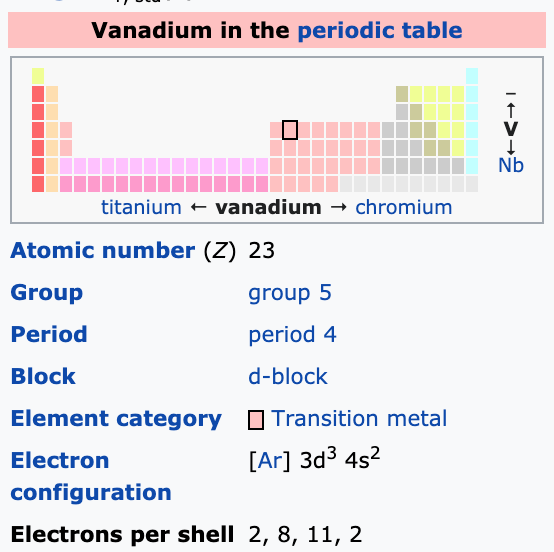
  • Atomic Number: the atomic number is the number of protons in the nucleus and this number uniquely identifies the element. The atomic number of Vanadium is 23 meaning that it has 23 protons in its nucleus. To quote from Wikipedia:
Vanadium is a chemical element with the symbol V and atomic number 23. It is a hard, silvery-grey, malleable transition metal. The elemental metal is rarely found in nature, but once isolated artificially, the formation of an oxide layer (passivation) somewhat stabilizes the free metal against further oxidation.

Figure 1: source

  • Atomic Mass Number: the atomic mass number is the total number of protons and neutrons (together known as nucleons) in an atomic nucleus. The stable isotope of Sodium (Na) has an atomic mass number of 23 (11 protons and 12 neutrons). To quote from Wikipedia again:
Sodium is a chemical element with the symbol Na (from Latin "natrium") and atomic number 11. It is a soft, silvery-white, highly reactive metal. Sodium is an alkali metal, being in group 1 of the periodic table. Its only stable isotope is \(^{23}\)Na. The free metal does not occur in nature, and must be prepared from compounds. Sodium is the sixth most abundant element in the Earth's crust and exists in numerous minerals such as feldspars, sodalite, and rock salt (NaCl). Many salts of sodium are highly water-soluble: sodium ions have been leached by the action of water from the Earth's minerals over eons, and thus sodium and chlorine are the most common dissolved elements by weight in the oceans.

ASTRONOMY

To quote from this source:

Today, the Earth's axis is tilted 23.5° from the plane of its orbit around the sun. But this tilt changes. During a cycle that averages about 40,000 years, the tilt of the axis varies between 22.1° and 24.5°.  The average of 22.1° and 24.5° is of course 23.3°.


COSMOLOGY

Not that I believe in dark matter but for those that do, it's postulated that 23% of the Universe consists of it. Here is a graph to convince you it's true!


*********************************************

 There's a lot more that could be said about the number 23 but that will do for now.