Showing posts with label sum of cubes. Show all posts

Wednesday, 28 August 2024

Some Special Sums of Squares and Cubes

It's well known that some numbers can be written as the sum of two squares. The number 2 is the first such number because:$$2=1^2+1^2$$The first number that can be written as the sum of two distinct squares is 5 because:$$5=2^2+1^2$$However, let's consider the number 20 where we have:$$20 = 2^2 + 4^2$$What makes 20 special is that the divisors of 20 are 1, 2, 4, 5, 10 and 20. Two of the divisors, 2 and 4, form the base of the two squares that add together to total 20. This is the first such number with this property and, up to 40000, the other numbers are (permalink):

20, 80, 90, 180, 272, 320, 360, 468, 500, 650, 720, 810, 980, 1088, 1280, 1332, 1440, 1620, 1872, 2000, 2250, 2420, 2448, 2450, 2600, 2880, 2900, 3240, 3380, 3600, 3920, 4160, 4212, 4352, 4410, 4500, 5120, 5328, 5760, 5780, 5850, 6480, 6642, 6800, 7220, 7290, 7488, 7650, 8000, 8820, 9000, 9680, 9792, 9800, 10100, 10388, 10400, 10580, 10890, 11520, 11600, 11700, 11988, 12500, 12960, 13328, 13520, 14400, 14580, 14762, 15210, 15680, 16250, 16400, 16640, 16820, 16848, 17408, 17640, 18000, 19220, 20250, 20480, 20880, 21312, 21780, 22032, 22050, 22932, 23040, 23120, 23400, 24500, 25578, 25920, 26010, 26100, 26568, 27200, 27380, 27540, 28730, 28880, 29160, 29952, 30420, 30600, 31850, 32000, 32400, 32490, 32912, 33300, 33620, 35280, 36000, 36980, 37440, 37908, 38612, 38720, 39168, 39200, 39690

Looking more closely at these numbers it can be seen that some are multiples of smaller numbers. For example, consider the second number in the sequence: 80. We find that:$$ \begin{align} 80 &= 4^2+8^2\\ &=2^2(2^2+4^2) \\ &=4 \times 20 \end{align}$$Numbers like 20 are called primitive numbers and form OEIS A338485:


 A338485

Primitive numbers that are the sum of the squares of two of their distinct divisors.


The members of this sequence up to 40000 are (permalink):

20, 90, 272, 468, 650, 1332, 2450, 2900, 3600, 4160, 6642, 7650, 10100, 10388, 14762, 16400, 20880, 25578, 27540, 28730, 38612

Let's look at the last member in the sequence above: 38612. We have:$$  38612 = 14^2+196^2$$The divisors of 38612 are 1, 2, 4, 7, 14, 28, 49, 98, 196, 197, 394, 788, 1379, 2758, 5516, 9653, 19306, 38612 and we can see that 14 and 196 are represented.

Figure 1 shows a list bases for the squares that form the primitive and non-primitive numbers from 27540 upwards.


Figure 1

20 is the first number than can be represented as the sum of squares of two of its divisors

I was naturally curious as to whether there were primitive numbers that are the sum of the cubes of two of their distinct divisors. There are indeed. The numbers, not necessarily primitive with this property, are up to 40000 (permalink):

72, 520, 576, 756, 1944, 4160, 4608, 6048, 7560, 9000, 14040, 15552, 15750, 19656, 19710, 20412, 24696, 32832, 33280, 36864

The primitive numbers up to 40000 are (permalink):

72, 520, 576, 756, 1944, 4160, 6048, 7560, 9000, 14040, 15552, 15750, 19656, 19710, 20412, 24696, 32832

The first number in the first list not to appear in the second list is 4608 which can be rendered as:$$ \begin{align} 4608 &= 8^3+16^3 \\  &=2^3 (4^3+8^3) \\ &=8 \times 576 \end{align}$$It can be seen then that 4608 is not a primitive number whereas 576 is. 576 has divisors of 1, 2, 3, 4, 6, 8, 9, 12, 16, 18, 24, 32, 36, 48, 64, 72, 96, 144, 192, 288 and 576 and 4 and 8 are included amongst these divisors.

The algorithm used to generate these lists is easily modified to accommodate fourth, fifth etc. powers if one is interested. I'll stop with the cubes in this post. Figure 2 shows what the bases of the cubes are for the primitive and non-primitive numbers.


Figure 2

Saturday, 21 November 2020

Twenty Three

With the 23rd November only two days away, I thought that I'd make a post focused simply on this number 23. I know four people who were born on that day. Firstly, I thought I'd look back over my previous posts and see what references to 23 that I could find:

SUM OF CUBES

Most recently I made a post on Sum of Cubes (October 20th 2020) in which I noted that 23 and 239 are the only integers requiring nine positive cubes for their representation. Only 15 integers require eight cubes: 15, 22, 50, 114, 167, 175, 186, 212, 231, 238, 303, 364, 420, 428, and 454. All other numbers require seven cubes or less. In the case of 23 we have:$$23=1^3+1^3+1^3+1^3+1^3+1^3+1^3+2^3+2^3$$CYCLIC NUMBERS

In a post on Cyclic Numbers (November 23rd 2019), I observed that if the digital period of \(1/p\) where \(p\) is prime is \(p\)−1, then the digits represent a cyclic number. 23 is such a prime because it has a period of 22:$$\frac{1}{23}=\text{ 0.0434782608695652173913 }$$Multiplying 0434782608695652173913 progressively by 1 to 22 yields all possible cyclic permutations of this number:

0434782608695652173913    multiplication by 1
0869565217391304347826    multiplication by 2
1304347826086956521739    multiplication by 3
1739130434782608695652    multiplication by 4
2173913043478260869565    multiplication by 5
2608695652173913043478    multiplication by 6
3043478260869565217391    multiplication by 7
3478260869565217391304    multiplication by 8
3913043478260869565217    multiplication by 9
4347826086956521739130    multiplication by 10
4782608695652173913043    multiplication by 11
5217391304347826086956    multiplication by 12
5652173913043478260869    multiplication by 13
6086956521739130434782    multiplication by 14
6521739130434782608695    multiplication by 15
6956521739130434782608    multiplication by 16
7391304347826086956521    multiplication by 17
7826086956521739130434    multiplication by 18
8260869565217391304347    multiplication by 19
8695652173913043478260    multiplication by 20
9130434782608695652173    multiplication by 21
9565217391304347826086    multiplication by 22

Those two posts were the only two that I could find that were of interest regarding 23. Now let's look elsewhere. 

BIRTHDAY PARADOX

23 pops up in the birthday paradox where, in a group of 23 (or more) randomly chosen people, the probability is more than 50% that some pair of them will have the same birthday. Here is the explanation (source):

With 23 people we have 253 pairs: \(\frac{23 \: 22}{2} = 253\). The chance of two people having different birthdays is:$$1 - \frac{1}{365} = \frac{364}{365} = .997260$$Makes sense, right? When comparing one person's birthday to another, in 364 out of 365 scenarios they won't match. Fine. But making 253 comparisons and having them all be different is like getting heads 253 times in a row -- you had to dodge "tails" each time. Let's get an approximate solution by pretending birthday comparisons are like coin flips.We use exponents to find the probability:$$\big( \frac{364}{365} \big )^{253} = 0.4995$$Our chance of getting a single miss is pretty high (99.7260%), but when you take that chance hundreds of times, the odds of keeping up that streak drop. Fast.

SPECIAL PRIMES
  • Sophie-Germain prime: a prime \(p\) is a Sophie-Germain prime if \(2 \times p+1\) is prime. In the case of 23, we have 23 x 2 + 1 = 47, a prime. 

  • Safe prime: a prime \(p\) is a  safe prime if \( \frac{p-1}{2} \) is prime. In the case of 23, we have \( \frac{23-1}{2} =11\) and 11 is prime. 

  • Cunningham chain: 23 is the next to last member of the first Cunningham chain (a sequence of prime numbers) of the first kind to have five terms (2, 5, 11, 23, 47). 

  • Twin prime: 23 is the smallest odd prime that is not a twin prime.

  • Woodell prime: a Woodell number \(W_n\) is any natural number of the form \( W_{n}=n\cdot 2^{n}-1\) for some natural number \(n\). A Woodell prime is simply a Woodell number that is prime. 23 is the second such prime after 7. The progression is 7, 23, 383, 32212254719, ... so they are not that common.

  • Factorial prime: a factorial prime is a prime number that is one less or one more than a factorial (all factorials > 1 are even). 23 = 4!-1 and so it qualifies.

  • Eisenstein prime: this is a little complicated but here is a Wikipedia link for learning more about them. The initial Eisenstein primes are 2, 5, 11, 17, 23, 29, 41, 47, 53, 59, 71, 83, 89, 101, ...

  • Smarandache–Wellin prime: an integer that in a given base is the concatenation of the first \(n\) prime numbers written in that base is called a Smarandache–Wellin number. If the number is prime, it's called a Smarandache–Wellin prime. The initial such primes are 2, 23 and 2357.

  • Sum of primes: the sum of the first 23 primes is 874, which is divisible by 23, a property shared by few other numbers.

  • Repunit prime: a number whose digits are all 1 is called a repunit and if that number is prime, then it is called a repunit prime. The 23 digit number 11111111111111111111111 is such a prime 

FACTORIALS

The number 23 is the only prime \(p\) such that \(p\)! is \(p\) digits long. 

23! = 25852016738884976640000

In fact 23 is one of only four numbers \(n\) such that \(n\)! is \(n\) digits long. The others are 1, 22, and 24. The number 23! is the smallest pandigital factorial—it contains each digit at least once.

HUMAN GENOME

Human cells (apart from the sex cells) contain 46 chromosomes: 23 from the mother and 23 from the father. The sex cells contain 23 chromosomes. There are$$2^{23}=8,324,608$$ possible combinations of 23 chromosome pairs and thus$$2^{46}=70,368,744,177,664$$ possible combinations when male and female sex cells combine to produce a human.

CHEMISTRY
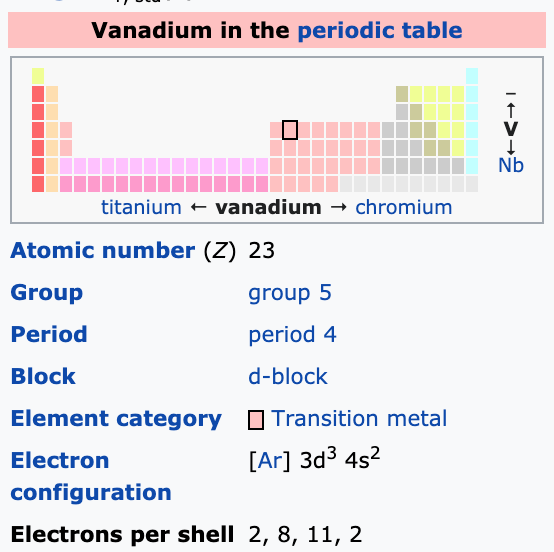
  • Atomic Number: the atomic number is the number of protons in the nucleus and this number uniquely identifies the element. The atomic number of Vanadium is 23 meaning that it has 23 protons in its nucleus. To quote from Wikipedia:
Vanadium is a chemical element with the symbol V and atomic number 23. It is a hard, silvery-grey, malleable transition metal. The elemental metal is rarely found in nature, but once isolated artificially, the formation of an oxide layer (passivation) somewhat stabilizes the free metal against further oxidation.

Figure 1: source

  • Atomic Mass Number: the atomic mass number is the total number of protons and neutrons (together known as nucleons) in an atomic nucleus. The stable isotope of Sodium (Na) has an atomic mass number of 23 (11 protons and 12 neutrons). To quote from Wikipedia again:
Sodium is a chemical element with the symbol Na (from Latin "natrium") and atomic number 11. It is a soft, silvery-white, highly reactive metal. Sodium is an alkali metal, being in group 1 of the periodic table. Its only stable isotope is \(^{23}\)Na. The free metal does not occur in nature, and must be prepared from compounds. Sodium is the sixth most abundant element in the Earth's crust and exists in numerous minerals such as feldspars, sodalite, and rock salt (NaCl). Many salts of sodium are highly water-soluble: sodium ions have been leached by the action of water from the Earth's minerals over eons, and thus sodium and chlorine are the most common dissolved elements by weight in the oceans.

ASTRONOMY

To quote from this source:

Today, the Earth's axis is tilted 23.5° from the plane of its orbit around the sun. But this tilt changes. During a cycle that averages about 40,000 years, the tilt of the axis varies between 22.1° and 24.5°.  The average of 22.1° and 24.5° is of course 23.3°.


COSMOLOGY

Not that I believe in dark matter but for those that do, it's postulated that 23% of the Universe consists of it. Here is a graph to convince you it's true!


*********************************************

 There's a lot more that could be said about the number 23 but that will do for now.

Tuesday, 20 October 2020

Sums of Cubes

 I've written about cubic numbers before, specifically in posts titled:

  • Cubic Numbers from the 11th January 2016 in which I discuss turning \(29^3\) days old
  • Cuban Primes from the 11th July 2016 in which I discuss primes that are the difference of two consecutive cubes
  • Sums of Cubes and Squares of Sums from the 31st July 2018 in which I discuss with the property that the sum of the cubes of their digits is equal to the square of the sums of their digits
  • Platonic Numbers from the 20th November 2018 in which I discuss cubes or cubic numbers as being one type of platonic number along with tetrahedral, octahedral, icosahedral and dodecahedral numbers.
  • 42 is the new 33 from the 1st April 2019 in which I report on the discovery that 33 is expressible as a sum of three signed cubes and that only 42 remains to be cracked.
  • 42 from the 9th September 2019 in which I report on the discovery is expressible as a sum of three signed cubes and that a new way of expressing 3 as a sum of three signed cubes was discovered
  • The Original Taxi Cab Number in a New Light from the 21st December 2019 in which I discuss 1729 and centred cube numbers
In this post, I'll examine 26132 that has the interesting property that it can be expressed as a sum of six cubes in three possible ways. It is a member of OEIS A048931


A048931

Numbers that are the sum of 6 positive cubes in exactly 3 ways.      
    What's remarkable about 26132 is that it's the last such number with this property. Beginning with 221, the sequence has 1141 members and 26132 is the last member. It is expressible as the sum of the following cubic numbers: [8, 2744, 2744, 3375, 8000, 9261], [64, 1331, 2744, 4913, 4913, 12167] and [512, 512, 2197, 2744, 8000, 12167].

    From WolframMathWorld we learn that:
    • 23 and 239 are the only integers requiring nine positive cubes
    • only 15 integers require eight cubes: 15, 22, 50, 114, 167, 175, 186, 212, 231, 238, 303, 364, 420, 428, and 454 
    The same source also provides the following table that gives the first few numbers which require at least N = 1, 2, 3, ..., 9 (i.e., N or more) positive cubes to represent them as a sum.

    nOEISnumbers
    1A0005781, 8, 27, 64, 125, 216, 343, 512, ...
    2A0033252, 9, 16, 28, 35, 54, 65, 72, 91, ...
    3A0477023, 10, 17, 24, 29, 36, 43, 55, 62, ...
    4A0477034, 11, 18, 25, 30, 32, 37, 44, 51, ...
    5A0477045, 12, 19, 26, 31, 33, 38, 40, 45, ...
    6A0460406, 13, 20, 34, 39, 41, 46, 48, 53, ...
    7A0188907, 14, 21, 42, 47, 49, 61, 77, ...
    8A01888915, 22, 50, 114, 167, 175, 186, ...
    9A01888823, 239

    Again, the same source provides the following table that gives the numbers which can be represented in exactly \(W\) different ways as a sum of \(N\) positive cubes.

    NWOEISnumbers
    10A0074122, 3, 4, 5, 6, 7, 9, 10, 11, 12, 13, 14, ...
    11A0005781, 8, 27, 64, 125, 216, 343, 512, ...
    20A0579031, 3, 4, 5, 6, 7, 8, 10, 11, 12, 13, 14, ...
    212, 9, 16, 28, 35, 54, 65, 72, 91, ...
    22A0188501729, 4104, 13832, 20683, 32832, ...
    23A00382587539319, 119824488, 143604279, ...
    24A0038266963472309248, 12625136269928, ...
    2548988659276962496, ...
    268230545258248091551205888, ...
    30A0579041, 2, 4, 5, 6, 7, 8, 9, 11, 12, 13, 14, ...
    31A0253953, 10, 17, 24, 29, 36, 43, 55, 62, ...
    32251, ...
    40A0579051, 2, 3, 5, 6, 7, 8, 9, 10, 12, 13, 14, ...
    41A0254034, 11, 18, 25, 30, 32, 37, 44, 51, ...
    42A025404219, 252, 259, 278, 315, 376, 467, ...
    50A0579061, 2, 3, 4, 6, 7, 8, 9, 10, 11, 13, 14, 15, ...
    51A0489265, 12, 19, 26, 31, 33, 38, 40, 45, ...
    52A048927157, 220, 227, 246, 253, 260, 267, ...
    60A0579071, 2, 3, 4, 5, 7, 8, 9, 10, 11, 12, 14, 15, ...
    61A0489296, 13, 20, 27, 32, 34, 39, 41, 46, ...
    62A048930158, 165, 184, 221, 228, 235, 247, ...
    63A048931221, 254, 369, 411, 443, 469, 495, ...

    In the final row of the above table, we see the sequence to which 26132 belongs. There's a lot more of course that could be said about numbers formed from the sum of cubes but what we do know is that, after 26132, there are no more numbers that can be formed from six cubes in only three ways. How we know this, I don't know!