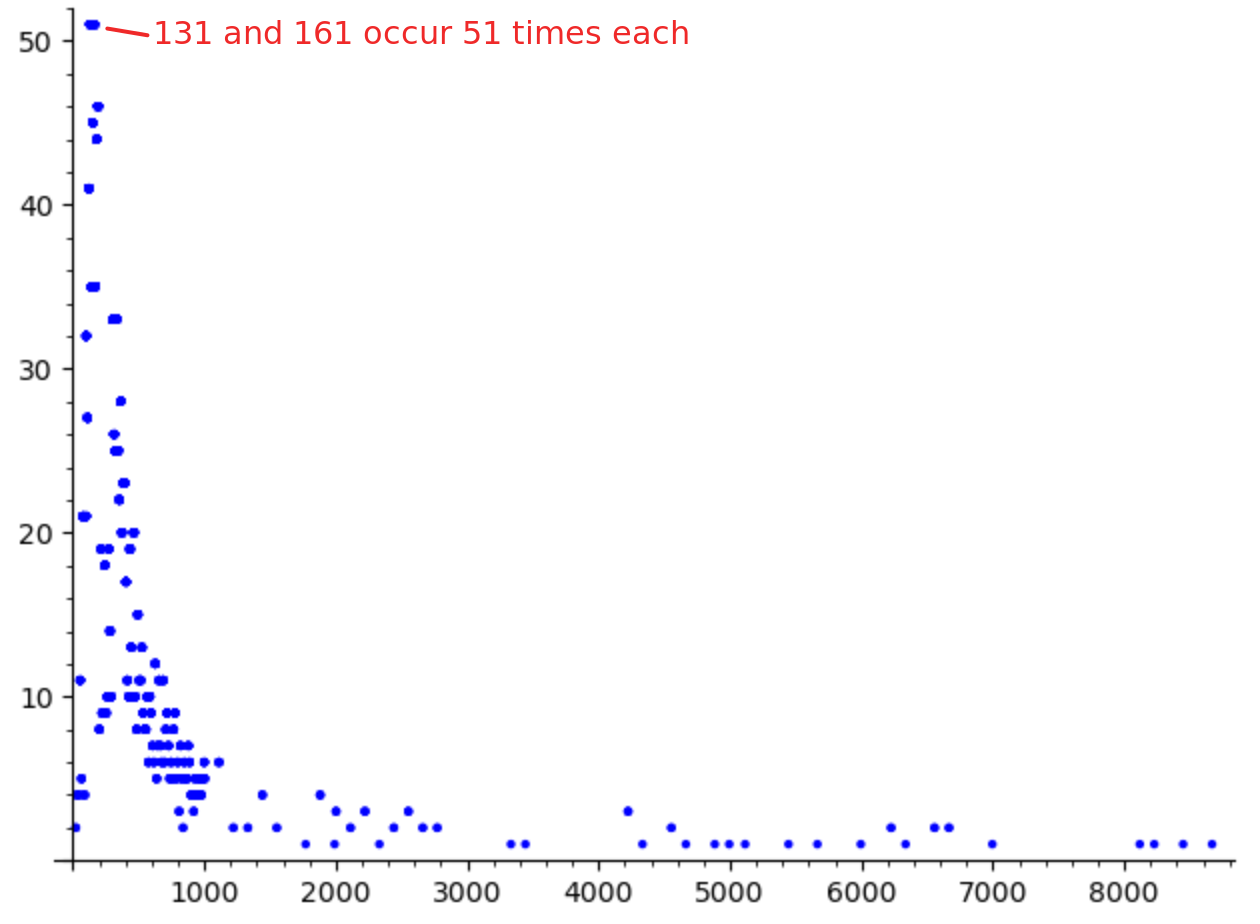
A138131 | Palindromic cyclops numbers. |
| A175750 | Numbers with 42 divisors. |
A139041 | Sum of divisors of the number of partitions of \(n\). |
A138131 | Palindromic cyclops numbers. |
| A175750 | Numbers with 42 divisors. |
A139041 | Sum of divisors of the number of partitions of \(n\). |
I've written explicitly about Harshad numbers in two previous posts: Harshad Numbers on Saturday, 11 February 2017 and Harshad Numbers Revisited on Saturday, 30 June 2018. However, I've only mentioned Base-\(n\) Harshad numbers in passing and so this post will be about them, although the focus will be on the value of \(n=2\).
I was reminded of them because the number associated with my diurnal age today, 27070, has a property that affords it membership in OEIS A330932. Let's remember that Niven numbers are another name for Harshad numbers.
A330932 | Starts of runs of 3 consecutive Niven numbers in base 2 (A049445). |
Cooper and Kennedy proved in 1993 that no 21 consecutive integers are all harshad numbers in base 10. They also constructed infinitely many 20-tuples of consecutive integers that are all 10-harshad numbers, the smallest of which exceeds \(10^{44363342786} \).H. G. Grundman (1994) extended the Cooper and Kennedy result to show that there are \(2b\) but not \(2b + 1\) consecutive \(b\)-harshad numbers for any base \(b\). This result was strengthened to show that there are infinitely many runs of \(2b\) consecutive b-harshad numbers for \(b = 2\) or \(3\) by T. Cai (1996) and for arbitrary b by Brad Wilson in 1997.In binary, there are thus infinitely many runs of four consecutive Harshad numbers and in ternary infinitely many runs of six.
Runs of four consecutive base-2 Harshad numbers occur for very large numbers. I checked and there were none in the range up to one million and, I suspect, far beyond this.
I've written about what I term AD and BC numbers in a post titled, quite sensibly, AD and BC Numbers. I was reminded of them because my diurnal age today, 27068, converts to 69BC in hexadecimal. For some time now, these BC numbers have been occurring every 256 days.
27068 --> 69bc
However, this regular march of time is now at an end because if 256 is added to 27068, the resultant number (27324) is 6ABC. The decimal equivalent of 70AD is 28845, representing a jump of 1792 or 7 x 256 days.
24749 --> 60ad
25005 --> 61ad
25261 --> 62ad
25517 --> 63ad
25773 --> 64ad
26029 --> 65ad
26285 --> 66ad
26541 --> 67ad
26797 --> 68ad
27053 --> 69ad
Find out your diurnal age and determine when you will next have a connection to AD or BC year (via decimal to hexadecimal conversion). What was significant about that year.
See my post titled 69BC for details on what was significant about this year in history. Students could be shown how to determine their diurnal age using Wolfram Alpha and they could also use it to convert between decimal and hexadecimal. Overall, a useful and interesting exercise.
An emirp is a prime that remains prime when its digits are reversed. The prime and its reversal must be different and so this excludes palindromic primes like 101. The smallest emirp is 13 that, when reversed, gives 31 which is also prime. By "Prime Emirp Pair Averages", I mean primes that are the average of an emirp pair. The first such prime is 11311, a palindromic prime, and it is the average of the emirp pair 10321 and 12301. Thus$$11311=\frac{10321+12301}{2}$$These sorts of primes form OEIS A178581:
A178581 | Primes that are the average of the members of emirp pairs. |
A178587 | Primes that are the average of the members of more than one emirp pair. |
There's something very obvious about the number associated with my diurnal age today. The number is 27064 and the cubes (27 and 64) stand out clearly. In fact 27064 can be written as a sum of two cubes:$$ \begin{align} 27064 &=27000+64\\&=30^3+4^3 \end{align}$$Unfortunately, the number cannot be written as a concatenation of two cubes because the zero gets in the way. The problem is that 4 cubed has only two digits. However, the cubes of the numbers from 5 to 9 all have three digits and so the zero disappears. This allows us to write the following numbers as both sums and concatenations of two cubes. The symbol | indicates concatenation$$ \begin{align} 27125 =30^3+5^3 = 3^3|5^3\\27216 =30^3+6^3 = 3^3|6^3\\27343 = 30^3+7^3 = 3^3|7^3\\27512 = 30^3+ 8^3 = 3^3|8^3\\27729 = 30^3+9^3=3^3|9^3 \end{align} $$This series of numbers is the last that will occur in my lifetime because the next such sets of numbers will begin with 64125. However, if we were to consider sums of squares and concatenations of squares then I may see these come to pass. Consider the following sets of numbers, some of which occur more than once (permalink).$$ \begin{align} 36100= 114^2+152^2=6^2|10^2\\36121 =20^2+ 189^2=6^2|11^2\\36121 =61^2+ 180^2=6^2|11^2\\36196=40^2+ 186^2=6^2|14^2\\36324 =90^2+ 168^2=6^2|18^2\\36361 =60^2 +181^2=6^2|19^2\\36361=125^2+ 144^2=6^2|19^2\\36441=96^2+ 165^2=6^2|21^2\\36529=48^2+ 185^2=6^2|23^2\\36625=12^2+ 191^2=6^2|25^2\\36625=56^2+ 183^2=6^2|25^2\\36625=65^2+ 180^2=6^2|25^2\\36625=105^2+ 160^2=6^2|25^2\\36676=24^2+190^2=6^2|26^2\\36676=80^2+174^2=6^2|26^2\\36900 =6^2+ 192^2=6^2|30^2\\36900=48^2+ 186^2=6^2|30^2\\36900= 120^2+ 150^2=6^2|30^2 \end{align} $$The first of these numbers (36100) corresponds to Monday, February 3rd, 2048 by which time I'll be almost 88. Maybe I'll make it, maybe I won't.
There's only one reference that I've made to Brazilian primes in this blog and that was in a post titled Fermat Primes and Brazilian Numbers on February 26th 2018 which is now over five years ago. I was reminded of them once again when a number associated with my diurnal age, 27061, was identified as a Brazilian prime. I wrote the following about Brazilian numbers in that earlier post:
These numbers are listed in OEIS A125134 and defined as:
Numbers \( n \) such that there is a natural number \( b \) with \( 1 < b < n-1 \) such that the representation of \( n \) in base \( b \) has all equal digits.
All even numbers \( \geq \) 8 are Brazilian numbers because: $$ \begin{align} 2p&=2(p-1)+2 \\&= 22 \end{align}$$in base \(p-1\) if \(p-1>2 \) and that is true if \(p \geq 4 \).
The odd Brazilian numbers are listed in OEIS A257521 and are fairly common, with some being prime numbers:
7, 13, 15, 21, 27, 31, 33, 35, 39, 43, 45, 51, 55, 57, 63, 65, 69, 73, 75, 77, 81, 85, 87, 91, 93, 95, 99, 105, 111, 115, 117, 119, 121, 123, 125, 127, 129, 133, 135, 141, 143, 145, 147, 153, 155, 157, 159, 161, 165, 171, 175, 177, 183, 185, 187, 189, 195, ...
As an example, take 27 in the above sequence which can be expressed as \(33_8 \). As for the even numbers, take a number like 28. It can be written as 2 x (14-1) + 2 and thus can be represented as \(22_{13} \).
Brazilian primes are simply Brazilian numbers that are prime. These constitute OEIS A085104:
A085104 | Primes of the form \(1 + n + n^2 + n^3 + ... + n^k \) where \(n > 1\) and \( k > 1\). |
For example, in the case of 27061 we have: $$ \begin{align} 27061& = 1+164+164^2 \\ &= 164^2+164+1\\&=111_{164} \end{align}$$These primes can be generated using this permalink. The initial members of the sequence are:
7, 13, 31, 31, 43, 73, 127, 157, 211, 241, 307, 421, 463, 601, 757, 1093, 1123, 1483, 1723, 2551, 2801, 2971, 3307, 3541, 3907, 4423, 4831, 5113, 5701, 6007, 6163, 6481, 8011, 8191, 8191, 9901, 10303, 11131, 12211, 12433, 13807, 14281, 17293, 19183, 19531, 20023, 20593, 21757, 22621, 22651, 23563, 24181, 26083, 26407, 27061, 28057, 28393, 30103, 30941, 31153, 35533, 35911, 37057, 37831, 41413, 42643, 43891, 46441, 47743, 53593, 55933, 55987, 60271, 60763, 71023, 74257, 77563, 78121, 82657, 83233, 84391, 86143, 88741, 95791, 98911
The OEIS comments to this sequence are informative:
The number of terms \(k+1\) is always an odd prime, but this is not enough to guarantee a prime, for example 111 = 1 + 10 + 100 = 3 x 37.
The inverses of the Brazilian primes form a convergent series; the sum is slightly larger than 0.33.
It is not known whether there are infinitely many Brazilian primes.
Brazilian primes can be written in the form:
$$ \dfrac{(n^p - 1)}{(n - 1}\\ \text{ where } p \text{ is an odd prime and } n > 1$$
The number of terms less than \(10^n\) are 1, 5, 14, 34, 83, 205, 542, 1445, 3880, 10831, 30699, 88285, ...
Brazilian primes fall into two classes:
- when \(n\) is prime, we get sequence OEIS A023195 except 3 which is not Brazilian,
- when \(n\) is composite, we get sequence OEIS A285017.
The conjecture that "No Sophie Germain prime is Brazilian (prime)" is false because:$$ \begin{align} a(856) &= 28792661\\ &= 1 + 73 + 73^2 + 73^3 + 73^4 \\&= (11111)_{73} \end{align} $$and 28792661 is the 141385-th Sophie Germain prime.
In this post, I want to look at some connections between between sphenic numbers and palindromes. The most obvious link is to those sphenic numbers that are palindromic. In the range up to 100,000, there are 229 palindromic sphenic numbers. The list is shown below.
66, 222, 282, 434, 474, 494, 555, 595, 606, 646, 777, 969, 1001, 1221, 1551, 1771, 2222, 2882, 3333, 3553, 4334, 4994, 5335, 5555, 5665, 5885, 5995, 6226, 6446, 6886, 7337, 7557, 7667, 7777, 7887, 8338, 8558, 8998, 9339, 9669, 9779, 9889, 11211, 11811, 12121, 12621, 12921, 13731, 14241, 14541, 15051, 15951, 16261, 16761, 17171, 18381, 18681, 19491, 19591, 19691, 20002, 20702, 20802, 20902, 22222, 22922, 24042, 24342, 24542, 24742, 24942, 26062, 26162, 26462, 28082, 28282, 28382, 28582, 28882, 28982, 30003, 30503, 31413, 31913, 32123, 32223, 32523, 32623, 32923, 33333, 33733, 34143, 34743, 35553, 37373, 37973, 38283, 38883, 39093, 39193, 39693, 39893, 41114, 41214, 41914, 43334, 43934, 45154, 45354, 45854, 47174, 47274, 47474, 49594, 49994, 50005, 50105, 50205, 50405, 50605, 51815, 51915, 53635, 53735, 54245, 54345, 54645, 54845, 55155, 55255, 55455, 55555, 56165, 56465, 56665, 58785, 58985, 59095, 59395, 59495, 60106, 60706, 60906, 62326, 62626, 62726, 62926, 64046, 64146, 64546, 64946, 66266, 66466, 66566, 66866, 66966, 68086, 68186, 68386, 68686, 68786, 68986, 70007, 70807, 70907, 71517, 71617, 71817, 72127, 72427, 72527, 72627, 73337, 74847, 75057, 75257, 75757, 75957, 76067, 76467, 76867, 77577, 77777, 78987, 79097, 79597, 79797, 81318, 81818, 83138, 83238, 83738, 85058, 85258, 85458, 85558, 85758, 87378, 87478, 87878, 89198, 89498, 89798, 89898, 89998, 91119, 91419, 91819, 92229, 92729, 92929, 93439, 93939, 94449, 94549, 95259, 95459, 95559, 96069, 97179, 97279, 97679, 97779, 98589, 99199, 99399, 99499, 99699, 99799
How many of these numbers have prime factors that sum to a palindrome? Well, as it turns out, only 21. These are shown below along with the factorisations and prime factor sums:
![]() |
Figure 1: permalink |