Showing posts with label polyhedra. Show all posts

Tuesday, 19 November 2024

Stella Octangula

The term "stella octangula" is another name for a "stellated octahedron" such as is shown in Figure 1.

Figure 1: stellated octahedron
Source

I've only made one previous post about stellated polyhedra and that was The Cubohemioctahedron and other Polyhedra back on the 21st July 2019. Here's what Wikipedia had to say about the stellated octahedron:

The stellated octahedron is the only stellation of the octahedron. It is also called the stella octangula (Latin for "eight-pointed star"), a name given to it by Johannes Kepler in 1609, though it was known to earlier geometers. It was depicted in Pacioli's De Divina Proportione, 1509.

It is the simplest of five regular polyhedral compounds, and the only regular compound of two tetrahedra. It is also the least dense of the regular polyhedral compounds, having a density of 2.

It can be seen as a 3D extension of the hexagram: the hexagram is a two-dimensional shape formed from two overlapping equilateral triangles, centrally symmetric to each other, and in the same way the stellated octahedron can be formed from two centrally symmetric overlapping tetrahedra. This can be generalized to any desired amount of higher dimensions; the four-dimensional equivalent construction is the compound of two 5-cells. It can also be seen as one of the stages in the construction of a 3D Koch snowflake, a fractal shape formed by repeated attachment of smaller tetrahedra to each triangular face of a larger figure. The first stage of the construction of the Koch Snowflake is a single central tetrahedron, and the second stage, formed by adding four smaller tetrahedra to the faces of the central tetrahedron, is the stellated octahedron.

Associated with this shape are the stella octangula numbers. These are figurate numbers  of the form \(n(2n^2 − 1) \) and they form OEIS A007588:

0, 1, 14, 51, 124, 245, 426, 679, 1016, 1449, 1990, 2651, 3444, 4381, 5474, 6735, 8176, 9809, 11646, 13699, 15980, 18501, 21274, 24311, 27624, 31225, 35126, 39339, 43876, 48749, 53970, 59551, 65504, 71841, 78574, 85715, 93276, 101269, 109706, 118599, 127960

To quote from Wikipedia again:

There are only two positive square stella octangula numbers. The first is \(1\) and the other is$$9653449 = 3107^2 = (13 × 239)^2$$corresponding to \(n = 1\) and \(n = 169\) respectively. The elliptic curve describing the square stella octangula numbers is:$$m^2=n(2n^2-1)$$Using Geogebra, this curve is shown in Figure 2.


Figure 2 
The stella octangula numbers arise in a parametric family of instances to the crossed ladders problem in which the lengths and heights of the ladders and the height of their crossing point are all integers. In these instances, the ratio between the heights of the two ladders is a stella octangula number.
The shape and these numbers caught my attention because my diurnal age today is 27624 and this number is a member of the OEIS sequence for the case of \(n=24\). These numbers are quite sparse. The previous number was 24311 and the next will be 31225.

Here is a video which shows how to create a stellated octahedron using origami. It was uploaded on the 13th March 2010 but the technique of course is timeless. Figure 3 shows another representation of the shape.


Figure 3: source

Figure 4 shows how the shape can be inscribed in a cube and also illustrates its connection with the hexagon.

Figure 4: 
source

The site from which Figures 3 and 4 were taken also contains illustrations of nets can be used to construct the models. This approach is easier than the origami method. Instructions for the construction of wire frame models can also be found there.

Figure 5 shows a screenshot from a site that provides a stellated octahedron calculator. Entering a side length of 53 generates a volume of 26318 to the nearest decimal place. However, the \(a\) shown in Figure 5 is a side length whereas the common formula uses edge length \(b\) where \(b=a/2\). The volume of the shape using edge length of \( b \) is \(b^3 \sqrt {2} \).

Figure 5: source

Monday, 10 July 2023

Johnson Solids J1 and J8

The number associated with my diurnal age today, 27126, introduced me to the notion of Johnson solids via its membership in OEIS A227221:


 A227221

Volume of Johnson square pyramid placed upright on cube (rounded down) with edge lengths equal to \(n\).


The members of this sequence, up to 40000, are:

1, 9, 33, 79, 154, 266, 423, 632, 900, 1235, 1644, 2135, 2714, 3390, 4170, 5061, 6071, 7206, 8475, 9885, 11443, 13157, 15034, 17082, 19307, 21718, 24322, 27126, 30137, 33363, 36812

The formula for the area is given by \(  (1+\dfrac{ \sqrt{2}}{6}) \times n\) where \(n\) is the edge length. For 27216, \(n=28\). This shape is known as an elongated square pyramid and represent Johnson solid J8. A Johnson solid is a convex polyhedron with all edges equal and there 92 distinct types. The equilateral square pyramid sitting on one of the faces of the cube is Johnson solid J1. See Figures 1 and 2.


Figure 1: Johnson solid J1 (source)


Figure 2: Johnson solid J8 (source)

Figure 3 shows a octahedron, one of the five Platonic solids, that can be considered a square bipyramid, i.e. two Johnson square pyramids connected base-to-base.


Figure 3: octahedron (source)

Figure 4 shows a tetrakis hexahedron that can be constructed from a cube with Johnson square pyramids added to each face. It is a Catalan solid.


Figure 4: tetrakis hexahedron (source)

Thursday, 8 December 2022

Hexagon and Cube

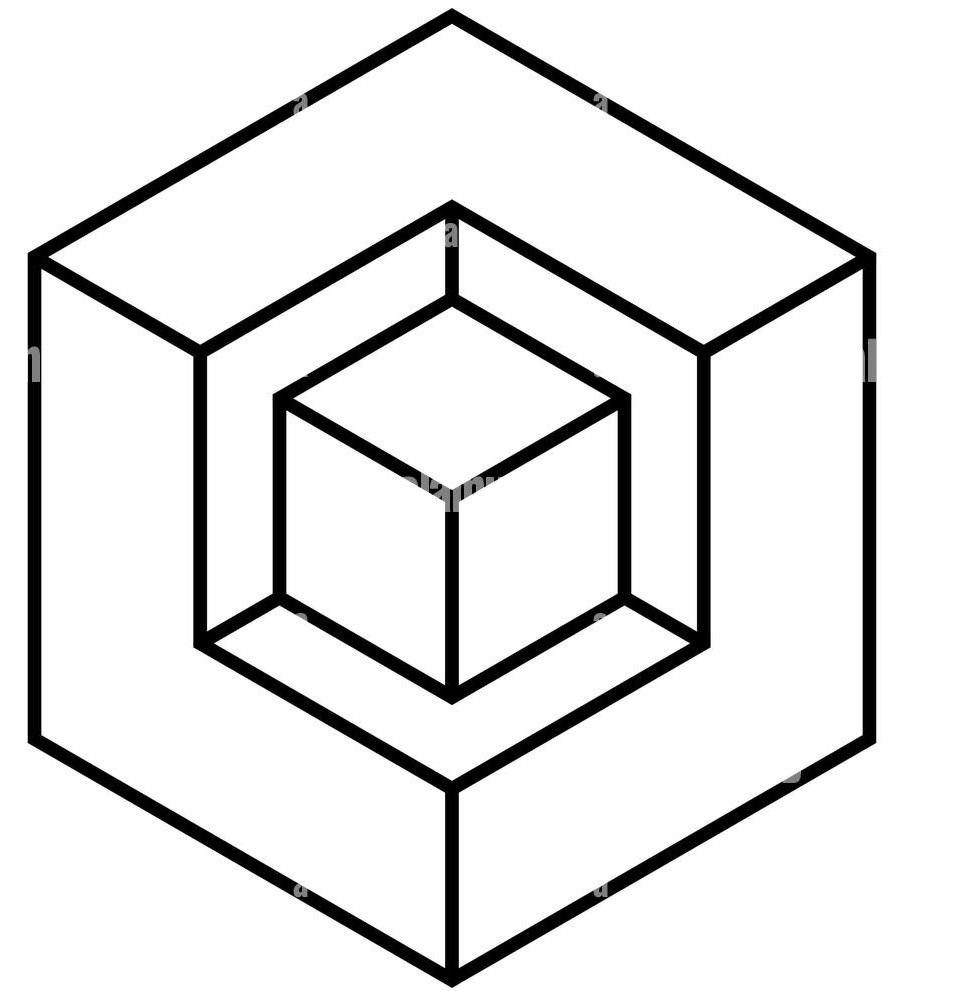
A regular hexagon is a two dimensional polygon with six equal sides while a cube is a three dimensional polyhedron with twelve edges formed by its six sides meeting at right angles.


Represention of 3-D cube


It's only when we see the three dimensional cube represented in two dimensions that the connection with the hexagon is obvious. Here are some more images highlighting the connection between the two.


A cube or hexagon?
The stripes support a 3-D view

Strong 3-D effect created by the central embedded cube


Strong 3-D effect created by multiple embedded cubes


Three hexagons/cubes from nine trapezia


Cube/hexagon embedded in triangular shape


Strong colours produce a striking hexagon/cube ambivalence

That's all there is to this post that simply shows by means of visual examples how the two dimensional regular hexagon and the three dimensional cube merge into each other when viewed from a certain perspective. It occurred to me, while completing this post, that I should consider more posts such as this linking mathematics to visual art (and to other topics as well).

Wednesday, 1 September 2021

Dali and the Unfolded Hypercube

Figure 1

In April of 1984, as a birthday present from my father, I acquired a TR-80 computer from Tandy with 32Kb of RAM and a keyboard but no disk drive. Data input and output were via a cassette tape. Display was via a connected TV. Using this I began my BASIC programming and one of my first creations was a simulation of a projectile being launched to hit a target. The essential formulae for the projectile's motion are:$$x(t)=v_0 \cos(\theta) \cdot t \text{ and } y(t)=v_0 \sin(\theta) \cdot t - 0.5 g t^2$$where we have:

  • \(x(t)\) is horizontal position of projectile after time \(t\) with \(x=0\) when \(t=0\)
  • \(y(t)\) is vertical position of projectile after time \(t\) with \(y=0\) when \(t=0\)
  • \(v_0\) is initial velocity at time \(t=0\)
  • \(\theta\) is angle of projection
  • \(g\) is deceleration due to gravity \(\approx \) -9.8 \(ms^{-2}\)
Figure 1 shows the situation with an angle of 60° and an initial velocity fo 6 \(ms^{-1}\). What has all this to do with unfolding hypercubes? Well, April of 1984 marked my return to Mathematics after a long absence. In August of that year, I began my training as a Mathematics teacher and one of the assigned projects was an assignment on some aspect of Mathematics. I chose Mathematics and Art, a choice which led to me to the unfolded hypercube. In the University library, I came across Salvator Dali's 1954 Crucifixion (Corpus Hypercubus). See Figure 2.


Figure 2: source

It is a large oil painting, with dimensions of 194.3 cm × 123.8 cm (76.5 in × 48.7 in). Figure 3 shows the net of a hypercube (or tesseract).


Figure 3: source

What reminded me of my youthful investigation into the realm of the hypercube was a Mathologer video that I watched today titled The Iron Man hyperspace formula really works.


Figure 4 shows a screenshot that demonstrates information about the number of vertices, edges and faces in an \(n\)-dimensional cube where \(n\) varies from 0 to 4. Looking at it, we see that a zero dimensional "cube" consists of only a single point or vertex. The number of vertices is shown by the coefficients of the \(x^0\) terms, coloured red. A one dimensional "cube", corresponding to a line, has two vertices and one edge. The number of edges is shown by the coefficients of the \(x^1\) terms, coloured green. A two dimensional "cube", corresponding to a square, has four vertices, 4 edges and one face. The number of faces is shown by the coefficients of the \(x^2\) terms. The familiar three dimensional cube has 8 vertices, 12 edges and 6 faces, plus one cube. The number of cubes is shown by the coefficients of the \(x^3\) terms. The four dimensional hypercube has 16 vertices, 32 edges, 24 faces, 8 cubes and one hypercube. The vertices, edges, faces and cubes can be counted using the net shown in Figure 2.


Figure 4: source

Figure 5 shows another screenshot where a more general version of Euler's polyhedron formula is displayed. It begins with one dimension where a line of finite length does indeed have two end points or vertices. Thus V=2. For two dimensions, the number of vertices equals the number of edges e.g. consider a square. Thus V=E. For three dimensions, we have the familiar V-E+F=2 and for the hypercube we have V-E+F-C=0 because as can be seen in Figure 4, V=16, E=32, F=24 and C=8.


Figure 5: source

However, getting back to Dali's hypercube, I just finished watching an interesting talk about Dali from an American mathematician who met the artist on a number of occasions. The video is titled Math Encounters -- Encountering Salvador Dali in the Fourth Dimension. 


The video was uploaded in March of 2014 and the mathematician, Tom Banchoff, is still alive and now aged 83. He born on April 7th 1938. He has written a book, titled Beyond the Third Dimension Geometry, Computer Graphics, and Higher Dimensions, a digital copy of which I've managed to acquire. It was first published in 1990. The cover is shown in Figure 6.


Figure 6

The author makes mention of his book in this talk and mentions also Flatland which is a classic that I remember reading many years ago but exactly when I can't recall. Here is a little more about this 1884 book:
This masterpiece of science (and mathematical) fiction is a delightfully unique and highly entertaining satire that has charmed readers for more than 100 years. The work of English clergyman, educator and Shakespearean scholar Edwin A. Abbott (1838-1926), it describes the journeys of A. Square, a mathematician and resident of the two-dimensional Flatland, where women-thin, straight lines-are the lowliest of shapes, and where men may have any number of sides, depending on their social status. 
Through strange occurrences that bring him into contact with a host of geometric forms, Square has adventures in Spaceland (three dimensions), Lineland (one dimension) and Pointland (no dimensions) and ultimately entertains thoughts of visiting a land of four dimensions—a revolutionary idea for which he is returned to his two-dimensional world. Charmingly illustrated by the author, Flatland is not only fascinating reading, it is still a first-rate fictional introduction to the concept of the multiple dimensions of space. "Instructive, entertaining, and stimulating to the imagination." — Mathematics Teacher.
Figure 7 shows the frontispiece to the original publication. Dali was probably familiar with this book as he was very interested in such dimensional adventures. 


Figure 7

Speaking of Flatland's two dimensions, what would a hypercube look like in Flatland? One way it could appear is shown in Figure 8. I got this image from an interesting web page about hypercubes.

Figure 8: source

Figure 9 gives a clearer idea of why this is so. The shadow of the tesseract, itself the 3D shadow of the hypercube, is shown falling on a two dimensional surface.


Figure 9: source

To end this post, I'll return to Mathologer and his YouTube channel. In July of 2017, he posted an interesting video about hypercube shadows that's well worth a look.

Sunday, 21 July 2019

The Cubohemioctahedron and other Polyhedra

Figure 1: a cubohemioctahedron (source)

Today I turned 25675 days old and one of the properties of this number is that it is figurate, of the centered cubohemioctahedral variety. Specifically it is a member of OEIS A274973: centered cubohemioctahedral numbers:$$ \text{a(}n \text{)} = 2 \times n^3+9 \times n^2+n+1$$In the case of 25675, the value of \(n\) is 22. However, I had no idea what a cubohemioctahedron was and so I set about finding out.

A cubohemioctahedron is shown in Figure 1 and, where F stands for faces, E for edges and V for vertices, it is characterised by \(F = 10, E = 24\) and \(V = 12\). Naturally this shape adheres to $$ \text{Euler's Formula: } V-E+F=2$$It is an impressive shape with the indented tetrahedra (in yellow), meeting at a central point which acts as the first term (1) of the centered cubohemioctahedral numbers. It is described thus in Wikipedia:
In geometry, the cubohemioctahedron is a nonconvex uniform polyhedron, indexed as U15. Its vertex figure is a crossed quadrilateral. It is given Wythoff symbol 4/3 4 | 3, although that is a double-covering of this figure. A nonconvex polyhedron has intersecting faces which do not represent new edges or faces. In the picture vertices are marked by golden spheres, and edges by silver cylinders. It is a hemipolyhedron with 4 hexagonal faces passing through the model centre. The hexagons intersect each other and so only triangle portions of each are visible.
There are several terms is this definition that require further explanation. Firstly though, Figure 2 shows the cubohemioctahedron in the centre with the relates shapes of cuboctahedron and octahemioctahedron on the left and right:

Figure 2: source

Compare the cubohemioctahedron with the first stellation of the cuboctahedron as shown in Figure 3.

Figure 3: first stellation of the cuboctahedron (source)

In the stellation shown in Figure 3, the square and triangular faces have been stellated. If only the triangular faces were stellated then the cubohemioctahedron would represent the opposite of that. In other words, the tetrahedra would be removed rather than added. I don't want to discuss the Wythoff symbol in this post because I'd rather focus on the beauty and practical construction of these objects rather than the more abstract mathematics. 

What follows are some interesting links and resources relating to polyhedra in this post. This is an area of mathematics that has long interested me but which, for whatever reasons, I've rather neglected.
  • How To Fold It: The Mathematics of Linkages, Origami, and Polyhedra. An interesting book by Joseph O'Rourke who has a website related to this book and containing additional material. Cover photo in Figure 4.

Figure 4

  • There is a nice PowerPoint presentation titled Polyhedra in Art by George W. Hart. that looks at historical examples of polyhedra in art.


  • Amazing Origami, a book by Kunihiko Kasahara described as "a complete introduction to the mathematical theory of Origami based on the teachings of Freidrich Froebel (1782-1852) and a step-by-step guide to 33 colourful and fun paper folding projects". Cover photo in Figure 5.

Figure 5

  • A Constellation of Original Polyhedra, a book by John Montroll described as "origami expert John Montroll provides simple directions and clearly detailed diagrams for creating amazing polyhedral. Step-by-step instructions show how to create 34 different models". Cover photo in Figure 6.
Figure 6

  • Unit Polyhedron Origami, a book by Tomoko Fuse described as "With step-by-step diagrams, detailed instructions and over 70 photographs in vibrant full-color, internationally-renowned origamist and author Tomoko Fuse offers an innovative approach to origami based on assembling separate, multi-dimensional shapes into one structure". Figure 7 shows a page from the book in which a structure is made out of twenty cuboctohedra.
Figure 7

Figure 8

A space-filling polyhedron, sometimes called a plesiohedron, is a polyhedron which can be used to generate a tessellation of space. Although even Aristotle himself proclaimed in his work On the Heavens that the tetrahedron fills space, it in fact does not. Several space-filling polyhedra are in Figure 8. 
The cube is the only Platonic solid possessing this property. However, a combination of tetrahedra and octahedra do fill space. In addition, octahedra, truncated octahedron, and cubes, combined in the ratio 1:1:3, can also fill space. In 1914, Föppl discovered a space-filling compound of tetrahedra and truncated tetrahedra. 
There are only five space-filling convex polyhedra with regular faces: the triangular prism, hexagonal prism, cube, truncated octahedron. The rhombic dodecahedron and elongated dodecahedron, and trapezo-rhombic dodecahedron appearing in sphere packing are also space-fillers, as is any non-self-intersecting quadrilateral prism. The cube, hexagonal prism, rhombic dodecahedron, elongated dodecahedron, and truncated octahedron are all "primary" parallelohedra.

Well, I've made a start on this project but it's far from finished. Today I turned 25676 days old. This was kind of inevitable because yesterday I was 25675 days old but the point is that the number 25676 is associated with the stellated dodecahedron as shown in Figure 9.

Figure 9: stellated dodecahedron (source)

The dodecahedron has 20 vertices and 12 faces. In the stellated docedahedron, the faces become pentagonal pyramids and the associated 12 vertices make for a total of 32 points where edges meet. 25676 is a member of OEIS A318159: figurate numbers based on the small stellated dodecahedron: $$ \text{a(}n \text{)} = \frac{n \times (21 \times n^2 - 33 \times n + 14)}{2}$$The initial terms are:$$1, 32, 156, 436, 935, 1716, 2842, 4376, 6381, 8920, 12056, 15852, 20371, 25676, ...$$

Thursday, 9 May 2019

Golygons

As I track my diurnal age, every day's number always holds some mathematical significance that Numbers Aplenty or the Online Encyclopaedia of Integer Sequences will usually uncover. Every day holds the promise that I'll be introduced to some mathematical concept that I've never encountered before. Today was one such day because I was introduced to the concept of a golygon.

The number that lead me there was 25603, a twin prime with 25601, and one of the OEIS sequences to which it belonged caught my attention:
A292618: the first prime of 8 consecutive primes a, b, c, d, e, f, g, h such that a + g = c + e and b + h = d + f. 
The sequence begins: 359, 389, 839, 853, 937, 1019, 2213, 2221, 2237, 2593, 3019, 3821, 3823, 4111, 4231, 4801, 5407, 5839, 6997, 12241, 13499, 14741, 15473, 25603, ...
At first I was inclined to dismiss this as another of the many highly contrived sequences that litter the OEIS but then an ASCII diagram (see Figure 1) in the comments section caught my attention:

Figure 1

This was interesting. The relationship between the octuplet of primes now had a clear geometrical significance. It was a link in the OEIS entry that lead me to the golygon. So what is a golygon? Wikipedia states that:
A golygon is any polygon with all right angles (a rectilinear polygon) whose sides are consecutive integer lengths. Golygons were invented and named by Lee Sallows, and popularised by A.K. Dewdney in a 1990 Scientific American column (Smith). Variations on the definition of golygons involve allowing edges to cross, using sequences of edge lengths other than the consecutive integers, and considering turn angles other than 90°.
The least possible number of sides that a golygon can have is eight and there is only one of this type (see Figure 2):

Figure 2 (from Wikipedia)
The sequence of numbers shown 1, 2, 3, 4, 5, 6, 7, 8 can be modified to 2, 3, 4, 5, 6, 7, 8, 9 or 3, 4, 5, 6, 7, 8, 9, 10 etc. However, the 8-sided golygon with its sides formed from eight consecutive prime numbers is an instance of the variations alluded to in the definition. The number of sides that a golygon can have must be a multiple of eight and so the next largest golygon will have 16 sides. There are 112 possibilities. Figure 3 shows a 16-sided golygon with sides whose lengths form the first 16 prime numbers:

Figure 3 (from blog)

Figure 4 shows the tessellation of the plane using the unique 8-sided golygon:

Figure 4: from blog

There is a three dimensional analogue of the two dimensional golygon. It's called a golyhedron but I'll save that for a possibly later post. Finally, Figure 5 shows the 8-sided golygon that I created using geoboard (by trial and error because I didn't refer to the original diagram in creating it).

Figure 5: golygon created using geoboard

This would be a good exercise for primary students who could also easily count the number of squares (52) that comprise it and work out its perimeter (36). They could then investigate the area of a square and rectangles with the same perimeter as the golygon. 

Figure 6 shows another variation on the classical 8-sided golygon. This one has sides that are not in sequence but alternate from odd to even. In the classic 8-sided polygon, the horizontal sides have opposite parity to the vertical sides.

Figure 6: from blog

Figure 8 shows a 6-sided "golygon" (although strictly speaking a golygon must have eight sides) in which the sides are formed from the Fibonacci numbers 1, 2, 3, 5, 8, 13:

Figure 8: from blog

Tuesday, 3 April 2018

Permutahedron

On Quanta, I came across an interesting interview with a mathematician, Federico Ardila, who speaks about the connection between combinatorics and geometry:
When you look at the geometric side of things, suppose, for example, you want to study the permutations (the ways of rearranging a collection of objects). It’s pretty well known that if you have n objects, the number of ways of putting them in a row is n factorial (the product n(n-1)(n-2)…1). So it’s not a very interesting problem to count how many ways there are. But what is their inherent structure?  
The three-dimensional permutahedron, a geometric depiction of the ways to rearrange the numbers 1, 2, 3 and 4. Two permutations are connected by an edge if one can be transformed into the other by swapping two consecutive numbers.     
If you look at when two permutations are related to each other by just swapping two elements, then you start understanding not only how many there are but how are they related to each other. And then, when you say, “OK, let’s take all the permutations, and put an edge between two of them if they’re a swap away,” then you find that you get this beautiful shape that’s a polytope (a geometric object with flat sides). I think it’s completely surprising initially that the inherent relations between permutations are captured in this beautiful polytope called a permutahedron. So all of a sudden you have this geometric model, and you can use tools from polytope theory to try to say new things about permutations. And that polytope has existed for a long time and is very well understood.
The three-dimensional permutahedron, a geometric depiction of the ways to rearrange the numbers 1, 2, 3 and 4. Two permutations are connected by an edge if one can be transformed into the other by swapping two consecutive numbers
This particular structure is in fact a truncated octahedron with fourteen faces comprised of six squares and eight hexagons. There are 24 vertices and 36 edges. Whereas the octahedron is a Platonic solid, the truncated version is an Archimedean solid defined as follows:

In geometry, an Archimedean solid is one of the 13 solids first enumerated by Archimedes. They are the semi-regular convex polyhedra composed of regular polygons meeting in identical vertices, excluding the 5 Platonic solids (which are composed of only one type of polygon) and excluding the prisms and antiprisms. They differ from the Johnson solids, whose regular polygonal faces do not meet in identical vertices. Source.

An example of a Johnson solid would be a triangular bipyramid or dipyramid, a type of hexahedron formed by joining two identical tetrahedra together, the face on one being exactly against a face of the other. The truncated octahedron ends up looking like this:


Interestingly the above shape can, like the cube, tesselate or pack 3-dimensional space. It's by no means obvious but, quite amazingly, this is what happens:


In Mathematics, a permutahedron is an (n−1)-dimensional polytope embedded in an n-dimensional space, the vertices of which are formed by permuting the coordinates of the vector (1, 2, 3, ..., n). Thus the permutahedron of order 4 exists in 3 dimensions, order 3 in two dimensions and order 2 in 1 dimension. A polytope is defined as:
... a geometric object with "flat" sides. It is a generalisation in any number of dimensions of the three-dimensional polyhedron. Polytopes may exist in any general number of dimensions n as an n-dimensional polytope or n-polytope. Flat sides mean that the sides of a (k+1)-polytope consist of k-polytopes that may have (k-1)-polytopes in common. For example, a two-dimensional polygon is a 2-polytope and a three-dimensional polyhedron is a 3-polytope. Source.
All this takes us into complicated areas of mathematics but what's important here is simply to note the link has been forged between two apparently disparate mathematical topics: combinatorics and geometry.