Showing posts with label polygon. Show all posts

Monday, 12 October 2026

Details of the Einstein and Spectre Monotiles

Having read an article in Quanta about the Einstein Tile, I asked Gemini to do some deep research into the topic. It produced a detailed report without a single diagram which was ridiculous and highlights the deficiencies of this sort of report. Lesson learned. Even the Quanta article is sorely lacking in visual support. 

I opted instead to ask Gemini for a detailed diagram of the original Einstein tile. Figure 1 shows what it came up with.


Figure 1

The tile is made up of eight "deltoidal trihexagonal kites", one of which is shown on far right of Figure 1. However, to tile the plane the reflection of the hat is required as shown on the bottom right of Figure 1. The "Spectre" or "Vampire Einstein" monotile fixes this problem (see Figure 2).


Figure 2

I made the following observation:
The Spectre tile is clearly not a polygon. Wasn't the aim to fill 2-D space with a suitable polygon. Does this mean that there is no vampire monotile that is a polygon?
Here was Gemini's response:
Does a truly "polygonal" vampire monotile exist?

Actually, yes! Although curves are the easiest way to visualize the "Spectre's" chiral enforcement, you can replace those curves with polygonal (jagged) features.

If instead of smooth curves you use jagged, puzzle-like zig-zagged sub-edges (effectively turning the 14-sided tile into a vastly more complex polygon with many tiny, straight-line notches), you can strictly forbid reflection without using a single curve. However, doing so requires creating a heavily complex, jagged polygon with dozens of vertices, which makes it much harder to print, analyze, or illustrate clearly on a grid.

For simplicity, mathematicians and illustrators typically show the smooth-curved Spectre as the definitive "vampire monotile" because it naturally forces its own chirality without the visual clutter of dozens of tiny polygonal zig-zags.

Friday, 26 April 2024

Perimeter Magic Polygons

My previous post was titled Anti-Magic Squares Revisited in which I mentioned heterosquares. Only today however, I came across the concept of a perimeter magic square that is an example of a perimeter magic polygon or PMP to use an acronym. The definition is:

A PMP is defined to be a regular polygon with the consecutive positive integers from 1 to N placed along the perimeter in such a way that the sums of the integers on each side are constant. The order of a polygon refers to the number of integers along each side. The examples in Figures 1, 2 and 3 show a 4th-order triangle, and a 3rd-order square and pentagon. The magic constants are given inside the figures. Source.

Let's look at some perimeter magic triangles to begin with. To quote from Wikipedia:
A magic triangle or perimeter magic triangle is an arrangement of the integers from 1 to \(n\) on the sides of a triangle with the same number of integers on each side, called the order of the triangle, so that the sum of integers on each side is a constant, the magic sum of the triangle. Unlike magic squares, there are different magic sums for magic triangles of the same order. Any magic triangle has a complementary triangle obtained by replacing each integer \(x\) in the triangle with \(1 + n − x\). See Figure 4.


Figure 4

The author of this paper comes up to two sets of formula in which \(C\) is the magic constant,  \(n\) is the order of the polygon and \(k\) is the number of sides. Figures 5 and 6 show these.

Figure 5 shows the formulae for the case of \(n\) even or both \(n\) and \(k\) odd.


Figure 5

Figure 6 shows the formulae for the case of \(n\) is odd and \(k\) is even.


Figure 6

To quote from the article:
With these formulas one can now begin to construct PMPs of any order and number of sides. One word of caution is still in order. There are times when a solution is not possible for certain values of C. The formulas only serve to indicate where solutions may be found, and that there is no need to look elsewhere. However, luck is still with the solver. Based on this author's experience, there are only two cases where solutions cannot be made with values obtained from the formulas. These are 4th-order triangles with \(C \) = 18 and 22, and 3rd-order pentagons with \( C \) = 15 and 18.

By controlling certain of the variables, one can discover some interesting patterns that permit the rapid construction of special PMPs. For example, for 3rd-order PMPs with an odd number of sides, it can be proved that a solution s always possible for the minimum \(C \). And it can be further demonstrated (to the amazement of your friends) that you can produce the solution just as rapidly as it takes to write the \(N\) integers. Rather than present the proof here, two examples will be given, and you can easily note the pattern for yourself.

Figure 7 shows the two examples. 14 is the minimum value of \(C\) for \(n\) = 3 and \(k\) = 5. 19 is the minimum value for \(n\) = 3 and \(k\) = 7.


Figure 7

The pattern in easily perceived once you look at the numbers closely. The article goes further into how to create various PMPs and reference should be made to that for further examples. 

I stumbled upon this topic by way of the number associated with my diurnal age today, 27417. This number is a member of OEIS A135503 for the case where \(n\) = 38.


 A135503

\( \text{a} (n) = \dfrac{n \cdot (n^2 - 1)}{2} \)


The initial members of the sequence are:

0, 0, 3, 12, 30, 60, 105, 168, 252, 360, 495, 660, 858, 1092, 1365, 1680, 2040, 2448, 2907, 3420, 3990, 4620, 5313, 6072, 6900, 7800, 8775, 9828, 10962, 12180, 13485, 14880, 16368, 17952, 19635, 21420, 23310, 25308, 27417, 29640, 31980, 34440

The OEIS comments state that for \(n\) > 2, a(\(n\)) is the maximum value of the magic constant in a perimeter-magic \(n\)-gon of order \(n \). For the case of \(n\) = 38, \(n\) is even and so the formula in Figure 5 applies. Substituting in \(n\) = 38 and \(k\) = 38 does indeed give the maximum value of the magic constant as 27417.

Thursday, 8 December 2022

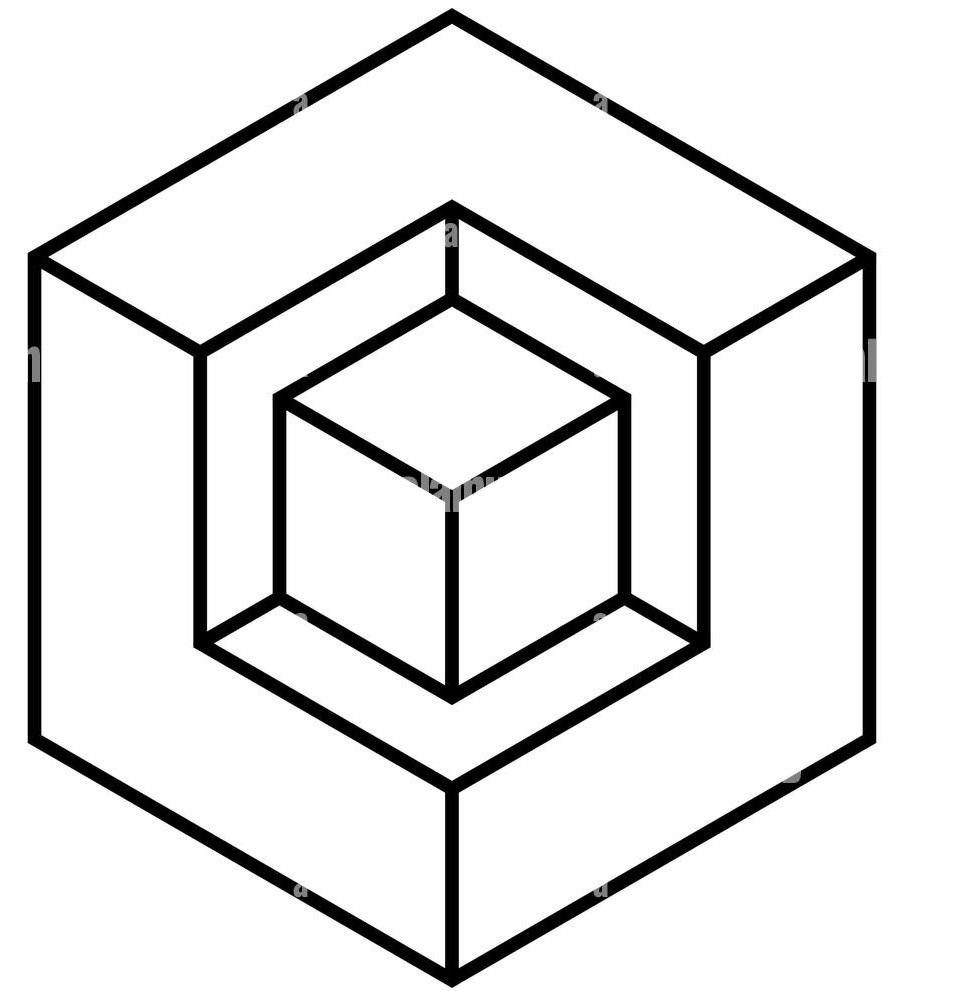
Hexagon and Cube

A regular hexagon is a two dimensional polygon with six equal sides while a cube is a three dimensional polyhedron with twelve edges formed by its six sides meeting at right angles.


Represention of 3-D cube


It's only when we see the three dimensional cube represented in two dimensions that the connection with the hexagon is obvious. Here are some more images highlighting the connection between the two.


A cube or hexagon?
The stripes support a 3-D view

Strong 3-D effect created by the central embedded cube


Strong 3-D effect created by multiple embedded cubes


Three hexagons/cubes from nine trapezia


Cube/hexagon embedded in triangular shape


Strong colours produce a striking hexagon/cube ambivalence

That's all there is to this post that simply shows by means of visual examples how the two dimensional regular hexagon and the three dimensional cube merge into each other when viewed from a certain perspective. It occurred to me, while completing this post, that I should consider more posts such as this linking mathematics to visual art (and to other topics as well).

Tuesday, 18 January 2022

Pyramidal Numbers

Today I turned 26588 days old and one of the properties of this number is that it's a 15-gonal or pentadecagonal number and a member of OEIS A177890:


 A177890

15-gonal (or pentadecagonal) pyramidal numbers:                

a(\(n\)) = \( \dfrac{n (n+1)  (13n-10)}{6}\)


The initial members of the sequence are:
0, 1, 16, 58, 140, 275, 476, 756, 1128, 1605, 2200, 2926, 3796, 4823, 6020, 7400, 8976, 10761, 12768, 15010, 17500, 20251, 23276, 26588, 30200, 34125, 38376, 42966, 47908, 53215, 58900, 64976, 71456, 78353, 85680, 93450, 101676, 110371, 119548, 129220

GENERAL FORMULA

There is a general formula for \(P(n)\), the \(n\)-th polygonal pyramidal number, that uses \(T(n)\), the \(n\)-th triangular number, and \(s\) representing the number of sides of the polygon. Here it is:$$P(n,s)=T(n) \times \frac{(s-2) \times n - (s-5)}{3}$$In the case of 15-gonal numbers, the formula becomes:$$ \begin{align} P(n)&=T(n) \times \frac{13n - 10}{3}\\&=\frac{n(n+1)(13n-10)}{6} \text{ where }T(n)=\frac{n(n+1)}{2}\end{align}$$GENERATING FUNCTION

The generating function for pyramidal numbers is given by:$$G(x,s)=x \, \frac{(s-3)x+1}{(1-x)^4}$$In the case of the pentadecagonal numbers, this results in:$$G(x)=x \, \frac{12x+1}{(1-x)^4}$$PARTICULAR EXAMPLE

Figure 1 shows how a square pyramidal number is constructed:


Figure 1: source

Note that the 3-dimensional pyramidal numbers are constructed from 2-dimensional polygons stacked one on top of the other. In Figure 1, these polygons are squares. The sequence of square pyramidal numbers is given by:$$P_n^{^ {\,4}}=\frac{n(n+1)(2n+1)}{6}$$Figure 2 shows an actual pile of cannonballs forming a square-based pyramid.


Figure 2: source

On the topic of cannonballs, the cannonball problem can be stated as follows:

The cannonball problem asks for the sizes of pyramids of cannonballs that can also be spread out to form a square array, or equivalently, which numbers are both square and square pyramidal. Besides 1, there is only one other number that has this property: 4900, which is both the 70th square number and the 24th square pyramidal number. Source.

SUMS OF RECIPROCALS

The sums of the reciprocals of the pyramidal polygonal numbers all converge. Here are some examples:

  • triangular pyramidal: \( \displaystyle \sum_{n=1}^{\infty} \dfrac{6}{n(n+1)(n+2)}=\dfrac{3}{2} \)
  • square pyramidal: \( \displaystyle \sum_{n=1}^{\infty} \dfrac{6}{n(n+1)(2n+1)}=6(3-4 \log(2)) \)
  • pentagonal pyramidal: \( \displaystyle \sum_{n=1}^{\infty} \dfrac{6}{n^2(n+1)}=\dfrac{\pi^2}{3}-2 \)
More results are listed at this site. There is a rather formidable general formula for the sum of the reciprocals of the pyramidal numbers. I don't claim to understand it but here it is:$$ - \, \frac{6 [ s-5 +(s-2)(\psi ( \frac{3}{s-2} ) +\gamma)]}{(s-5)(2s-7)} $$where \( \psi(x) \) is the digamma function and \( \gamma \) is the  Euler-Mascheroni constant.

Alternating sums of reciprocals are also convergent. An example is the alternating sum of reciprocals of square pyramidal numbers where we have:$$6\sum_{n=1}^{\infty}  \dfrac{(-1)^{n-1}}{n(n+1)(2n+1)}=6(\pi-3)$$

Thursday, 9 May 2019

Golygons

As I track my diurnal age, every day's number always holds some mathematical significance that Numbers Aplenty or the Online Encyclopaedia of Integer Sequences will usually uncover. Every day holds the promise that I'll be introduced to some mathematical concept that I've never encountered before. Today was one such day because I was introduced to the concept of a golygon.

The number that lead me there was 25603, a twin prime with 25601, and one of the OEIS sequences to which it belonged caught my attention:
A292618: the first prime of 8 consecutive primes a, b, c, d, e, f, g, h such that a + g = c + e and b + h = d + f. 
The sequence begins: 359, 389, 839, 853, 937, 1019, 2213, 2221, 2237, 2593, 3019, 3821, 3823, 4111, 4231, 4801, 5407, 5839, 6997, 12241, 13499, 14741, 15473, 25603, ...
At first I was inclined to dismiss this as another of the many highly contrived sequences that litter the OEIS but then an ASCII diagram (see Figure 1) in the comments section caught my attention:

Figure 1

This was interesting. The relationship between the octuplet of primes now had a clear geometrical significance. It was a link in the OEIS entry that lead me to the golygon. So what is a golygon? Wikipedia states that:
A golygon is any polygon with all right angles (a rectilinear polygon) whose sides are consecutive integer lengths. Golygons were invented and named by Lee Sallows, and popularised by A.K. Dewdney in a 1990 Scientific American column (Smith). Variations on the definition of golygons involve allowing edges to cross, using sequences of edge lengths other than the consecutive integers, and considering turn angles other than 90°.
The least possible number of sides that a golygon can have is eight and there is only one of this type (see Figure 2):

Figure 2 (from Wikipedia)
The sequence of numbers shown 1, 2, 3, 4, 5, 6, 7, 8 can be modified to 2, 3, 4, 5, 6, 7, 8, 9 or 3, 4, 5, 6, 7, 8, 9, 10 etc. However, the 8-sided golygon with its sides formed from eight consecutive prime numbers is an instance of the variations alluded to in the definition. The number of sides that a golygon can have must be a multiple of eight and so the next largest golygon will have 16 sides. There are 112 possibilities. Figure 3 shows a 16-sided golygon with sides whose lengths form the first 16 prime numbers:

Figure 3 (from blog)

Figure 4 shows the tessellation of the plane using the unique 8-sided golygon:

Figure 4: from blog

There is a three dimensional analogue of the two dimensional golygon. It's called a golyhedron but I'll save that for a possibly later post. Finally, Figure 5 shows the 8-sided golygon that I created using geoboard (by trial and error because I didn't refer to the original diagram in creating it).

Figure 5: golygon created using geoboard

This would be a good exercise for primary students who could also easily count the number of squares (52) that comprise it and work out its perimeter (36). They could then investigate the area of a square and rectangles with the same perimeter as the golygon. 

Figure 6 shows another variation on the classical 8-sided golygon. This one has sides that are not in sequence but alternate from odd to even. In the classic 8-sided polygon, the horizontal sides have opposite parity to the vertical sides.

Figure 6: from blog

Figure 8 shows a 6-sided "golygon" (although strictly speaking a golygon must have eight sides) in which the sides are formed from the Fibonacci numbers 1, 2, 3, 5, 8, 13:

Figure 8: from blog

Sunday, 7 April 2019

Canonical Polygons

Today I turned 25571 days old and one of the OEIS entries for this number was A052436: canonical polygons of n sides. This prompted the inevitable question: what is a canonical polygon? Well, according to MathWorld:
A canonical polygon is a closed polygon whose vertices lie on a point lattice and whose edges consist of vertical and horizontal steps of unit length or diagonal steps (at angles which are multiples of 45 degrees with respect to the lattice axes) of length \(\sqrt 2\). In addition, no two steps may be taken in the same direction, no edge intersections are allowed, and no point may be a vertex of two edges. 
On this same site, all the possible shapes for polygons with sides from 3 to 8 are shown (see Figure 1):

Figure 1: all possible canonical polygons
with sides ranging from 3 to 8

There are exactly eight distinct convex canonical polygons (see Figure 2). It is not a requirement that the canonical polygons are convex however, and a great many more shapes are possible when concave polygons are included.

Figure 2: the eight possible convex canonical polygons

For polygons with 13 sides, there are 25571 different possible configurations. Geoboard of course is a great way to experiment with the different possible shapes. Figure 4 shows a concave canonical polygon with 13 sides. It has an area of 7.5 square units (the distance between successive vertical and horizontal points on the lattice is one unit). The double area is 15 square units and this way of expressing the area is preferred because it gets rid of any 0.5 decimals. The maximum possible area of a 13-sided canonical polygon is 15.5 square units or a double area of 31 square units. There is only one such shape and that is shown in Figure 3.

Figure 3: the 13-sided canonical polygon with
maximum area of 15.5 square units

Figure 4: 13-sided canonical polygon created
using geoboard. Area is 7.5 square units.
This link to a PDF file is titled:

A052436 Examples
Lars Blomberg
February 18, 2019
Abstract
Examples of Canonical Polygons are given ordered by number of edges
and area.

The file shows examples of canonical polygons from 3 up to 18 sides. Figure 5 shows an extract from this file.

Figure 5: extract from Lars Blomberg's file showing
examples of canonical polygons with sides up to 18