Showing posts with label percentages. Show all posts

Monday, 27 June 2022

Multiplicative Persistence and Multiplicative Digital Root

My diurnal age today (26748) has the property that it has a multiplicative persistence of 6. This qualifies it for membership in OEIS A199996:


 A199996

Composite numbers whose multiplicative persistence is 6.       


The initial members of the sequence are:

6788, 6878, 6887, 7688, 7868, 7886, 8678, 8687, 8768, 8786, 8876, 16788, 16878, 16887, 17688, 17868, 17886, 18678, 18687, 18768, 18786, 18867, 18876, 23788, 23878, 24678, 24687, 24768, 24786, 24867, 24876, 26478, 26487, 26748, 26784, 26847, 26874, 27388 ...

To quote from Wikipedia:
In number theory, the multiplicative digital root of a natural number \(n\) in a given number base \(b\) is found by multiplying the digits of \(n\) together, then repeating this operation until only a single-digit remains, which is called the multiplicative digital root of \(n\). Multiplicative digital roots are the multiplicative equivalent of digital roots.

The number of iterations required to reach the multiplicative digital root is termed the multiplicative persistence. It is conjectured that there is no number with a multiplicative persistence greater than 11. The smallest numbers with multiplicative persistence of 0, 1, 2, 3, 4, 5, 6, 7, 8, 9, 10 and 11 are:

0, 10, 25, 39, 77, 679, 6788, 68889, 2677889, 26888999, 3778888999, 277777788888899

These numbers constitute OEIS A003001 in the OEIS (see permalink for an algorithm that will generate the members of this sequence up to one million). 

Here is permalink to an algorithm that will calculate multiplicative persistence and multiplicative digital roots for a range of numbers (both composite and prime). The algorithm is easily modified to search for a specific multiplicative persistence or multiplicative digital root. Primes can be excluded by simply adding that condition to the relevant section of the code.

ADDENDUM

On October 4th 2022, my diurnal age was 26847, a permutation of the digits of 26748 and thus also having a multiplicative persistence of 6. In between these two diurnal ages, I passed 26784 days, another permutation, and 26874 is still to come. Altogether there are 120 permutations of the digits 2, 4, 6, 7 and 8. 

It's interesting to look at a breakdown of the percentages of numbers with various multiplicative persistences. Up to one million, the breakdown is:

7    0.245%

6    0.449%

5    2.47%

4    6.68%

3    12.4%

2    37.5%

1    40.3%

In this range there are no numbers with a multiplicative persistence of 8. The first such number is 2,677,889. 

Monday, 7 February 2022

Wordle Statistics


In my Pedagogical Posturing blog, I recently posted about Wordle but in post I want to focus on the statistics of the letter frequencies. Of primary interest of course is how frequently the various letters of the alphabet occur within the Wordle "universe". In A Mathematician's Guide to Wordle, it's explained that:

Wordle has both a ‘source’ word list and a ‘target’ word list. You can guess anything from the source word list (which is the 5 letter words from CSW19) ... The target word list is a small hand-curated subset of less than 2500 of these words.

CSW stands for Collins Scrabble Words that consists of 279,496 words. The article just quoted from goes on to say that:

It is well known that when you order letters by frequency of appearance in English words, you get ETAOIN SHRDLU. However ... if you take all 5 letter words in CSW19, you get SEAORY LTNUDY.

Figure 1 shows the full sequence of letters and their relative frequencies. The commentary on this chart includes:

  • In fact, they're essentially tied, S appearing only three more times than E in the 64,860 letters in the word list. That's a 0.0046 percentage point difference.

  • After those two, the distribution doesn't fall off that much. A is 9.2%, O is 6.8%, R is 6.4%.

  • The top 10 most frequent letters in the list make up 67% of the occurrences. That's all five vowels, plus the Wheel of Fortune consonants, R S T L N.

  • For those of you wondering about that "other" vowel, Y is 12th at 3.2%.

  • The least common 5 letters, Q X J Z V, combine for a mere 2.8% of the occurrences, about the same as the letter H, the 16th ranked letter.

  • The most common letter, S, is overwhelmingly more likely to be in fifth position (59%). Otherwise, it's more likely that it appears first (23%) than in any of the middle positions combined.

  • Vowels occur most commonly in the second position. That is unless you're E, which is more common in the fourth spot (35%) than second (24%). Again, "-ed" words are a plausible explanation.

  • For you Y fans: The pseudo-vowel shows up in the last spot 63% of the time when it appears.

  • Of the most common letters, L has the most level distribution, appearing most in the third position (25%) and least in the last position (14%).

  • Words in which letters appear twice make up a little more than 35.8% of the accepted word list.


Figure 1: source

Looking at Figure 1, it would seem that the AROSE would be a good starting point. Figure 2 shows the positions within a word of the most common letters.


Figure 2: source

Figure 2 shows that S occurs most frequently in the final position and so the previous choice of AROSE is perhaps not as good a choice as it first seemed. There are no permutations of this word that have S in the final position. Finally Figure 3 shows the frequency of letters occurring twice in a word compared with their overall frequency.


Figure 3: source

Given that both E are S more likely to occur twice in a word, it would seem that EASES might be good choice of starting word. Some other suggested starting words are:

  • TARES
  • SORES
  • CARES
  • CORES
  • REAIS
  • BLAHS
  • SOLAR
There are a lot of factors to consider but this post is at least a start and will definitely improve my Wordle prowess.

Saturday, 7 August 2021

Key Points in the Year

Thanks to my newly initiated tracking of the number of days that have elapsed in the current year and the number of days remaining, I noticed that today is quite significant. The date today is August 7th 2021, a non-leap year, and Figure 1 displays the numbers.


Figure 1: source

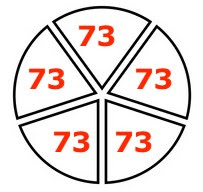
These numbers, along with 365, factor as follows:
  • 365 = 5 x 73
  • 146 = 2 x 73
  • 219 = 3 x 73


This means that today 60% of the year has passed and 40% remains. It can be seen that earlier in the year, on Wednesday May 26th 2021 to be exact, 146 days had elapsed and 219 days remained. Extending this it can be seen that:
  • 073 = 1 x 73 --> March 14th (20% elapsed and 80% remaining)
  • 146 = 2 x 73 --> May 26th (40% elapsed and 60% remaining)
  • 219 = 3 x 73 --> August 7th (60% elapsed and 40% remaining)
  • 292 = 4 x 73 --> October 19th (80% elapsed and 20% remaining)
Things of course are different during a leap year (the next is 2024) because:
  • 366 = 2 x 3 x 61
  • 366 = 2 x 183
  • 366 = 3 x 122
  • 366 = 6 x 61


It is only day 183 that yields a whole percentage (50%) and this occurs on July 1st of every leap year. However, the leap year divides into multiples of 61 and so we have:
  • 061 = 1 x 61 --> March 1st
  • 122 = 2 x 61 --> May 1st
  • 183 = 3 x 61 --> July 1st (50% elapsed and 50% remaining)
  • 244 = 4 x 61 --> August 31st 
  • 305 = 5 x 61 --> October 31st