There are 14 elements represented by a single letter on the periodic table: Hydrogen (H), Boron (B), Carbon (C), Nitrogen (N), Oxygen (O), Fluorine (F), Potassium (K), Yttirium (Y), Iodine (I), Tungsten (W), Uranium (U), Sulfur (S), Phosphorus (P), and Vanadium (V). There atomic numbers representing the number of protons in their nuclei are as follows:
- Hydrogen (H) - 1
- Boron (B) - 5
- Carbon (C) - 6
- Nitrogen (N) - 7
- Oxygen (O) - 8
- Fluorine (F) - 9
- Potassium (K) - 19
- Yttrium (Y) - 39
- Iodine (I) - 53
- Tungsten (W) - 74
- Uranium (U) - 92
- Sulfur (S) - 16
- Phosphorus (P) - 15
- Vanadium (V) - 23
An interesting question is how many English words can be formed from this mixture of vowels and consonants. Let's repeat the letters below and sort them into two categories:
I, O, U, B, C, F, H, K, N, P, S, V, W, Y
Here are some words that ChatGPT found that can be formed using these letters. It's not an exhaustive list.
hub, cub, sin, pin, win, his, if, vow, soy, spy, wok, sky, sun, pun, fun, kin, ink, no, on, up, us, so, is, by, icy, coy, buy, boy, fob, hob, sob, bow, cow, how, low, now, own, won, you, ivy, ups, cup, pus, sup, pin, nip, hip, sip, cop, sop, vow, sow, soy, cosy, coif, sync, piny, fowl, foul, busy, busybody, snow, snowy, cow, cowpox, cup, cupful, cusp, sushi
Each of these words can be assigned a numeric value on the basis of the atomic numbers associated with their letters. For example, hub = 1 + 92 + 5 = 98 and sushi = 19 + 92 + 19 + 1 + 53 = 184. What I've created is a gematria of sorts.
Of course, one does not need to limit oneself just to elements with a single letter. An article has been written titled List of Words Made From Periodic Table Element Symbols. It was posted on June 17, 2014 by Anne Helmenstine and updated on January 9, 2023. Figure 1 shows a screenshot displaying the words PHYSiCs, BaNaNa, FUN and GeNiUS.
 |
Figure 1: |
Using the atomic numbers again. It can be seen that PHYSiCs = 124, BaNaNa = 88 and GeNiUS = 168. The words in the article are listed alphabetically and in camel case. Figure 2 shows a screenshot of the C words.
 |
| Figure 2 |
The article only considers the words that can be made from the chemical elements and does not assign the words any numerical values, based on atomic numbers or anything else. That was my idea which is why I'm posting to this mathematics blog and not my Pedogogical Posturing blog.
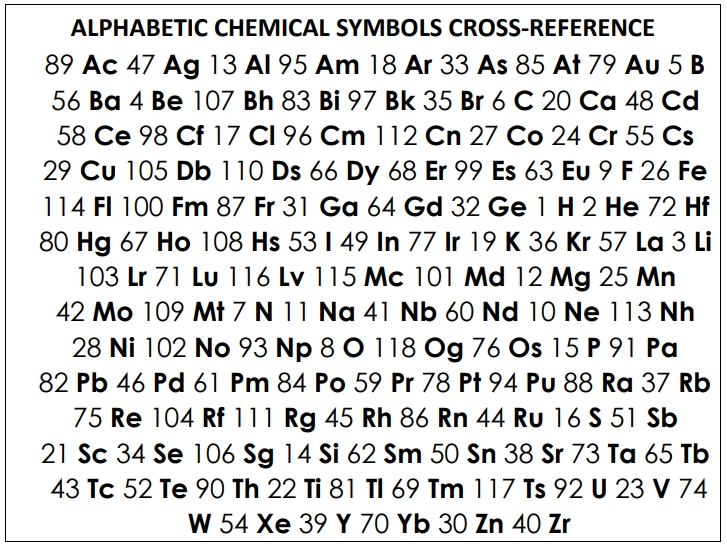
I can't think of any practical use for this gematria at the moment but that's of no consequence. Perhaps something will occur to me later. Like in standard Greek or Hebrew gematria, the atomic number assignments to elements will create links between words that add to the same sum. Figure 3 shows a table of elements and atomic numbers, sorted by element.
 |
Figure 3: source |
Figure 4 shows a periodic style table that shows the elements sorted by atomic number.
 |
Figure 4: source |
Of course there are many words that cannot be formed by combining the letters together e.g. light. We can start with Li (Lithium) but after that no further progress can be made. An interesting SageMath project would be to create a dictionary of elements and their atomic numbers and use this to automatically output the number of any word that was input.
ChatGPT created a list of triplets containing chemical name, chemical symbol and atomic number. Here it is:
[("Hydrogen", "H", 1), ("Helium", "He", 2), ("Lithium", "Li", 3), ("Beryllium", "Be", 4), ("Boron", "B", 5), ("Carbon", "C", 6), ("Nitrogen", "N", 7), ("Oxygen", "O", 8), ("Fluorine", "F", 9), ("Neon", "Ne", 10), ("Sodium", "Na", 11), ("Magnesium", "Mg", 12), ("Aluminum", "Al", 13), ("Silicon", "Si", 14), ("Phosphorus", "P", 15), ("Sulfur", "S", 16), ("Chlorine", "Cl", 17), ("Argon", "Ar", 18), ("Potassium", "K", 19), ("Calcium", "Ca", 20), ("Scandium", "Sc", 21), ("Titanium", "Ti", 22), ("Vanadium", "V", 23), ("Chromium", "Cr", 24), ("Manganese", "Mn", 25), ("Iron", "Fe", 26), ("Cobalt", "Co", 27), ("Nickel", "Ni", 28), ("Copper", "Cu", 29), ("Zinc", "Zn", 30), ("Gallium", "Ga", 31), ("Germanium", "Ge", 32), ("Arsenic", "As", 33), ("Selenium", "Se", 34), ("Bromine", "Br", 35), ("Krypton", "Kr", 36), ("Rubidium", "Rb", 37), ("Strontium", "Sr", 38), ("Yttrium", "Y", 39), ("Zirconium", "Zr", 40), ("Niobium", "Nb", 41), ("Molybdenum", "Mo", 42), ("Technetium", "Tc", 43), ("Ruthenium", "Ru", 44), ("Rhodium", "Rh", 45), ("Palladium", "Pd", 46), ("Silver", "Ag", 47), ("Cadmium", "Cd", 48), ("Indium", "In", 49), ("Tin", "Sn", 50), ("Antimony", "Sb", 51), ("Tellurium", "Te", 52), ("Iodine", "I", 53), ("Xenon", "Xe", 54), ("Cesium", "Cs", 55), ("Barium", "Ba", 56), ("Lanthanum", "La", 57), ("Cerium", "Ce", 58), ("Praseodymium", "Pr", 59), ("Neodymium", "Nd", 60), ("Promethium", "Pm", 61), ("Samarium", "Sm", 62), ("Europium", "Eu", 63), ("Gadolinium", "Gd", 64), ("Terbium", "Tb", 65), ("Dysprosium", "Dy", 66), ("Holmium", "Ho", 67), ("Erbium", "Er", 68), ("Thulium", "Tm", 69), ("Ytterbium", "Yb", 70), ("Lutetium", "Lu", 71), ("Hafnium", "Hf", 72), ("Tantalum", "Ta", 73), ("Tungsten", "W", 74), ("Rhenium", "Re", 75), ("Osmium", "Os", 76), ("Iridium", "Ir", 77), ("Platinum", "Pt", 78), ("Gold", "Au", 79), ("Mercury", "Hg", 80), ("Thallium", "Tl", 81), ("Lead", "Pb", 82), ("Bismuth", "Bi", 83), ("Polonium", "Po", 84), ("Astatine", "At", 85), ("Radon", "Rn", 86), ("Francium", "Fr", 87), ("Radium", "Ra", 88), ("Actinium", "Ac", 89), ("Thorium", "Th", 90), ("Protactinium", "Pa", 91), ("Uranium", "U", 92), ("Neptunium", "Np", 93), ("Plutonium", "Pu", 94), ("Americium", "Am", 95), ("Curium", "Cm", 96), ("Berkelium", "Bk", 97), ("Californium", "Cf", 98), ("Einsteinium", "Es", 99), ("Fermium", "Fm", 100), ("Mendelevium", "Md", 101), ("Nobelium", "No", 102), ("Lawrencium", "Lr", 103), ("Rutherfordium", "Rf", 104), ("Dubnium", "Db", 105), ("Seaborgium", "Sg", 106), ("Bohrium", "Bh", 107), ("Hassium", "Hs", 108), ("Meitnerium", "Mt", 109), ("Darmstadtium", "Ds", 110), ("Roentgenium", "Rg", 111), ("Copernicium", "Cn", 112), ("Nihonium", "Nh", 113), ("Flerovium", "Fl", 114), ("Moscovium", "Mc", 115), ("Livermorium", "Lv", 116), ("Tennessine", "Ts", 117), ("Oganesson", "Og", 118)]
This is suitable for pasting into SageMath and doing further analysis. Here is a permalink to an algorithm that will input chemical symbols that make a word (in camelcase) and output the word in uppercase together with its atomic number value. I've used "B", "O", "Th" and "Er" as input and gotten "BOTHER has an atomic number of 171" as output.