Showing posts with label Georg Cantor. Show all posts

Saturday, 5 February 2022

Apocalyptic Numbers


X-Men: Apocalypse (2016)

Numbers Aplenty has to say about apocalyptic numbers:

A number of the form \(2^n\) is called apocalyptic if its digits contain "666" as a substring. The smallest apocalyptic number is \(2^{157}\), which is equal to:$$182687704\underline{666}362864775460604089535377456991567872$$while \(2^{220}\) is the smallest apocalyptic number which contains two 666 groups, being equal to:$$ {\tiny 168499\underline{66666}969149871\underline{666}88442938726917102321526408785780068975640576} $$The smallest power of 2 with 3 groups is \(2^{931}\).

A number \(n\) such that \(2^n\) is apocalyptic is called an apocalyptic power or apocalyptic exponent.

Between \(1\) and \(3 \times 10^6\) there are 3715 numbers which are non-apocalyptic exponents, the largest being 29784. In other words, it is highly probable that \(2^n\) for \(n \ge 29785\) is an apocalyptic number.

Probably there are only 8 numbers, namely 2666, 3666, 5666, 6660, 6665, 6669, 11666, 26667 which contains 666 among their digits but are not apocalyptic exponents.

The first apocalyptic exponents are 157, 192, 218, 220, 222, 224, 226, 243, 245, 247, 251, 278, 285, 286, 287, 312, 355, 361, 366, 382, 384, 390, 394, 411, 434, 443, 478, 497, 499, 506, ...

Here is a link to the first 1000 apocalyptic exponents. As the numbers get larger, the frequency of numbers being non-apocalyptic exponents decreases so that, after 29874, the frequency is (probably) zero. For example, in the range from 20000 to 30000, there are only the following non-apocalyptic exponents:

20271, 20300, 20509, 20644, 20710, 21077, 21600, 21602, 22447, 22734, 23097, 23253, 24422, 24441, 25026, 25357, 25896, 26051, 26667, 29784

Why this interest in apocalyptic numbers? Well, in my diurnal age count, I've entered what might be termed an "apocalyptic phase". I'm currently 26606 days old and heading toward 26666 (the latter occurs a day before my 73rd birthday). Interestingly, as can be seen in the range of numbers above, 26667 is the second last non-apocalyptic exponent.

Numbers Aplenty also shows the smallest 3 × 3 magic square made of consecutive apocalyptic numbers. See Figure 1.
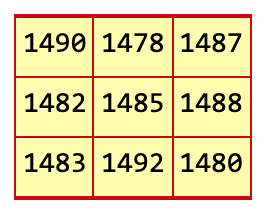
Figure 1

The apocalyptic powers comprise OEIS A007356:


 A007356

Apocalyptic powers: \(2^n\) contains \(666\).                           
                                

Finally, let's not forget that:
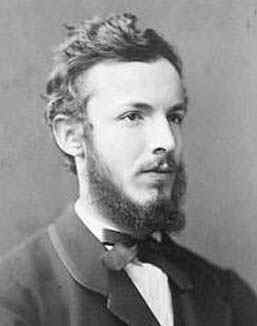
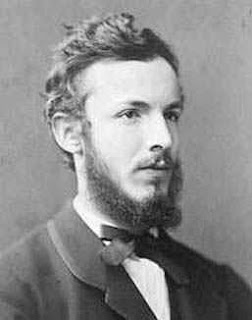
Georg Cantor was born on the 3rd March 1845 in St Petersburg, Russia, and died on the 6th January 1918 in Halle, Germany. At the time of this death, he was 72 years 10 months and 3 days old or 72.85 years of age which is equivalent to 26606 days.
Georg Cantor

This is the exact age that I am today.  

Sunday, 2 January 2022

The Cantor Ternary Set

Today I turned 26572 days old and discovered that \(\dfrac{1}{26572}\) is in the Cantor set.


Figure 1: Georg Cantor source

Now Georg Cantor is one of my favourite mathematicians. Figure 1 shows a photograph of him as a young man. He was born on the 3rd March 1845 in St Petersburg, Russia, and died on the 6th January 1918 in Halle, Germany. At the time of this death, he was 72 years 10 months and 3 days old or 72.85 years of age which is equivalent to 26606 days. Thus he was 34 days older than I am now when he died. A short biography of his life can be found here.

So what is a Cantor set? Well, Wikipedia provides as good an explanation as any and I quote:

The Cantor ternary set \( \mathcal{C} \) is created by iteratively deleting the open middle third from a set of line segments. One starts by deleting the open middle third \( \left ( \frac{1}{3}, \frac{2}{3} \right ) \) from the interval \( \left [ 0,1 \right ] \), leaving two line segments: $$ \left [0,\frac{1}{3} \right ] \cup \left [ \frac{2}{3},1 \right ] $$Next, the open middle third of each of the remaining segments is deleted, leaving four line segments:$$ \left [0,\frac{1}{9} \right ] \cup \left [\frac{2}{9},\frac{1}{3} \right ] \cup \left [\frac{2}{3},\frac{7}{9} \right ] \cup \left [ \frac{8}{9},1 \right ]$$The Cantor ternary set contains all points in the interval \( \left [ 0,1 \right ] \) that are not deleted at any step in this infinite process. 

Figure 2 shows the situation diagrammatically:


Figure 2: source

Importantly, the article notes that:

In arithmetical terms, the Cantor set consists of all real numbers of the unit interval \( \left [ 0,1 \right ] \) that do not require the digit 1 in order to be expressed as a ternary (base 3) fraction ... It may appear that only the endpoints of the construction segments are left, but that is not the case either. The number \( \frac{1}{4} \) for example, has the unique ternary form:$$0.020202 \dots_{\scriptsize{3}} = 0.\overline{02}_{\scriptsize{3}}$$
So too does our "fraction of the day": $$\frac{1}{26572}=0.\overline{000000000202}_{\scriptsize{3}}$$Our "fraction of the day" made its appearance in OEIS A173793:


 A173793

Primitive numbers \(n\) such that \( \dfrac{1}{n} \) is in the Cantor set.         

The initial members of the sequence are:

1, 4, 10, 13, 28, 40, 82, 91, 121, 244, 328, 364, 730, 757, 820, 949, 1036, 1093, 2188, 2362, 2812, 2920, 3280, 6562, 6643, 7381, 9490, 9841, 19684, 20440, 26248, 26572, 28009, 29524, 59050, 59293, 63973, 65620, 66124, 66430, 84253, 88573, 177148

The fact that "1" cannot appear in the ternary expression of a number if it is to be in the Cantor set, makes it easy to write a program that generates this sequence. However, it is important to bear in mind the OEIS comments:

Sequence A121153 gives the \(n\) such that \(1/n\) is in the Cantor set. Most of those \(n\) are 3 times a smaller number in that sequence. This sequence (A173793) has only those terms in A121153 that are not 3 times a smaller number in the sequence.

Here is a permalink to the SageMathCell algorithm that will generate the sequence. 

In conclusion, it should be noted that the Cantor set is not countable and the Wikipedia article supplies a proof of this. The next two such primitive numbers after 26572 are 28009 and 29524 with reciprocals and ternary values as follows:$$ \begin{align} \frac{1}{28009}&=0.\overline{000000000200222022}_{\scriptsize{3}}\\ \frac{1}{29524}&=0.\overline{0000000002}_{\scriptsize{3}} \end{align} $$After that there is a big gap to 59050 with reciprocal and ternary value of:$$ \frac{1}{59050} =0.\overline{00000000002222222222}_{\scriptsize{3}}$$