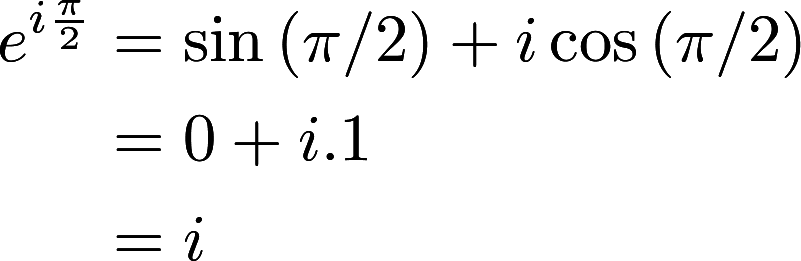
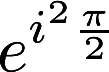
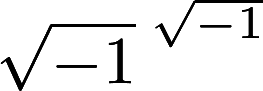
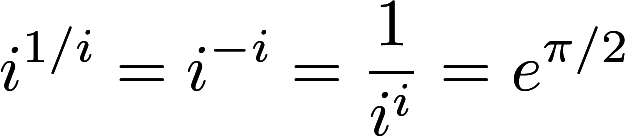
There was an interesting tweet by Cliff Pickover today that is shown below as Figure 1.
 |
Figure 1 |
The URL shown in the tweet leads to the Wikipedia article about it. First and formost however, who was Gelfond? As usual the MacTutor site at St.Andrews provides a brief biography.
*****************************
 |
Born: 24th October 1906 in St Petersburg, Russia
Died: 7th November 1968 in Moscow, Russia. |
Summary
Gelfond developed basic techniques in the study of transcendental numbers.
Biography
Aleksandr Osipovich Gelfond's father was Osip Isaacovich Gelfond who was a physician who also had an interest in philosophy. Gelfond entered Faculty of Physics and Mathematics at Moscow State University in 1924 and completed his undergraduate studies in 1927. He then began research under the supervision of Aleksandr Khinchin and Vyacheslaw Stepanov and completed his postgraduate studies in 1930.
During 1929-30 he taught mathematics at Moscow Technological College but already he had published some important papers: The arithmetic properties of entire functions (1929); Transcendental numbers (1929); and An outline of the history and the present state of the theory of transcendental numbers (1930). The second of these 1929 papers contained the lecture which Gelfond gave to the First All-Union Mathematics Congress held in Kharkov in 1930. These papers by Gelfond represent a major step forward in the study of transcendental numbers. The first of the papers examines the growth of an entire function which assumes integer values for integer arguments. In the second of the 1929 papers Gelfond applied this result to prove that certain numbers are transcendental, so solving a special case of Hilbert's Seventh Problem. We explain some of these ideas below.
In an article he wrote, Gelfond describes the four month visit which he made in 1930 to Germany where he spent time at both Berlin and Göttingen. He was particularly influenced by Hilbert, Siegel and Landau during his visit. After his return to Russia, Gelfond taught mathematics from 1931 at Moscow State University where he held chairs of analysis, theory of numbers and the history of mathematics. From 1933 he also worked in the Mathematical Institute of the Russian Academy of Sciences.
Gelfond developed basic techniques in the study of transcendental numbers, that is numbers that are not the solution of an algebraic equation with rational coefficients. In addition to his important work in the number theory of transcendental numbers, Gelfond made significant contributions to the theory of interpolation and the approximation of functions of a complex variable. He also contributed to the study of differential and integral equations and to the history of mathematics.
In 1934 he proved a special case of his conjecture namely that \(a^x\) is transcendental if \(a\) is algebraic (\(a \neq 0,1 \)) and \(x\) is an irrational, algebraic number. This result is now known as Gelfond's theorem and solved Problem 7 of the list of Hilbert problems. It was solved independently by Schneider. In 1966 Alan Baker proved Gelfond's Conjecture in general. Gelfond's papers in 1933 and 1934, which include his remarkable achievement, are:
- Gram determinants for stationary series (written jointly with Khinchin) (1933)
- A necessary and sufficient criterion for the transcendence of a number (1933)
- Functions that take integer values at the points of a geometric progression (1933)
- On the seventh problem of D Hilbert (1934)
Gelfond addressed the Second All-Union Mathematics Congress in Leningrad in 1934) on Transcendental numbers.
*****************************
The decimal expansion of Gelfond's Constant is:$$e^{\pi} = 23.14069263277926900572 \dots$$The Wikipedia article states that \(e^{\pi} \) also appears in the volumes of hyperspheres. The volume of an \(n\)-sphere with radius \(R\) is given by:$$V_n(R) = \frac{\pi^{n/2} R^n}{\Gamma (n/2+1)}$$where \(R\) is the gamma function. If we take \(R=1\) we get:$$V_n(1) = \frac{\pi^{n/2} }{\Gamma (n/2+1)}$$Any even dimensional \(2n\)-sphere now gives:$$V_{2n}(1) = \frac{\pi^{n} }{\Gamma (n+1)}$$Summing up all even-dimensional unit sphere volumes and utilizing the series expansion of the exponential function gives:$$ V_{2n}(1) = \sum_{0}^{\infty} \frac{\pi^{n}}{n!}=e^{\pi}$$The Wikipedia article also looks at some related functions and the first of them is Ramanujan's Constant:$$ \begin{align} e^{\pi \sqrt{163}} &= 262537412640768743.99999999999925007259 \dots \\ &\approx 640320^3 + 744 \text{ to within one trillionth}\end{align}$$The article goes on to say that:
This is an application of Heegner numbers, where 163 is the Heegner number in question. This number was discovered in 1859 by the mathematician Charles Hermite. In a 1975 April Fool article in Scientific American magazine, "Mathematical Games" columnist Martin Gardner made the hoax claim that the number was in fact an integer, and that the Indian mathematical genius Srinivasa Ramanujan had predicted it—hence its name. Ramanujan's constant is also a transcendental number.
There is also the transcendental constant \(e^{\pi}-\pi \) which approximates to:$$e^{\pi}-\pi =19.99909997918947576726 \dots$$The constant \(i^i\) can be evaluated as follows:$$ \begin{align} i^i &= (e^{i\pi /2})^i\\ &= e^{-\pi/2} \\&=(e^{\pi})^{-1/2}\\ &= 0.20787957635076190854 \dots \end{align}$$As for \( \pi^e \), it is not known whether it is transcendental or not.
Following the link above for Charles Hermite yields the following biography. I've included it in full because I believe it's important to promote awareness of the lives of famous mathematicians to whom we owe so much.
*****************************
 |
Born: 24 December 1822 in Dieuze, Lorraine, France
Died: 14 January 1901 in Paris, France |
Summary
Charles Hermite's work in the theory of functions includes the application of elliptic functions to the quintic equation. He published the first proof that e is a transcendental number.
Biography
Charles Hermite's father was Ferdinand Hermite and his mother was Madeleine Lallemand. Ferdinand Hermite was a trained engineer and he worked in this capacity in a salt mine near Dieuse. After he married Madeleine he joined in the draper's trade in which her family were involved. However he was an artistic man who always wanted to pursue art as a career. He had his wife look after the draper's business and he took up art. Charles was the sixth of his parents seven children and when he was about seven years old his parents left Dieuse and went to live in Nancy to where the business had moved.
Education was not a high priority for Charles's parents but despite not taking too much personal interest in their children's education, nevertheless they did provide them with good schooling. Charles was something of a worry to his parents for he had a defect in his right foot which meant that he moved around only with difficulty. It was clear that this would present him with problems in finding a career. However he had a happy disposition and bore his disability with a cheerful smile.
Charles attended the Collège de Nancy, then went to Paris where he attended the Collège Henri. In 1840-41 he studied at the Collège Louis-le-Grand where some fifteen years earlier Galois had studied. In fact he was taught mathematics there by Louis Richard who had taught Galois. In some ways Hermite was similar to Galois for he preferred to read papers by Euler, Gauss and Lagrange rather than work for his formal examinations.
If Hermite neglected the studies that he should have concentrated on, he was showing remarkable research ability publishing two papers while at Louis-le-Grand. Also like Galois he was attracted by the problem of solving algebraic equations and one of the two papers attempted to show that the quintic cannot be solved in radicals. That he was unfamiliar with Galois's contributions, despite being at the same school, is not at all surprising since the mathematical community were completely unaware of them at this time. However he might reasonably have known of the contributions of Ruffini and Abel to this question, but apparently he did not.
Again like Galois, Hermite wanted to study at the École Polytechnique and he took a year preparing for the examinations. He was tutored by Catalan in 1841-42 and certainly Hermite fared better than Galois had done for he passed. However it was not a glorious pass for he only attained sixty-eighth place in the ordered list. After one year at the École Polytechnique Hermite was refused the right to continue his studies because of his disability. Clearly this was an unfair decision and some important people were prepared to take up his case and fight for him to have the right to continue as a student at the École Polytechnique. The decision was reversed so that he could continue his studies but strict conditions were imposed. Hermite did not find these conditions acceptable and decided that he would not graduate from the École Polytechnique.
Hermite made friends with important mathematicians at this time and frequently visited Joseph Bertrand. On a personal note this was highly significant for he would marry Joseph Bertrand's sister. More significantly from a mathematical point of view he began corresponding with Jacobi and, despite not shining in his formal education, he was already producing research which was ranking as a leading world-class mathematician. The letters he exchanged with Jacobi show that Hermite had discovered some differential equations satisfied by theta-functions and he was using Fourier series to study them. He had found general solutions to the equations in terms of theta-functions. Hermite may have still been an undergraduate but it is likely that his ideas from around 1843 helped Liouville to his important 1844 results which include the result now known as Liouville's theorem.
After spending five years working towards his degree he took and passed the examinations for the baccalauréat and licence which he was awarded in 1847. In the following year he was appointed to the École Polytechnique, the institution which had tried to prevent him continuing his studies some four years earlier; he was appointed répétiteur and admissions examiner.
Hermite made important contributions to number theory and algebra, orthogonal polynomials, and elliptic functions. He discovered his most significant mathematical results over the ten years following his appointment to the École Polytechnique. In 1848 he proved that doubly periodic functions can be represented as quotients of periodic entire functions. In 1849 Hermite submitted a memoir to the Académie des Sciences which applied Cauchy's residue techniques to doubly periodic functions. Sturm and Cauchy gave a good report on this memoir in 1851 but a priority dispute with Liouville seems to have prevented its publication.
Another topic on which Hermite worked and made important contributions was the theory of quadratic forms. This led him to study invariant theory and he found a reciprocity law relating to binary forms. With his understanding of quadratic forms and invariant theory he created a theory of transformations in 1855. His results on this topic provided connections between number theory, theta functions, and the transformations of abelian functions.
On 14 July 1856 Hermite was elected to the Académie des Sciences. However, despite this achievement, 1856 was a bad year for Hermite for he contracted smallpox. It was Cauchy who, with his strong religious conviction, helped Hermite through the crisis. This had a profound effect on Hermite who, under Cauchy's influence, turned to the Roman Catholic religion. Cauchy was also a very staunch royalist and Hermite was influenced by him to also become a royalist. We made comparisons with Galois earlier on in this article, but with royalist views, Hermite was now completely opposed to the views which the staunch republican Galois had held.
The next mathematical result by Hermite which we must mention is one for which he is rightly famous. Although an algebraic equation of the fifth degree cannot be solved in radicals, a result which was proved by Ruffini and Abel, Hermite showed in 1858 that an algebraic equation of the fifth degree could be solved using elliptic functions. He applied these results to number theory, in particular to class number relations of quadratic forms.
In 1862 Hermite was appointed maître de conférence at the École Polytechnique, a position which had been specially created for him. In the following year he became an examiner there. The year 1869 saw him become a professor when he succeeded Duhamel as professor of analysis both at the École Polytechnique and at the Sorbonne. Hermite resigned his chair at the École Polytechnique in 1876 but continued to hold the chair at the Sorbonne until he retired in 1897. In the 1890s Hermite became much less interested in the new results found by the mathematicians of the next generation.
The 1870s saw Hermite return to problems which had interested him earlier in his career such as problems concerning approximation and interpolation. In 1873 Hermite published the first proof that e is a transcendental number. This is another result for which he is rightly famous. Using method's similar to those of Hermite, Lindemann established in 1882 that π was also transcendental. Many historians of science regret that Hermite, despite doing most of the hard work, failed to use it to prove the result on which would have brought him fame outside the world of mathematics. Hermite is now best known for a number of mathematical entities that bear his name: Hermite polynomials, Hermite's differential equation, Hermite's formula of interpolation and Hermitian matrices.
For Hermite certain areas of mathematics were much more interesting than other areas. Hadamard, who unlike his teacher Hermite worked in all areas of mathematics, spoke of Hermite's dislike for geometry:
[Hermite] had a kind of positive hatred of geometry and once curiously reproached me with having made a geometrical memoir.
Hermite's great love was for analysis and, not surprisingly, he had a great respect for Weierstrass. When Mittag-Leffler arrived in Paris to study with him, Hermite greeted him warmly but said:
You have made a mistake, sir, you should follow Weierstrass's course in Berlin. He is the master of us all.
Poincaré is almost certainly the best known of Hermite's students. He once suggested that Hermite's mind did not proceed in logical fashion. He wrote:
But to call Hermite a logician! Nothing can appear to me more contrary to the truth. Methods always seemed to be born in his mind in some mysterious way.
Hadamard like Poincaré was very interested in the way that mathematics was discovered. He also had this to say about the way that Hermite made his discoveries:
Hermite used to observe [that biology] may be a most useful study even for mathematicians, as hidden and eventually fruitful analogies may appear between processes in both kinds of studies.
Hadamard had great respect for Hermite as a teacher. He said:
I do not think that those who never listened to him can realise how magnificent Hermite's teaching was, overflowing with enthusiasm for science, which seemed to come to life in his voice and whose beauty he never failed to communicate to us, since he felt it so much himself to the very depth of his being.
[Hermite] was making a deep impression on us, not only with his methods and those of Weierstrass, but also with his enthusiasm and love of science; in our brief but fruitful conversations, Hermite loved to direct to me remarks such as: "He who strays from the paths traced by providence crashes." These were the words of a profoundly religious man, but an atheist like me understood them very well, especially when he added at other times: "In mathematics, our role is more of servant than of master." It goes without saying that gradually, as years and my scientific work unfolded, I came to understand more and more deeply the aptness and scope of his words.
Cross, reviewing where 125 letters from Hermite to Mittag-Leffler are reproduced, writes:
So there stands revealed one of the most engaging and influential men in Parisian and French mathematics in the second half of the 19th century, one might even say the central character for the period in which he published, 1842-1901. What radiates from the text is [Hermite's] humility, his Catholicism, his concern for his (very extended) family, his willingness to fight for colleagues whose merit he discerns, and his devotion to family, merit, and principle rather than simple influence.
In terms of his family life Hermite had married Louise Bertrand, Joseph Bertrand's sister. One of their two daughters married Émile Picard. Struik writes:
Hermite lived a retired life, with his family. His working hours were devoted to mathematical research and teaching. His outlook on mathematics was realistic in the Platonic sense: a mathematician, like a naturalist, discovers an outside world, in his case a world of ideas. Hermite, therefore, disliked Cantor's world, in which a new mathematical world was created.
*****************************