Showing posts with label complex numbers. Show all posts

Monday, 26 January 2026

Cyclotomic Polynomials Revisited

It was in November of 2020 that I made my first and only post about cyclotomic polynomials. Here is a link to that post. Today I was reminded of this category of polynomials because the number associated with my diurnal age today, 28057, is connected with the third cyclotomic polynomial, namely \(x^2 + x + 1\) because the number is a member of OEIS A053183:


  OEIS A053183: primes of the form \(p^2 + p + 1\) when \(p\) is prime.

In the case of 28057, the value of \(p\) is 167 and thus:$$28057 = 167^2 + 167 + 1$$What follows is what Gemini had to say about this particular polynomial.

The Complex Roots of $x^2 + x + 1 = 0$

The roots of the polynomial $x^2 + x + 1$ are the two primitive cube roots of unity. In mathematical literature, these are commonly denoted by the Greek letters ω (omega) and ω2.

1. Numerical Values

Using the quadratic formula, we find the exact complex coordinates:

  • x1: $-\dfrac{1}{2} + \dfrac{\sqrt{3}}{2}i$ (approx. $-0.5 + 0.866i$)

  • x2: $-\dfrac{1}{2} - \dfrac{\sqrt{3}}{2}i$ (approx. $-0.5 - 0.866i$)

2. Geometric Representation

When plotted on the Argand plane (complex plane), these roots exhibit specific geometric properties:

  • The Unit Circle: Both roots have a magnitude of 1, meaning they sit exactly on the circumference of a circle with radius 1 centered at the origin.

  • Conjugate Symmetry: The roots are reflections of each other across the real (horizontal) axis.

  • The Equilateral Triangle: These two roots, combined with the third cube root ($x = 1$), form the vertices of a perfect equilateral triangle.

For further exploration of complex numbers and their visualization, you can use tools like the GeoGebra Complex Number Tool or check detailed proofs on Wolfram MathWorld.

All numbers generated by \(x^2+x+1\) for positive integer values of \(x\) are one more than the pronic numbers because the polynomial can be written as \(x(x+1) + 1 \).

Wednesday, 29 May 2024

Solving a Well-Known Integral Without Trigometric Substitution

This approach to the integration of a well-known integral is explained in William Keen's article in Cantor's Paradise. I'm just following the steps that the article outlined and getting an opportunity to reinforce my LaTeX skills. Let's start with the integral:$$\int \! \frac{1}{1+x^2} \, dx$$Firstly, we factorise it, making use of complex numbers. This gives:$$\int \! \frac{1}{(x+i)\, (x-i) }\, dx$$Next we create partial fractions:$$ \int \! \Big ( \frac{\frac{1}{2} i}{x-i} - \frac{\frac{1}{2} i}{x+i} \Big ) \, dx$$We can now split the integral into two parts and take out the common factor:$$ \tfrac{1}{2} i \int \! \frac{1}{x-i} \, dx - \tfrac{1}{2} i \int \! \frac{1}{x+i} \, dx$$This is an easy integration, that gives the following:$$ \tfrac{1}{2} i \, (\ln(x-i)-\ln(x+i))$$This simplifies to:$$ \tfrac{1}{2} i \, \ln \Big ( \dfrac{x-i}{x+i} \Big ) \text{ . . .  key expression}$$Figure 1 shows a diagram from the article that illustrates how the complex numbers \(x+i \) can be changed into polar coordinates and, by extension, \(x-i \).


Figure 1

Converting our complex numbers to polar coordinates, we find that:$$ \begin{align} x+i &= \sqrt{x^2+1} \, e^{\, i \, \arctan(1/x)} \\x+i &= \sqrt{x^2+1} \, e^{\, -i \,\arctan(1/x)} \end{align}$$Substituting these expressions back into the earlier marked key expression gives:$$ \begin{align}  \tfrac{1}{2} \, i \, \ln \Big ( e^{ \,2i  \arctan(1/x) } \Big ) &= -\arctan \Big ( \dfrac{1}{x} \Big ) \\ &= \arctan(x) \pm \dfrac{\pi}{2} \end{align} $$So finally we have:$$ \begin{align} \int \! \frac{1}{1+x^2} \, dx &= \arctan(x) \pm \dfrac{\pi}{2} + C' \\ &= \arctan(x) + C \end{align}$$

Sunday, 4 December 2022

Natural Numbers associated with the Eisenstein Integers

 My number associated with my diurnal age today, 26908, is a member of OEIS A118886:


 A118886

Numbers expressible as \(x^2 + x \cdot y + y^2, 0 \leq x \leq y \), in two or more ways. 


In the case of 26908, there are three ways viz. 
  • \(x=4 \) and \(y=162\) so that \(4^2+4 \cdot 162+162^2=26908\)
  • \(x=62\) and \(y=124\) so that \(62^2+62 \cdot 124+124^2=26908\)
  • \(x=74\) and \(y=114\) so that \(74^2+74 \cdot 114+114^2=26908\)
As stated in the OEIS comments, the numbers in this sequence represent squares of distances between two points in the triangular lattice in two or more non-trivially different ways. The triangular lattice being referred here is that formed by the so-called Eisenstein integers. Such integers are complex numbers of the form:$$z=a+ b \omega\\ \text{ where } a \text{ and } b \text{ are integers and }\\ \omega=\frac{-1+i \sqrt{3}}{2}=e^{2\pi i/3}$$Thus we have:$$a^2+ab+b^2=(a-\omega)(b-\omega^2) \text{ because }1+\omega+\omega^2=0$$Numbers of the form \(a^2-ab+b^2 \) represent the squared modulus of an Eisenstein integer:

\(|a+b\omega|^2=(a-\frac{1}{2}b)^2+\frac{3}{4}b^2=a^2-ab+b^2\)


Figure 1: from Wikipedia

Thus both numbers of the form \(a^2+ab+b^2 \) and \(a^2-ab+b^2 \) are associated with Eisenstein integers. Looking at the latter type of number we can write:$$ \begin{align} a^2+ab+b^2 &= a^2-2ab+b^2+3ab\\&=(a-b)^2+(\sqrt{3ab})^2\\&=(a-b-i\sqrt{3ab})(a-b+\sqrt{3ab}) \\&=(a-b-i\sqrt{3} \sqrt{ab})(a-b+i\sqrt{3} \sqrt{ab}) \\ &=(a-b-(2\omega+1)\sqrt{ab})(a-b+(2\omega+1)\sqrt{ab}) \\&=(a-b-\sqrt{ab}-2\sqrt{ab} \cdot \omega)(a-b+\sqrt{ab}+2\sqrt{ab} \cdot \omega) \\&=(c_1-d\omega)(c_2+d\omega)\end{align}$$which represents the product of two Eisenstein integers which could be evaluated for 26908 since we know three different sets of values for \(a\) and \(b\). For example, for the case of 
\(a=4 \) and \(b=162\), we have \( \sqrt{ab}=18\sqrt{2}\). There's a lot more that could be said here of course but the important takeaway is the association with the Eisenstein integers.

Getting back to the original OEIS A118886, we find that there are numbers that are of the form \(x^2+xy+y^2\) in eight or more ways. Such numbers include 53599, 63973, 74347, 84721 and 105469. Let's take the last number as an example. The \(x,y\) values associated with this number are (15, 317), (33, 307), (53, 295), (100, 263), (108, 257), (145, 227), (153, 220) and (187, 188).

Using a Jupyter notebook, I was able to find these numbers, in the range up to a little beyond one million, that can be represented in nine or more ways:

157339, 229957, 256711, 306397, 356083, 375193, 427063, 447811, 472017, 505141, 520429, 548359, 554827, 593047, 604513, 612157, 629356, 654199, 654493, 689871, 696787, 730639, 738283, 760627, 770133, 803257, 810901, 831649, 849121, 852943, 872053, 883519, 894691, 902629, 919191, 919828, 956137, 966511, 967603, 1013467, 1018381, 1026844, 1067857, 1101373, 1125579, 1173991, 1204567

Here is a permalink to the code being used but it will time out if run in SageMathCell. Further investigation yielded the numbers shown below that can be represented in ten or more ways. However, now that the list was considerably shorter, it was possible to test each of these numbers to see how many representations are possible and these numbers are shown in brackets after each number. As can be seen, the maximum is twelve in the range up to a little over one million.

375193 (12), 447811 (12), 520429 (12), 593047 (10), 696787 (12), 730639 (12), 738283 (12), 810901 (12), 831649 (12), 849121 (12), 883519 (12), 956137 (12), 966511 (12), 967603 (10), 1013467 (12), 1018381 (12), 1067857 (12), 1101373 (12), 1125579 (12)

SageMathCell makes it easy to determine the number of possible pairs for each number. It's just necessary to tset up the equation. Let's use 1125579 as an example:$$x^2 + x \cdot y + y^2 =1125579$$Here is a permalink to the code that solves this Diophantine equation and the output is:


Figure 2 shows the graph of this elliptic function and there are exactly twenty four points on this graph with coordinates that are integers. Why 24 when we have only 12 above? Well, a restriction had been applied such that \(x \leq y\) but no such restriction need apply for this ellipse. The case of A = (422, 785) and B = (785, 422) is shown below.


Figure 2: using GeoGebra

Monday, 2 November 2020

Cyclotomic Polynomials

Recently I turned 26142 days and this number has the property that it is a member of OEIS A138938:


A138938

Indices k such that A019326(k)=\( \Phi_8\) is prime, where \( \Phi \) is a cyclotomic polynomial.

I've heard many times about cyclotomic polynomials over the past five years without really understanding their significance. This occasion provided an opportunity to investigate the topic further. I discovered that SageMath (which I use for most of my calculations) has a function to generate the cyclotomic polynomials. The following simple command will generate the first twenty cyclotomic polynomials:

for n in [1..20]:

    print(n,"-->",cyclotomic_polynomial(n,x))

\( \Phi_1 = x - 1\)

\( \Phi_2 = x + 1\)

\( \Phi_3 = x^2 + x + 1\)

\( \Phi_4 = x^2 + 1\)

\( \Phi_5 = x^4 + x^3 + x^2 + x + 1\)

\( \Phi_6 = x^2 - x + 1\)

\( \Phi_7 = x^6 + x^5 + x^4 + x^3 + x^2 + x + 1\)

\( \Phi_8 = x^4 + 1\)

\( \Phi_9 = x^6 + x^3 + 1\)

\( \Phi_{10} = x^4 - x^3 + x^2 - x + 1\)

\( \Phi_{11} = x^{10} + x^9 + x^8 + x^7 + x^6 + x^5 + x^4 + x^3 + x^2 + x + 1\)

\( \Phi_{12} = x^4 - x^2 + 1\)

\( \Phi_{13} = x^{12} + x^{11} + x^{10} + x^9 + x^8 + x^7 + x^6 + x^5 + x^4 + x^3 + x^2 + x + 1\)

\( \Phi_{14} = x^6 - x^5 + x^4 - x^3 + x^2 - x + 1\)

\( \Phi_{15} = x^8 - x^7 + x^5 - x^4 + x^3 - x + 1\)

\( \Phi_{16} = x^8 + 1\)

\( \Phi_{17} = x^{16} + x^{15} + x^{14} + x^{13} + x^{12} + x^{11} + x^{10} + x^9 + x^8 + x^7 + x^6 + x^5 + x^4 + x^3 + x^2 + x + 1\)

\( \Phi_{18} = x^6 - x^3 + 1\)

\( \Phi_{19} = x^{18} + x^{17} + x^{16} + x^{15} + x^{14} + x^{13} + x^{12} + x^{11} + x^{10} + x^9 + x^8 + x^7 + x^6 + x^5 + x^4 + x^3 + x^2 + x + 1\)

\( \Phi_{20} =  x^8 - x^6 + x^4 - x^2 + 1\)


But what are the cyclotomic polynomials, or cyclotomic polynumbers as they are also called, and why are they important? A definition of a cyclotomic polynumber is that it is an irreducible polynumber with integer coefficients, \(n=1,2,3,...\) such that:$$ 1-x^n=\prod_{d|n} \Phi_d \text{ where } d\text{ are the divisors of } n$$By irreducible is meant they cannot be factored into a product of polynomials of lesser degree. In this respect, these polynumbers are like prime numbers. The name cyclotomic arrives from the view of these polynumbers being solutions to \(1-z^n\) on the complex plane. The solutions lie on the unit circle and can be thought of as cutting up this circle into \(n\) sectors (see Figure 1 that shows the solutions to \(1-z^{10}=0\)).


Figure 1

From the earlier definition it can be seen that:$$1-z^{10}=\Phi_1 \times \Phi_2 \times \Phi_5 \times \Phi_{10} \text{ and so}$$ $$1-z^{10}=(z-1)(z+1)(z^4 + z^3 + z^2 + z + 1)(z^4 - z^3 + z^2 - z + 1)$$There are some other interesting results, including:$$ \Phi_p=1+x+x^2+...+ \,x^{p-1} \text{ where } p \text{ is prime }$$Looking at the cyclotomic polynumbers shown at the beginning of this post, it can be seen that \( \Phi_2, \Phi_3, \Phi_5, \Phi_7, \Phi_{11}, \Phi_{13}, \Phi_{17} \text{ and } \Phi_{19} \) follow this pattern. Another interesting result is that:$$ \Phi_{p^k}=\Phi_p(x^{p^{k-1}}) \text{ with } p \text{ again prime }$$An example illustrating the previous result is: $$\Phi_9=\Phi_{3^2}=\Phi_3(x^3)=1+x^3+(x^3)^2 + 1=1+x^3+x^6$$Another property of cyclotomic polynumbers is that:$$ \Phi_{pm} \Phi_m=\Phi_m(x^p) \text{ where } p \text{ is prime and gcd}(p,m)=1$$This result could be used to find \( \Phi_{60}\) in terms of lesser polynumbers because 60 = 5 x 12 and so:$$\Phi_{60}\; \Phi_{12}=\Phi_{12}(x^5) = (x^5)^4 - (x^5)^2 + 1 = x^{20}-x^{10}+1$$ $$ \Phi_{60}= \frac{x^{20}-x^{10}+1}{x^4 - x^2 + 1}=1+x^2-x^6-x^8-x^{10}+x^{14}+x^{16}$$Another useful result arising from the previous result as the case where \(p=2\) is:$$ \Phi_{2m} \; \Phi_m=\Phi_m(x^2) \text{ where } m \text{ is odd }$$ $$ \text{ Hence } \Phi_{2m}= \frac{\Phi_m(x^2)}{\Phi_m}$$As a particular example, let's work out \( \Phi_{14} \) where of course 14 = 2 x 7:$$ \Phi_{14}=\frac{\Phi_7(x^2)}{\Phi_7}=\frac{1+x^2+x^4...+ \, x^{12}}{1+x+x^2+...+ \, x^6}=1-x+x^2-x^3+x^4-x^5+x^6$$Lastly, for this post at least, it can be noted that there is a connection with Euler's totient function via the relationship:$$ \text{ degree of } \Phi_n=\phi(n) \text{ where } \phi \text{ is Euler's totient function}$$We can see this result at work if we look at say \( \Phi_{12} = x^4 - x^2 + 1\) which has degree 4 and \(\phi(12)=4 \) since the numbers that are coprime to 12 are 1, 5, 7 and 11. I'd like to thank N. J. Wildberger's Insights into Mathematics YouTube channel for providing some of the examples and information in this blog post. Here is a link to this channel's videos on Cyclotomic Polynomials:
Cyclotomic polynumbers fall into the category of algebraic number theory and what's interesting about N. J. Wildberger's approach is that he doesn't feel complex numbers (falling into the category of Complex Analysis) should be used to explain their properties. Of course, I've only scratched the surface of this topic but at least I've made a start that I can build on in later posts.

Thursday, 17 January 2019

The Golden Key


Figure 1: this is the book that mentions the
Golden Key, a description of its contents is
included at the end of this post

The sets of infinite natural numbers and infinite prime numbers are related by a formula given by Euler, which, famously known as the Golden Key, is given by:$$

\prod_{ p} \frac{1}{1-\displaystyle \frac{1}{p^{\,s}}}=\sum_n \frac{1}{n^{\, s}} \text{ where } s>1

$$where the left-hand-side products are carried over all the prime numbers \(p\) and the right-hand-side sum is carried over all the natural numbers \(n\).

For the range of numbers from 1 to 100,000 (with \(k\)=100,000), the results are as follows:$$
\prod_{p=2}^k \frac{1}{1-\displaystyle \frac{1}{p^{\, s}}}=1.64493274720203 \text{ and } \sum_{n=1} ^{k} \frac{1}{n^s}=1.64492406679823

$$The right hand side of Euler's formula is of course the Riemann Zeta function and so the equation can be rewritten as:$$

\zeta(s)=\sum_{n \geq 1}n^{-s}=\prod_p (1-p^{-s})^{-1}

$$
Figure 2
which is an easier form to remember (s can be any complex number with s>1). The relationship at first seems strange, linking as it does a sum involving the reciprocals of the natural numbers and a product involving the reciprocals of the prime numbers. However, as this blog post points out, the formula is nothing but a fancy way of writing out the Sieve of Eratosthenes. The post goes on to derive the formula. I've just taken a screenshot of the working (Figure 2) rather than type it all out using LaTeX (lazy I know). In fact, this post is only the first in a long series of posts (from September 2013 to May 2017) dealing with Understanding the Riemann Hypothesis.

I came across the Golden Key when perusing Kumar Asok Mallik's book The Story of Numbers during his introduction to prime numbers on page 23. This is quite an interesting book that I've added to my Calibre library. The description of the book in the metadata is as follows:
This book is more than a mathematics textbook. It discusses various kinds of numbers and curious interconnections between them. Without getting into hardcore and difficult mathematical technicalities, the book lucidly introduces all kinds of numbers that mathematicians have created. Interesting anecdotes involving great mathematicians and their marvellous creations are included. The reader will get a glimpse of the thought process behind the invention of new mathematics. 
Starting from natural numbers, the book discusses integers, real numbers, imaginary and complex numbers and some special numbers like quaternions, dual numbers and p-adic numbers. Real numbers include rational, irrational and transcendental numbers. Iterations on real numbers are shown to throw up some unexpected behaviour, which has given rise to the new science of "Chaos". Special numbers like e, pi, golden ratio, Euler's constant, Gauss's constant, amongst others, are discussed in great detail.The origin of imaginary numbers and the use of complex numbers constitute the next topic. 
It is shown why modern mathematics cannot even be imagined without imaginary numbers. Iterations on complex numbers are shown to generate a new mathematical object called 'Fractal', which is ubiquitous in nature. Finally, some very special numbers, not mentioned in the usual textbooks, and their applications, are introduced at an elementary level.The level of mathematics discussed in this book is easily accessible to young adults interested in mathematics, high school students, and adults having some interest in basic mathematics. The book concentrates more on the story than on rigorous mathematics.
If I can read an entry a day from this book, I'll soon be a wiser man mathematically. Here is a link to a very useful series of slides explaining the importance of the Riemann zeta function and also mentioning the Golden Key.
on January 16th 2021
mainly improving the look of the mathematical expressions


Thursday, 26 July 2018

Octonions


I came across this fascinating article in Quanta Magazine (July 20th 2018) about octonions, a concept I'd never heard of before. Here is an excerpt:
The suspicion, harbored by many physicists and mathematicians over the decades but rarely actively pursued, is that the peculiar panoply of forces and particles that comprise reality spring logically from the properties of eight-dimensional numbers called “octonions.”
I knew about the Irish mathematician Hamilton's discovery of quaternions in the mid-nineteenth century and it was John Graves, a lawyer friend of Hamilton’s, (who) subsequently showed that pairs of quaternions make octonions: numbers that define coordinates in an abstract 8-D space.

A 39 year old mathematical physicist at the University of Cambridge by the name of Cohl Furey has been making progress recently connecting the octonions with the Standard Model of Physics. She has posted a series of short videos on YouTube, explaining what she is doing. Shown below is the first of the fourteen videos:


Below is a graphic that summarises some of the differences between the real and complex numbers as well as the quaternions and octonians. Double-click to enlarge. There's no point trying to summarise what's in the article or posting copious extracts. It's better to read it in full and then watch the videos. However, I have included a small quote.
FIGURE !: Four Special Number Systems
To reconstruct particle physics, Furey uses the product of the four division algebras, ⊗ ℂ ⊗ ℍ ⊗ 𝕆 (ℝ for reals, ℂ for complex numbers, ℍ for quaternions and 𝕆 for octonions) — sometimes called the Dixon algebra. 
Whereas Dixon and others proceeded by mixing the division algebras with extra mathematical machinery, Furey restricts herself; in her scheme, the algebras “act on themselves.” Combined as ℝ ⊗ ℂ ⊗ ℍ ⊗ 𝕆, the four number systems form a 64-dimensional abstract space. 
Within this space, in Furey’s model, particles are mathematical “ideals”: elements of a subspace that, when multiplied by other elements, stay in that subspace, allowing particles to stay particles even as they move, rotate, interact and transform. The idea is that these mathematical ideals are the particles of nature, and they manifest the symmetries of ℝ ⊗ ℂ ⊗ ℍ ⊗ 𝕆. 
What's fascinating is the possibility that a number system (the octonions) interacting with other number systems (the reals, complex numbers and quaternions) might be able to describe the existence and behaviour of all the particles and forces in the physical universe.

It will be interesting to follow the progress of Furey's research. Hopefully, she will post more YouTube videos. Her last upload was about nine months ago.

ADDENDUM

Here is a more recent article that relates to octonions titled Ask Ethan: Could Octonions Unlock How Reality Really Works?

Sunday, 9 April 2017

i to the power i

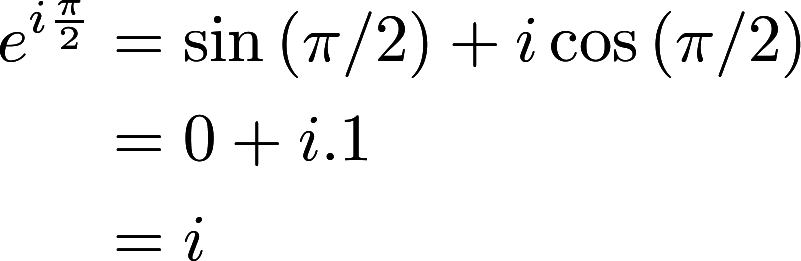
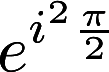
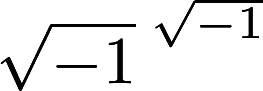
I'd never thought about it before until I saw the problem posed and then answered. Here is the problem: what is the value of ? Can it be evaluated? Is it a real number or a complex number? Well, it turns out that it's a real number and transcendental. One way of working out its value is to replace the  in the base with  because:


So we can replace  with  which becomes   which in turn becomes simply . This of course we can evaluate and it turns out to be approximately:

0.207879576350761908546955619834978770033877841631769608075...
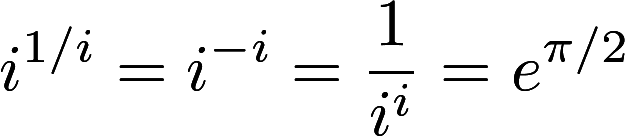
It looks even stranger if we pose the problem in the form . In whatever form it's posed however, the result is the same: a transcendental, real number with the value shown above. Of course, this leads one to pose other problems such as the value of   or . Having posed the problems, I guess I'll have to now investigate them.

  is easy because it can be written as:

 
WolframAlpha will give us an answer to   (  ) but it's not entirely clear why. I'll need to investigate further. Note that my previous post on Power Towers and Tetration is relevant to this problem.

Thursday, 30 June 2016

Gaussian Primes

Figure 1

Above is an excerpt from David Well's "Prime Numbers" of which I have an electronic copy as well as a physical copy (in Jakarta). It concerns, as can be seen, Gaussian primes; the pattern described above is shown below:

Figure 2
This pattern would emerge as the primes are plotted on the Argand diagram. The OEIS's associated with Gaussian primes are described below:

Figure 3
\(1949\), the year that I was born, is not a Gaussian prime since it is a \(4n+1\) prime and can be expressed as \(10^2+43^2 =(10+43i)(10-43i)\). The next prime \(1951\) is a \(4n+3\) and hence a Gaussian prime.