Showing posts with label symmetry. Show all posts

Wednesday, 16 October 2024

LEGO Mathematics

Figure 1 shows a 1 x 4 LEGO brick.

Figure 1

It turns out that if you have another three of these bricks and you stack them in every possible way on top of this base brick, then there are 27591 ways that you can do this. Today I'm 27591 days old and this number appeared in OEIS A123782:


A123782: number of ways to build a contiguous building with n LEGO blocks of size 1 x 4 on top of a fixed block of the same size. The base block is not counted among the \(n\) and must be the only block in the bottom layer of the building

The sequence begins 23, 679, 27591, 1227556, 59212274, 2990304700, 156407426393, ...

So there are 23 ways to stack a single 1 x 4 brick on top of another 1 x 4 brick. It took me a little sketching and visualisation but there are indeed 23 ways to do it. One way is to place the brick directly on top, then there are six more ways to do it with the long axes parallel and then sixteen ways to do with the long axes at right angles. Rotational symmetries are ignored here and only the strict physical orientation of the bricks are considered. Thus we have 1 + 6 + 16 = 23. So the famous number 23 pops up even in the context of LEGO.

There are other OEIS sequences relating to LEGO blocks and they are: 

  • A007575: number of stable towers of 2 X 2 LEGO blocks.

  • A007576: number of maximally stable towers of 2 X 2 LEGO blocks.

  • A112389: Number of ways, counted up to symmetry, to build a contiguous building with n LEGO blocks of size 2 X 4.

  • A112390: number of ways of building a building of height k using n 2 X 4 LEGO blocks, counted up to symmetry.

  • A123762: number of ways, counted up to symmetry, to build a contiguous building with n LEGO blocks of size 1 X 2

    ... right through to 

    A123827: number of ways to build a contiguous building with n LEGO blocks of size 2 X 3 on top of a fixed block of the same size so that the building is symmetric after a rotation by 180 degrees.

  • A123829: number of ways, counted up to symmetry, to build a contiguous building with n LEGO blocks of size 2x4 which is symmetric after a rotation by 180 degrees

    ... right through to

  • A123849: number of ways to build a contiguous building with n LEGO blocks of size 5 X 5 on top of a fixed block of the same size so that the building is symmetric after a rotation by 90 degrees.

  • A272690: number of buildings with n 2 X 4 LEGO bricks of maximal height.

Wednesday, 9 May 2018

Necklaces and Bracelets

At my recent diurnal age of 25136 (I'm 25138 days old as I write this), I noted that:
25236 is also a member of OEIS A141783: number of bracelets (turn over necklaces) with n beads: 1 blue, 12 green, and r = n-13 red (here n=20 and so r=7). This can be restated as "the number of bracelets with 1 blue, 12 green and 7 red beads is 25236". 
I had trouble understanding why the number of bracelets was 25236 and not 25194. According to my initial calculations, the number of necklaces (arrangements of beads that can't be lifted out of the plane and reversed) should be 19!/(12!*7!) = 50388. Here the numerator is 19! because 20!/20 adjusts for the rotational symmetry of the twenty beads and the denominator takes into account the fact that the beads in each of the groups, 12 green and 7 red, are indistinguishable from one another. Because bracelets can be lifted out of the plane and turned over, the number of bracelets should be 50338/2 = 25194.

As with most things, it's better to start at the beginning. The sequence runs: 1, 7, 49, 231, 924, 3108, 9324, 25236, ... and begins with n=13 at which point there is only one possible configuration as there are no red beads. When n=14, there is one red bead, one blue bead and twelve green beads. I would reckon the number of possible necklace configurations to be: 13!/12!=13 but in fact there is one more as can be seen in Diagram 1 and 2:

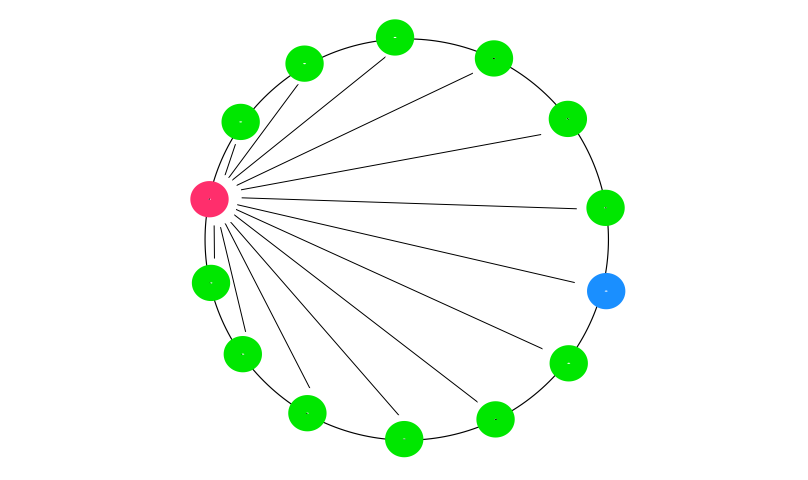
Diagram 1: blue bead on left, red bead on right

Diagram 2: red bead on left, blue bead on right.

As the two diagrams show, the first configuration with a blue bead on the left and a red bead on the right can be rotated to produce a new configuration where the red bead is on the left and the blue bed is on the right. This means that there are 13+1=14 possible necklaces and thus 14/2=7 possible bracelets.

When there are 20 beads, the situation is of course more complicated but the principle is the same. There will be the 50388 necklaces as calculated above but there are also the extra necklaces created by rotating the blue and red beads by 180° for the symmetric configurations like the one shown in Diagram 3. In every symmetric configuration, there will be nine beads (six green and three red) on either side of the red-blue bead axis. There are \( \binom{9}{3} = 84 \) ways this can be done and so the total number of necklaces is 50388+84=50472, corresponding to 50472/2=25236 bracelets.
Diagram 3: a symmetrical position with green and red
identically placed on either side of the red-blue axis


Monday, 13 February 2017

All Cubic Polynomials Are Point Symmetric

It was accident that I stumbled upon this PDF file discussing point symmetry in cubic polynomials. I had been looking for information about sketching cubic polynomials that could help a student I am currently tutoring in Mathematics. I've extracted the key observation in the screen shot below:


Here is an annotated graph that I produced in GeoGebra illustrating the point of symmetry for a specific cubic polynomial: \(\ f(x)=x^3-3x^2+2x-1\)


A translation of the graph (-1, 1) to (0, 0) makes the graph symmetry about the origin and an odd function. The new equation is calculated as follows: \(\ f(x)-1=(x+1)^3-3(x+1)^2+2(x+1)-1\) and \(\ f(x)=x(x+1)(x-1)\) or \(\ f(x)=x(x^2-1)\).