Showing posts with label quadrilateral. Show all posts

Tuesday, 12 September 2023

Cyclic Quadrilaterals

I was forced to think about cyclic quadrilaterals when looking for information about the number associated with my diurnal age today. 27190 is a member of OEIS A329950:


  A329950

Floor of area of quadrilateral with consecutive prime sides configured as a cyclic quadrilateral.


In the case of 27190, the consecutive prime sides are 157, 163, 167 and 173 and the area is given by Brahmagupta's formula: $$ \text{area }=\sqrt{(s-a) \times (s-b) \times (s-c) \times(s-d)}\\ \text{ where } s=\frac{a+b+c+d}{2} \text{ and }a,b,c \text{ and } d \text{ are the four sides}$$Here the area turns out to be 27190.9834504013 which is 27190 when truncated. The initial members of the sequence are (permalink):

13, 30, 70, 130, 214, 310, 461, 627, 874, 1167, 1423, 1750, 2094, 2512, 2995, 3574, 4137, 4603, 5237, 5829, 6526, 7522, 8507, 9478, 10390, 11014, 11650, 12932, 14314, 16053, 17799, 19278, 20698, 22159, 23994, 25403, 27190, 29033, 30595, 32718, 34558, 36255, 38014, 39954

The radius \(R\) of the circumcircle, referred to as the circumradius, is given by the formula:$$R=\frac{1}{4} \sqrt{\frac{(ab+cd)(ac+bd)(ad+bc)}{(s-a)(s-b)(s-c)(s-d)}}$$In the case of the cyclic quadrilateral with sides 157, 163, 167, 173 and truncated area of 27190, the truncated circumradius is 116 and the truncated area of the circumcircle is 42818 square units. 
These types of cyclic quadrilaterals are very close to being square in shape. For example, the quadrilateral with sides of 157, 163, 167 and 173 has an average side length of 165 and the area of a square with this side is 27225 square units and thus very close to 27190.

In the formula for the area given earlier, it can be noted that when \(d=0\), we get a triangle whose area is given by the familiar Heron's formula:$$ \text{area }=\sqrt{s \times (s-a) \times (s-b) \times (s-c) }\\ \text{ where } s=\frac{a+b+c}{2} \text{ and }\\a,b \text{ and } c \text{ are the three sides of the triangle}$$It should be noted that Brahmagupta's formula does not apply to quadrilaterals in general. It only applies to cyclic quadrilaterals. The more general formula is similar but more complex and I won't cover that here. For more information follow this link.

Thursday, 20 April 2017

The Euler Line

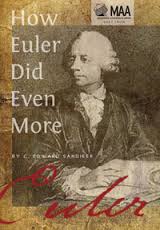
I started reading "How Euler Did Even More" by C. Edward Sandifer of the Western Connecticut State University, published and distributed by The Mathematical Association of America. This is a follow up on another book by Sandifer called "How Euler Did It". Ed apparently inspired The Euler Archive, a digital library dedicated to the work and life of Leonhard Euler. The individual chapters, which were posted month by month to the MAA Online and then collated into these two books, can be found in this archive (link). The actual chapter on the Euler line is located here.

The first chapter in the book is about the Euler line which is:
a line determined from any triangle that is not equilateral. It is a central line of the triangle, and it passes through several important points determined from the triangle, including the orthocenter, the circumcentre, the centroid, the Exeter point and the centre of the nine-point circle of the triangle. From Wikipedia.
Euler's line (red) is a straight line through the centroid (orange), orthocentre (blue), circumcentre (green) and centre of the nine-point circle (red).
Euler showed this in 1765, although he did not realise the importance of his discovery at the time. Here is an interesting excerpt from the Sandifer's chapter on the Euler line:
A hundred years ago, if you’d asked people why Leonhard Euler was famous, those who had an answer would very likely have mentioned his discovery of the Euler line, the remarkable property that the orthocenter, the centre of gravity and the circumcenter of a triangle are collinear. But times change, and so do fashions and the standards by which we interpret history. 
At the end of the 19th century, triangle geometry was regarded as one of the crowning achievements of mathematics, and the Euler line was one of its finest jewels. Mathematicians who neglected triangle geometry to study exotic new fields like logic, abstract algebra or topology were taking brave risks to their professional careers. Now it would be the aspiring triangle geometer taking the risks.
Euler seems to have been more interested in reconstructing the triangle from the various centres than in the fact that these centres were collinear. Sandifer compares Euler to Columbus in the conclusion to the chapter:
In some ways, Euler’s discovery of the Euler line is analogous to Columbus’s “discovery” of America. Both made their discoveries while looking for something else. Columbus was trying to find China. Euler was trying to find a way to reconstruct a triangle, given the locations of some of its various centres. Neither named his discovery. Columbus never called it “America” and Euler never called it “the Euler line.” 
Both misunderstood the importance of their discoveries. Columbus believed he had made a great and wonderful discovery, but he thought he’d discovered a better route from Europe to the Far East. Euler knew what he’d discovered, but didn’t realise how important it would turn out to be. 
Finally, Columbus made several more trips to the New World, but Euler, as with his polyhedral formula and the Königsberg bridge problem, made an important discovery but never went back to study it further.
The Wikipedia article makes the important point that the incentre does not normally lie on the Euler line, except in the case of an isosceles triangle. In the case of an equilateral triangle, there is no line because all the points are coincident. An interesting point is that there is an equivalent Euler line for the quadrilateral and tetrahedron. There are also other points that lie on the Euler line. These are:
A comprehensive biography of Euler can be found here on the MacTutor site where the biographies of many other mathematicians can be found. To quote from this site: Euler was the most prolific writer of mathematics of all time and we owe to Euler the notation $f(x)$ for a function (1734), $e$ for the base of natural logs (1727), $i$ for $\sqrt{-1}$ (1777), $\pi$ for pi, $\Sigma$ for summation (1755), the notation for finite differences $\Delta y$ and $\Delta^2 y$ and many others.