Showing posts with label centroid. Show all posts

Sunday, 7 November 2021

Trilinear Coordinates

I'm familiar with Cartesian coordinates and polar coordinates but only recently encountered trilinear coordinates in the context of triangles. See Figure 1.

Figure 1

In Figure 1, it can be seen that the point P is a perpendicular distance a', b' and c' from the sides a, b and c respectively. Working with Cartesian coordinates would require that the triangle be placed and oriented on the Cartesian plane. However, our interest is really on the distances a', b' and c' and even here it's not that actual distances but ratio of the distances. This is where trilinear coordinates come to our assistance.

The trilinear coordinates are written as ka' : kb' : kc' where k is any positive constant, chosen so that the ratio is in its simplest form. Point P in any triangle that is similar to that shown in Figure 1 can be associated with these trilinear coordinates. Figure 2 shows a different triangle in which the point P is external to the triangle.

Figure 2

Here the line AC or b lies between P and the vertex B. However, the lines AB or c and BC or a do not lie between the respective vertices C and A. In such a situation, kb' is given a negative sign whereas ka' and kc' are positive. Here are the trilinear coordinates for some common points:
  • A = 1 : 0 : 0

  • B = 0 : 1 : 1

  • C = 0 : 0 : 1

  • incentre = 1 : 1 : 1
    (the centre of the circle that has the triangle sides as tangents)

  • centroid = bc : ca : ab = 1/a : 1/b : 1/c = cosecA : cosecB : cosecC
    (the point where the medians meet)

  • circumcentre = cosA : cosB : cosC
    (the centre of the circle that passes through the three vertices)

  • orthocentre = secA : secB : secC
    (the point where the altitudes meet)
There are many more points associated with triangles but this is a start. Note how the trilinear coordinates or trilinears as they are sometimes called can be expressed in terms of the sides of the triangle or the angles opposite these sides. Figure 3 shows the situation for the centroid (marked G) where AX, BY and CZ are medians.

Figure 3

Remember that the medians of a triangle, divide it into six smaller triangles of equal area. Looking at Figure 3, it can be seen that:
  • Area of ∆AGC = Area of ∆AGB = Area of ∆BGC
  • 1/2 x b x b' = 1/2 x c x c' = 1/2 x a x a'
  • bb'=cc' and so b'/c'=c/b or b':c'=c:b or b':c'=ac:bc
  • cc'=aa' and so c'/a'=a/c or c':a'=a:c or c':a'=ab:bc
  • a':b':c'=bc:ac:ab=1/a:1/b:1/c
  • a/sinA=b/sinB=c/sinC and so a:sinA=b:sinB=c:sinC
  • a':b':c'=1/a:1/b:1/c=1/sinA:1/sinB:1/sinC=cosecA:cosecB:cosecC
Figure 4 shows a specific example of the trilinear coordinates for a right-angled triangle with angles of 30° and 60°.

Figure 4

References: 

Thursday, 20 April 2017

The Euler Line

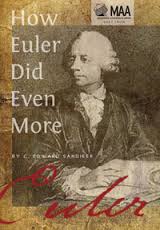
I started reading "How Euler Did Even More" by C. Edward Sandifer of the Western Connecticut State University, published and distributed by The Mathematical Association of America. This is a follow up on another book by Sandifer called "How Euler Did It". Ed apparently inspired The Euler Archive, a digital library dedicated to the work and life of Leonhard Euler. The individual chapters, which were posted month by month to the MAA Online and then collated into these two books, can be found in this archive (link). The actual chapter on the Euler line is located here.

The first chapter in the book is about the Euler line which is:
a line determined from any triangle that is not equilateral. It is a central line of the triangle, and it passes through several important points determined from the triangle, including the orthocenter, the circumcentre, the centroid, the Exeter point and the centre of the nine-point circle of the triangle. From Wikipedia.
Euler's line (red) is a straight line through the centroid (orange), orthocentre (blue), circumcentre (green) and centre of the nine-point circle (red).
Euler showed this in 1765, although he did not realise the importance of his discovery at the time. Here is an interesting excerpt from the Sandifer's chapter on the Euler line:
A hundred years ago, if you’d asked people why Leonhard Euler was famous, those who had an answer would very likely have mentioned his discovery of the Euler line, the remarkable property that the orthocenter, the centre of gravity and the circumcenter of a triangle are collinear. But times change, and so do fashions and the standards by which we interpret history. 
At the end of the 19th century, triangle geometry was regarded as one of the crowning achievements of mathematics, and the Euler line was one of its finest jewels. Mathematicians who neglected triangle geometry to study exotic new fields like logic, abstract algebra or topology were taking brave risks to their professional careers. Now it would be the aspiring triangle geometer taking the risks.
Euler seems to have been more interested in reconstructing the triangle from the various centres than in the fact that these centres were collinear. Sandifer compares Euler to Columbus in the conclusion to the chapter:
In some ways, Euler’s discovery of the Euler line is analogous to Columbus’s “discovery” of America. Both made their discoveries while looking for something else. Columbus was trying to find China. Euler was trying to find a way to reconstruct a triangle, given the locations of some of its various centres. Neither named his discovery. Columbus never called it “America” and Euler never called it “the Euler line.” 
Both misunderstood the importance of their discoveries. Columbus believed he had made a great and wonderful discovery, but he thought he’d discovered a better route from Europe to the Far East. Euler knew what he’d discovered, but didn’t realise how important it would turn out to be. 
Finally, Columbus made several more trips to the New World, but Euler, as with his polyhedral formula and the Königsberg bridge problem, made an important discovery but never went back to study it further.
The Wikipedia article makes the important point that the incentre does not normally lie on the Euler line, except in the case of an isosceles triangle. In the case of an equilateral triangle, there is no line because all the points are coincident. An interesting point is that there is an equivalent Euler line for the quadrilateral and tetrahedron. There are also other points that lie on the Euler line. These are:
A comprehensive biography of Euler can be found here on the MacTutor site where the biographies of many other mathematicians can be found. To quote from this site: Euler was the most prolific writer of mathematics of all time and we owe to Euler the notation $f(x)$ for a function (1734), $e$ for the base of natural logs (1727), $i$ for $\sqrt{-1}$ (1777), $\pi$ for pi, $\Sigma$ for summation (1755), the notation for finite differences $\Delta y$ and $\Delta^2 y$ and many others.