Showing posts with label number bases. Show all posts

Monday, 18 May 2026

Base 10 Primes in Higher Number Bases

The thought struck me as to what primes in base 10 remain prime when the digits stay the same but the number base increases to 11, 12, 13 etc. I got Gemini to investigate and it came up with useful summary and an impressive interactive tool for investigation:

To analyze this integer sequence mathematically, we can define the transformation as evaluating a polynomial.

Let a base-10 prime \( p \) have the decimal representation \( d_k d_{k-1} \dots d_1 d_0 \). The value of \( p \) is given by:

\[ p = \sum_{i=0}^{k} d_i 10^i \]

When we take these same digits and interpret them in a higher base \( b \) (where \( 11 \le b \le 36 \)), we are evaluating the new integer \( P_b \):

\[ P_b = \sum_{i=0}^{k} d_i b^i \]

The task is to find all instances where both \( p \) and \( P_b \) are prime. When we run this analysis across different bases, distinct number-theoretic patterns emerge, particularly regarding parity and divisibility.

The Parity Sieve for Odd Bases

The parity of the new number \( P_b \) depends entirely on whether the target base \( b \) is odd or even.

If the target base \( b \) is odd (e.g., base 11, 13, 15), then \( b \equiv 1 \pmod 2 \). Consequently, the modulo-2 value of the new number collapses to the sum of its digits:

\[ P_b \equiv \sum_{i=0}^{k} d_i \pmod 2 \]

This creates a massive sieve: if the sum of the digits of the original prime \( p \) is even, \( P_b \) will inevitably be even. Since \( P_b > 2 \) for all target primes in these higher bases, an even \( P_b \) is strictly composite. Therefore, odd bases yield a significantly sparser sequence of primes.

The Density in Even Bases

If the target base \( b \) is even (like the default \( b=16 \)), then \( b \equiv 0 \pmod 2 \). In this scenario, all terms multiplied by \( b \) are even, meaning the parity of \( P_b \) relies solely on the final digit \( d_0 \):

\[ P_b \equiv d_0 \pmod 2 \]

Because \( p \) is prime in base-10, its final digit \( d_0 \) must be odd (1, 3, 7, or 9) with the sole exception of \( p=2 \). Therefore, \( P_b \) will always be odd in an even base. Because they bypass the digit-sum parity trap, even bases like 16 retain a much higher density of prime numbers.

Small Examples in Base 16

For \( b=16 \), examining the first few base-10 primes reveals the retention rate:

  • 11: \( 1(16) + 1 = 17 \) (Prime)
  • 13: \( 1(16) + 3 = 19 \) (Prime)
  • 17: \( 1(16) + 7 = 23 \) (Prime)
  • 19: \( 1(16) + 9 = 25 \) (Composite, \( 5 \times 5 \))
  • 23: \( 2(16) + 3 = 35 \) (Composite, \( 5 \times 7 \))
  • 29: \( 2(16) + 9 = 41 \) (Prime)

To thoroughly investigate the sequence up to 40,000 across any base from 11 to 36 without relying on a static, truncated list, the interactive tool below is designed to compute the results dynamically. It handles the base conversions and primality testing locally within your browser.

Total Primes Found: 0
Index Base 10 Prime Value in Target Base

Tuesday, 18 October 2022

More About Munchausen Numbers

On September 22nd 2022, I made a post titled "What's Special About 3435?" in which it was revealed that 3435 was the only Munchausen number in base 10, apart from the trivial case of 1. It has the property that \(3^3+4^4+3^3+5^5=3435\). The convention \(0^0=1\) is being applied whenever a zero is encountered in a number. Using this convention, Figure1 shows the Munchausen numbers in bases from 2 to 10.

Source
Let's look at the Munchausen numbers for base 4:$$29_{10}=131_4=1^1+3^3+1^1\\55_{10}=313_4=3^3+1^1+3^3$$Getting back to Munchausen numbers in base 10, I got to thinking about numbers that differed by only 1 under the \( \text{digit}^{\text{digit}} \) sum. This yielded an interesting result in the range up to 100 million (permalink):

32 --> 31
3153 --> 3152
6255 --> 6254
870206 --> 870205
1647371 --> 1647370
1647372 --> 1647373

We can see that 1647371 gives a result that is one below the number while the next consecutive number 1647372 gives a result that is one above the number. The result is that the averages are the same:$$\frac{1647371+1647372}{2}=\frac{1647370+1647373}{2}=1647371.5$$I thought that was a pretty interesting result. 

Another variation is to consider squares and cubes of numbers and beyond. By this I mean what numbers have the property that:$$ \text{number}^n=\sum(\text{digit}^{\text{digit}})$$where \(n\) can equal 1, 2, 3 etc.

So far we've only considered the case of \(n=1\). What about if \(n=2\)? In the range up to ten million, we find only the numbers 1, 2 and 216 satisfying the condition (permalink):
$$ \begin{align}\textbf{1}^2&= 1^1 \\

\textbf{2}^2 &= 2^2 \\
\textbf{216}^2 &= 2^2+1^1+6^6 \end{align} $$What about cubes? Here we find, again in the range up to ten million, that only 1, 3, 36 and 729 qualify (permalink):$$ \begin{align} \textbf{1}^3&= 1^3\\ \textbf{3}^3&= 3^3 \\ \textbf{36}^3 &= 3^3+6^6\\ \textbf{729}^3 &= 7^7+2^2+9^9 \end{align}$$Perhaps we could term such numbers Munchausen numbers of the second order (for squares), Munchausen numbers of the third order (for cubes) and so on.  I thought this was an interesting variation on the original theme. Obviously one could go on and look at higher orders but I'll stop at 3.

Friday, 6 May 2022

Repdigits

On May 4th 2022, I turned 26694 days old and one of the properties of 26694 is that is a member of OEIS A167782: numbers that are repdigits with length > 2 in some base. Hmmm, but what base? Looking at the table from Numbers Aplenty, it can be seen that none of the bases from 2 to 16 satisfy (see Table 1).


Table 1

Testing out the bases from 17 to 36 (permalink), it can be seen that again there are no repdigits (see Table 2).


Table 2

The reason for stopping at base 36 is that we have run out of letters of the alphabet and need to resort to an alternative system for representing numbers in higher bases. Now I resorted to trial and error. Base 37 didn’t satisfy but base 38 did. I found that \( 18 \times 38^2+18 \times 38 + 18 = 26694 \) which we can write as \(18.18.18_{36} \). Of course, I got lucky. The number may have been a repunit in a much higher base. However, it’s easy to write a program to handle these higher bases and avoid wasting time on manual calculation (permalink). See Table 3.


Table 3

The table above shows representations for bases up to 60 and if nothing showed up in this range then calculations could be extended until the first number in the triplet reaches zero, in which case the length is equal to 2 and the number does not meet the criterion. For 26694, this occurs at base 164 where we find that \(0 \times 164^2+ 162 \times 164 + 126 = 26694\) which we can represent as \( 162.126_{164} \).

The initial members of OEIS A167782 are: 0, 7, 13, 15, 21, 26, 31, 40, 42, 43, 57, 62, 63, 73, 80, 85, 86, 91, 93, 111, 114, 121, 124, 127, 129, 133, 146, 156, 157, 170, 171, 172, 182, 183, 211, 215, 219, 222, 228, 241, 242, 255, 259, 266, 273, 285, 292, 307, 312, 314, 333, 341, 342, 343, 364, 365, 366. The accompanying comments can be found in the OEIS entry: definition requires “length > 2” because all numbers n > 2 are trivially represented as “11” in base n-1. 0 included at the suggestion of Franklin T. Adams-Watters (and others) as 0 = 000 in any base.

The 10,000th such number in the sequence is 583,744 which means that the percentage of such numbers up to that limit is about 1.713% or a little over 17 per thousand. Let’s not confuse repdigits with repunits:
In recreational mathematics, a repunit is a number like 11, 111, or 1111 that contains only the digit 1 — a more specific type of repdigit. The term stands for repeated unit and was coined in 1966 by Albert H. Beiler in his book Recreations in the Theory of Numbers. Wikipedia

All repdigits are multiples of repunits e.g. 666 is a multiple of the repunit 111. 

Thursday, 2 December 2021

AD and BC Numbers

In my quest to find interesting properties for the successive numbers that constitute my diurnal age, I usually make use of the OEIS and Numbers Aplenty. Occasionally these resources throw up little of interest and, after exhausting additional resources, I'm left to come up with some creative angle of my own.

Today's number, 26541, presented such a challenge and I'm proud to say I rose to the occasion. While professional mathematicians will sneer, recreational mathematical enthusiasts may appreciate my resourcefulness. Here is what I came up with. Decimal numbers when converted to hexadecimal can end in AD and the thought struck me that such numbers would form a sequence. I've entered this sequence into my own private database of sequences. Here it is:

S037: Anno Domini (AD) numbers: decimal numbers that when converted to hexadecimal contain at least three digits satisfying the following criteria: 

  • the second last digit is A
  • the last digit is D
  • all remaining digits are between 0 and 9

Up to 40000, the list of such numbers is as follows:

429, 685, 941, 1197, 1453, 1709, 1965, 2221, 2477, 4269, 4525, 4781, 5037, 5293, 5549, 5805, 6061, 6317, 6573, 8365, 8621, 8877, 9133, 9389, 9645, 9901, 10157, 10413, 10669, 12461, 12717, 12973, 13229, 13485, 13741, 13997, 14253, 14509, 14765, 16557, 16813, 17069, 17325, 17581, 17837, 18093, 18349, 18605, 18861, 20653, 20909, 21165, 21421, 21677, 21933, 22189, 22445, 22701, 22957, 24749, 25005, 25261, 25517, 25773, 26029, 26285, 26541, 26797, 27053, 28845, 29101, 29357, 29613, 29869, 30125, 30381, 30637, 30893, 31149, 32941, 33197, 33453, 33709, 33965, 34221, 34477, 34733, 34989, 35245, 37037, 37293, 37549, 37805, 38061, 38317, 38573, 38829, 39085, 39341

All the numbers differ by 256 except for a regular jump of 1792 or 7 x 256 after every 9th number. In fact, all the numbers equal 173 mod 256 and 173 is the decimal value of AD. The first number in the sequence, 429 = 256 + 173, converts to 1AD while the last number, 39341 = 9 x 4096 + 6 x 256 + 173, converts to 99AD. The number associated with my diurnal age, 26541, converts to 67AD. Here is a permalink to the code that I used in SageMathCell.

The logical extension of course is to identify BC numbers and that is what I've done in another private sequence:
S038: Before Christ (BC) numbers: decimal numbers that when converted to hexadecimal contain at least three digits satisfying the following criteria: 
  • the second last digit is B
  • the last digit is C
  • all remaining digits are between 0 and 9

Up to 40000, the members of this sequence are:

444, 700, 956, 1212, 1468, 1724, 1980, 2236, 2492, 4284, 4540, 4796, 5052, 5308, 5564, 5820, 6076, 6332, 6588, 8380, 8636, 8892, 9148, 9404, 9660, 9916, 10172, 10428, 10684, 12476, 12732, 12988, 13244, 13500, 13756, 14012, 14268, 14524, 14780, 16572, 16828, 17084, 17340, 17596, 17852, 18108, 18364, 18620, 18876, 20668, 20924, 21180, 21436, 21692, 21948, 22204, 22460, 22716, 22972, 24764, 25020, 25276, 25532, 25788, 26044, 26300, 26556, 26812, 27068, 28860, 29116, 29372, 29628, 29884, 30140, 30396, 30652, 30908, 31164, 32956, 33212, 33468, 33724, 33980, 34236, 34492, 34748, 35004, 35260, 37052, 37308, 37564, 37820, 38076, 38332, 38588, 38844, 39100, 39356

Again, all the numbers differ by 256 except for a regular jump of 1792 or 7 x 256 after every 9th number. Here, all the numbers equal 188 mod 256 and 188 is the decimal value of BC. The first number in the sequence, 444 = 256 + 188, converts to 1BC while the last number, 39356 = 9 x 4096 + 9 x 256 + 188, converts to 99BC. Here is a permalink to the code that I used in SageMathCell. 

I know that BCE and CE can be used instead of BC and AD but I refuse to use this system. Anyone so inclined however, could modify my existing algorithms or create algorithms of their own in order to generate hexadecimal numbers ending in BCE and CE.

The numbers don't have to be necessarily hexadecimal because the letters used in my system are A, B, C and D and thus will work for bases 14 and 15 and 17 up to 36. I just chose hexadecimal because of its widespread use in technology. 

It's interesting that 67 AD has associations with Christianity because this year marked the end of St. Paul's journeying around the Mediterranean. See Figure 1.


Figure 1: source

This post marks my 100th post for the year 2021, an annual record that I've never even approached before. Previously, my annual totals were:
  • 2020: 68 posts
  • 2019: 56 posts
  • 2018: 68 posts
  • 2017: 36 posts
  • 2016: 42 posts
  • 2015: 12 posts
I started this blog in September of 2015, shortly after my retirement from teaching.

Saturday, 11 September 2021

Displaying the SageMathCell Interface

Quite some time ago I tried embedding the SageMathCell interface in my blog posts but experienced some glitches that led me to turn to the use of permalinks as an alternative. The permalink is almost as good as having the interface embedded but it does require the user to click a hyperlink. There's something to be said for simple embedding as the user can execute the SageMath code right there on the page without following a hyperlink. In this post I just want to test this method out again, using a sequence from my previous post:


 A279093

Numbers that are nontrivially palindromic in three or more consecutive integer bases.

The initial members are:

178, 300, 373, 676, 1111, 1702, 2473, 3448, 4651, 6106, 7837, 9868, 12223, 14926, 18001, 21472, 25363, ...

Pressing evaluate in the embedded SageMathCell interface should produce "the initial members" as listed under the sequence. Now I'll take it a step further and display numbers along with their palindromic equivalents in the three consecutive number bases.


Tuesday, 6 October 2020

Honaker: Primes and Problem

Figure 1
G. L. Honaker Jr is a rather shadowy figure who, as we learn from his LinkedIn profile, is a Maths/Science graduate who has been teaching for 28 years. He lives in Bristol, Virginia, and must be around 50 years old. There's not much other biographical data about him, except that he is the co-author of a book that I'll talk about later.

The reason I mention him is that his name came up today as part of my diurnal age number investigation. Today I'm 26119 days old and this turns out to be a Honaker prime. It's pretty cool to have a type of prime number named after you. So what is a Honaker prime? It's defined as a prime \(p_n\) whose index \(n\) and \(p_n\) itself have the same sum of digits. For example, \(p_{32}=131\) is a Honaker prime because \(3+2=1+3+1\).

Unlike primeness, the property that defines a Honaker prime is base specific. For example in base 2, 32 becomes 100000 and 131 becomes 10000011, but the sums of their digits are different. The smallest prime which is Honaker in all the bases from 2 to 10 is  \(p_{277308991}= 5949670231\). I'm thankful to NumbersAplenty for this information.

Not only does Honaker have a type of prime named after him, he also has an eponymous problem. Wolfram MathWorld explains that Honaker's problem asks for all consecutive prime number triples \((p,q,r)\) with \(p<q<r\) such that \(p|(qr+1)\). Caldwell and Cheng (2005) showed that the only Honaker triplets for \(p<=2×10^{17} \text{ are }(2, 3, 5), (3, 5, 7) \text{ and } (61, 67, 71)\). It is conjectured that these three triplets may be the only such triplets with this property.

Interestingly, I'm currently 71 years old and 71 forms part of a Honaker triplet in addition to the fact that my diurnal age (26119) is a Honaker prime. Now getting back to Honaker's book that is available on Amazon. There is an accompanying website that boasts that "there are currently 25464 curios corresponding to 18548 different numbers in our database, that leaves an infinite number for you to discover!"

Naturally I typed in 26119 and discovered that "The number of Honaker primes less than or equal to 26119 is the smallest Honaker prime." This indeed true as the smallest Honaker prime is 131 and there are exactly 131 Honaker primes less than or equal to 26119. I was impressed. Clearly, this is a book to buy and a website to visit for anyone seriously interested in prime numbers.

Sunday, 29 March 2020

Sum Product Numbers and Near Misses

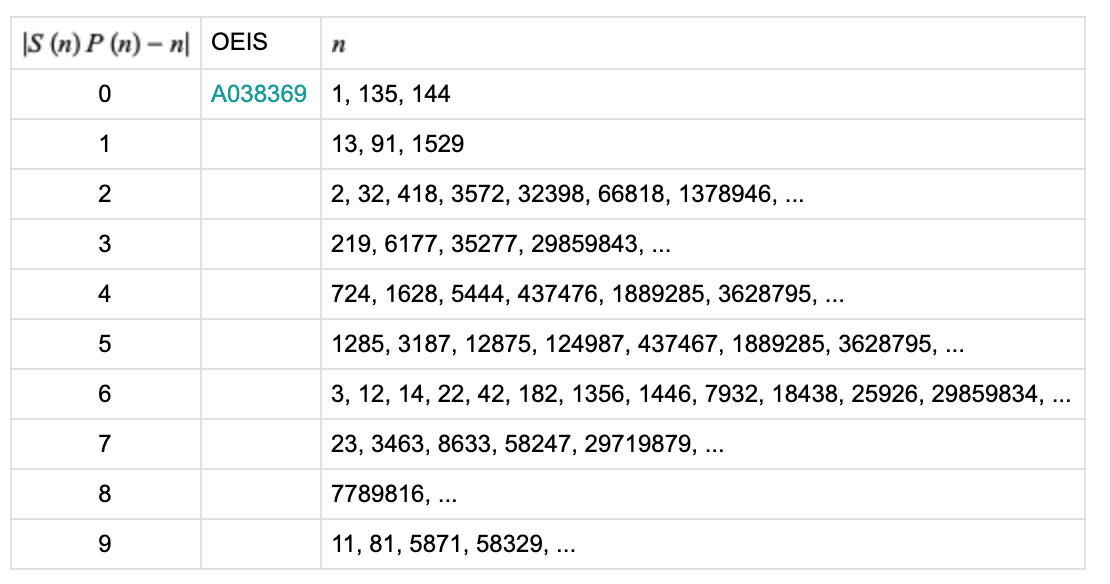
A sum-product number is a number \(n\) such that the sum of its digits times the product of its digit is \(n\) itself. For example:$$135=(1+3+5)\times (1 \times 3 \times 5)$$There are only three sum-product numbers: 1, 135, and 144 (OEIS A038369), although 0 of course could be included if desired.


  A038369

Numbers n such that n = (product of digits of n) * (sum of digits of n).   


Of interest also are numbers such that the sum of their digits times the product of their digit differ from by 1, 2, 3, … The table in Figure 1 shows these initial numbers (source):

Figure 1

The code to determine these initial numbers is shown in Figure 2 with a difference of 6 being used as the example:

Figure 2: permalink

Of course, if the number base is changed (say to 16), an entirely different set of numbers is obtained. In base 16 and with a number difference of 6, the set consists of 3, 482, 554, 582, 7494, 12954. In the case of 12954, it becomes 329A and so the sum of its digits is 3 + 2 + 9 + 10 = 24 and the product of its digits is 3 x 2 x 9 x 10 = 540. The product of 24 and 540 is 12960 which does indeed differ from 12954 by 6. See Figure 3.

Figure 3: permalink

These numbers, in base 10 or any other base, are curiosities and probably, like selfie numbers, not of any deep mathematical significance. However, I did turn 25926 days old recently (March 27th 2020) and that's when I stumbled upon the number thanks to a Wolfram MathWorld link. It features in the set of numbers shown in Figure 2 and it also appears in the table in Figure 1.

Tuesday, 30 July 2019

The Fibonacci Number Base


In a blog post of Sunday, 15th November 2015, titled Goldbach's Conjecture and Zeckendorf's Theorem, I wrote the following:
I came across Zeckendorf's Theorem when examining the number 24331. It's similar to Goldbach's Conjecture in that it deals with the decomposition of numbers but into Fibonacci numbers, not primes. It states, to quote from Wikipedia again, that: 
Every positive integer can be represented uniquely as the sum of one or more distinct Fibonacci numbers in such a way that the sum does not include any two consecutive Fibonacci numbers. 
Now the first few Fibonacci numbers are: 
1, 2, 3, 5, 8, 13, 21, 34, 55, 89, 144, 233, 377, 610, 987, 1597, 2584, 4181, 6765, 10946, 17711, 28657, 46368 
The Wikipedia article goes on to state that the theorem has two parts: 
Existence: every positive integer n has a Zeckendorf representation.Uniqueness: no positive integer n has two different Zeckendorf representations. 
The example is given of the number 100 = 89 + 8 + 3. There are other ways of representing 100 as the sum of Fibonacci numbers: 100 = 89 + 8 + 2 + 1 and 100 = 55 + 34 + 8 + 3 but these are not Zeckendorf representations because 1 and 2 are consecutive Fibonacci numbers, as are 34 and 55.
This is the first time I've revisited the topic. I found a site that will calculate the relevant Fibonacci numbers that add to a given number. Figure 1 shows the calculation for today's number of 25684:

Figure 1: source

The result as can be seen is {1,21,55,144,987,6765,17711}. I've also developed an algorithm in SageMath that does this also but I'm still refining it. The Zeckendorf system uses the set with the fewest Fibonacci numbers in it. The same site has a calculator that will express a given number in terms of a Fibonnaci number base using the digits 0 and 1. The idea is that a number like 25684 would be represented as 101000100010101000001 where the rightmost 1 stands for the largest Fibonacci number and the leftmost 1 or 0 stands for the smallest Fibonacci number (which is 1 in this system). If a particular number does not form part of the same then its position is occupied by a 0. The calculator is shown in Figure 2:

Figure 2: source

My SageMath algorithm clumps all the 0's and 1's together and I'm still trying to work out what the problem is. For numbers in the vicinity of my current age (in days), seven or eight numbers seem to be generally required:
  • \(25684 = 101000100010101000001_{Zeck}\) with 7 ones 
  • \(25685 = 101000100010101000010_{Zeck}\) with 7 ones
  • \(25686 = 101000100010101000100_{Zeck}\) with 7 ones
  • \(25687 = 101000100010101000101_{Zeck}\) with 8 ones
  • \(25688 = 101000100010101001000_{Zeck}\) with 7 ones
  • \(25689 = 101000100010101001001_{Zeck}\) with 8 ones
As a number base, it's hardly compact but a simple way to compress it would be to use the same system that it used in data compression: representing consecutive runs of 0's by the binary digit and an associated superscript that expresses the length of the run. There can't be runs of 1's in this representation. In this way, the numbers above become:
  • \(25684 = 1010^310^3101010^51_{Zeck}\) 
  • \(25685 =1010^310^3101010^410_{Zeck}\)
  • \(25686 =1010^310^3101010^310^2_{Zeck}\)
  • \(25687 = 1010^310^3101010^3101_{Zeck}\)
  • \(25688 = 1010^310^3101010^210^3_{Zeck}\)
  • \(25689 = 1010^310^3101010^210^21_{Zeck}\)
It's interesting to note, using the calculator in Figure 1, how many possible sets of Fibonacci numbers there are that add to a given number. Here are the results for the previous numbers:
  • 66 sets with a sum of 25684
  • 66 sets with a sum of 25685
  • 103 sets with a sum of 25686
  • 37 sets with a sum of 25687
  • 74 sets with a sum of 25688
  • 74 sets with a sum of 25689
The minimal set of numbers is being used to determine the Zeckendorf representation but others configurations are possible. As the site says:
The Zeckendorf system uses the set with the fewest Fibonacci numbers in it. What about choosing that set with the most Fibonacci numbers with a sum of n, each Fibonacci number being used at most once? This is called the maximal Fibonacci bit representation. "Bit" means that the only digits in the representations are 0 and 1. Zeckendorf's is therefore the minimal Fibonacci bit representation.
For 25684, the maximal set is 

{1, 3, 5, 13, 21, 34, 55, 89, 144, 233, 610, 987, 1597, 4181, 6765, 10946}

This consists of 16 numbers and can be found using the calculator in Figure 1. Compare this with the full set of Fibonacci numbers:

{1, 2, 3, 5, 8, 13, 21, 34, 55, 89, 144, 233, 377, 610, 987, 1597, 2584, 4181, 6765, 10946}

This number would thus become \(11101110111111111101\) or \(1^301^301^{10}01\) used my superscript system described earlier. As can be seen, only three numbers are missing and thus there are only three 0's. In order to avoid confusion, the subscript MaxFib or the like should be e.g. \(25684 = 11101110111111111101_{MaxFib}\) or \(1^301^301^{10}01_{MaxFib}\). Here's some historical background:
This system is also called the Zeckendorf representation of a number after Edouard Zeckendorf who wrote about it (in French) in 1972. He proved that each representation of a number n as a sum of distinct Fibonacci numbers, but where no two consecutive Fibonacci numbers are used (and there is only one column headed "1"), is unique. However, earlier, Lekkerkerker had written about this representation in 1952 in Dutch showing that there is only one way to write a number in this system but, unfortunately for him, the system is now generally called Zeckendorf's.
In formal mathematical terms, the Zeckendorf representation can be defined as follows:

A number written as a sum of nonconsecutive Fibonacci numbers, such that$$n=\sum_{k=0}^L \epsilon_k \,F_k$$where \(\epsilon_k\) are 0 or 1 and \( \epsilon_k \times \epsilon_{k+1}=0\). Every positive integer can be written uniquely in such a form (which is in itself a particular example of a Ostrowski numeration).

Here is a link to a PDF file of an academic paper with the following abstract:
Three contrasting polyphonic musical compositions based on Zeckendorf representations in the style of music characterised by Fibonacci numbers and the golden ratio are presented and analysed.

Wednesday, 28 November 2018

Hogben Numbers

Today I turned 25441 days and one of the properties of this number is that it's a Hogben number, the 160th such number in fact. I discovered this fact thanks to Numbers Aplenty in that site's description of the properties of this number. A link provided there contains the following information about these sorts of numbers:

The \(n\)-th Hogben number \(H_n\) is equal to \(n^2-n+1\).

Figure 1: SPIRAL ARRANGEMENT OF INTEGERS

In a spiral arrangement of the integers, Hogben numbers appear on the main diagonal (see Figure 1). Hogben numbers are often called central polygonal numbers. \(H_n\) is also the maximal number of ones that a \(n \times n\) {0,1} matrix can contain and still be invertible (that is an inverse matrix exists). The first Hogben numbers are 1, 3, 7, 13, 21, 31, 43, 57, 73, 91, 111, 133, 157, 183, 211, 241, 273, 307, 343, 381, ...

The Hogben numbers are listed in OEIS A002061 as the central polygonal numbers: \(a(n) = n^2 - n + 1\) with some interesting comments about where these Hogben numbers crop up. Let's consider some examples:

EXAMPLE 1
For n>1: a(n) is the maximum total number of queens that can coexist without attacking each other on an [n+1] x [n+1] chessboard. Specifically, this will be a lone queen of one colour placed in any position on the perimeter of the board, facing an opponent's "army" of size a(n)-1. 
The normal chess board consists of 8 x 8 = 64 squares, so the value of \(n^2-n+1\) when \(n=7\), namely 43, will give the maximum possible number of such queens. Figure 2 confirms this to be the case:

Figure 2: one against 42

EXAMPLE 2
Since \( (n+1)^2 - (n+1) + 1 = n^2 + n + 1 \) then from 7 onwards these are also exactly the numbers that are represented as 111 in all number bases: \(111_2=7 \), \(111_3=13 \), ... 
This is quite an interesting property and so we have the result that:

111 in base 2 is 7
111 in base 3 is 13
111 in base 4 is 21
111 in base 5 is 31
111 in base 6 is 43
111 in base 7 is 57
111 in base 8 is 73
111 in base 9 is 91
111 in base 10 is 111
111 in base 11 is 133
111 in base 12 is 157
111 in base 13 is 183
111 in base 14 is 211
111 in base 15 is 241
111 in base 16 is 273

The next example is taken from this source:

EXAMPLE 3

Figure 3: Hogben numbers within an isosceles triangle of numbers

This is a nice visual result and reveals an easy way to generate these numbers in a manner similar to Pascal's triangle.

So what about Lancelot Thomas Hogben after whom these numbers were named. He turns out to have been quite an interesting character. To quote from his Wikipedia entry:
Lancelot Thomas Hogben (9 December 1895 – 22 August 1975) was a British experimental zoologist and medical statistician. He developed the African clawed frog (Xenopus laevis) as a model organism for biological research in his early career, attacked the eugenics movement in the middle of his career, and popularised books on science, mathematics and language in his later career.
It is in his very popular 1936 book about Mathematics titled "Mathematics for the Million" that he presumably deals with numbers of the form \(n^2-n+1\). I have a copy of this book in electronic format in my library of ebooks but I couldn't find anything that sheds further light on these particular numbers. Here is a quote from the introduction to his book:


Figure 4: Lancelot Thomas Hogben 
Hogben was a conscientious objector in World War 1 and was imprisoned for a time. He was fiercely opposed to the Eugenics movement that was very active in the 1920s and 1930s. In World War 2, he was responsible for the British Army's medical statistics. He is quoted as saying:
"I like Scandinavians, skiing, swimming and socialists who realise it is our business to promote social progress by peaceful methods. I dislike football, economists, eugenicists, Fascists, Stalinists, and Scottish conservatives. I think that sex is necessary and bankers are not".
In addition to his extensive writing, he edited The "Loom of Language" by his friend Frederick Bodmer. This was a book that I borrowed from the library in Pontefract, Yorkshire, when I lived there in 1983-4, and which I read and very much enjoyed.